Governance infrastructure is becoming a board issue because the old operating model is reaching its limit
The Company Secretary function is changing faster than the infrastructure beneath it.
Governance teams are being asked to support more entities, more regulation, more board decisions, more technology and greater scrutiny, often without a corresponding increase in people or resources. The result is a growing gap between what organisations expect from governance professionals and the systems available to help them deliver it.
The Chartered Governance Institute UK & Ireland Governance Market Survey 2026, based on 971 governance professionals, found that 65% believe the influence of the governance function is increasing, while 66% said supporting board information quality and decision making is becoming more important. At the same time, 74% reported higher workloads and 42% said their governance functions were not adequately resourced.
A separate Diligent 2026 global entity compliance benchmark found that 74% of governance professionals said their remit had expanded during the previous two years, while 63% reported that workload had outpaced team growth or their teams had become smaller. More than half still relied on spreadsheets, Word documents and SharePoint for entity information, while 51% had experienced a near-miss compliance event.
These are not simply workload statistics. They describe a governance operating model under pressure.
The next phase of the Company Secretary profession will therefore be shaped by a fundamental shift: organisations are moving from disconnected governance administration towards governance infrastructure, where entity data, compliance, board activity, controls, decisions, actions and professional judgement become part of one connected environment.
For Company Secretaries, understanding that transition is becoming essential.
Read More: Corporate Governance Support
Executive Takeaway
The most important governance infrastructure trends are not about adding more software. They are about changing how governance operates.
The key trends Company Secretaries should be watching include:
- Governance moving from administration towards infrastructure
- Real-time entity and compliance visibility
- Greater board responsibility for material controls
- AI governance becoming part of the Company Secretary remit
- Digital corporate filing becoming the default
- Governance data becoming an enterprise asset
- Board information becoming more decision focused
- Action tracking becoming a recognised governance control
- Subsidiary governance becoming more connected
- Cyber and information governance moving closer to the board
- Greater demand for audit-ready governance evidence
- Hybrid models combining technology with professional Company Secretary expertise
- More emphasis on exception management rather than manual monitoring
Together, these trends point towards a different future for the profession.
The strongest Company Secretary functions will not simply process governance more efficiently. They will create the infrastructure that allows boards to see governance risk earlier, make better decisions and demonstrate that accountability is working.
1. Governance is moving from a collection of tasks to an operating system
For years, governance technology was often purchased one problem at a time.
An organisation bought a board portal for meetings, maintained a spreadsheet for entities, used calendars for compliance deadlines, stored registers in shared folders and tracked board actions through email.
Each tool performed a useful function. The problem is that the organisation still needed somebody to connect everything.
That person was frequently the Company Secretary.
This fragmented model is increasingly difficult to sustain because the governance chain is more interconnected than it appears. A director appointment affects the board, statutory records, regulatory filings, powers of authority, entity information and sometimes beneficial ownership. Similarly, a corporate restructuring can create obligations across several entities and jurisdictions.
Modern governance infrastructure therefore needs to connect:
- Entities
- Directors
- Shareholders
- Beneficial ownership
- Board meetings
- Decisions
- Actions
- Compliance deadlines
- Statutory registers
- Governance documents
- Reporting
The shift is from storing governance information to operating governance through connected information.
That distinction will define much of the next generation of Company Secretary technology.
Explore: CoSec Hub
2. Real-time entity visibility is replacing periodic reconciliation
One of the clearest trends in governance infrastructure is the move towards continuous entity visibility.
Traditional entity management often relies on periodic reconciliation. Local advisers update their records, headquarters updates another spreadsheet, finance holds a group structure chart and the governance team attempts to bring the information together when it is needed.
That model is becoming harder to defend.
The Diligent 2026 benchmark found that 55% of governance teams still manage entity information through spreadsheets, Word documents and SharePoint, while only 33% use a dedicated entity-management platform. More than half of respondents also spend six or more hours each week tracking filings, deadlines and record updates.
The emerging model is different.
Company Secretaries increasingly need one controlled view of:
- Active legal entities
- Directors and officers
- Shareholders
- Beneficial owners
- Regulatory status
- Upcoming filings
- Corporate actions
- Local advisers
- Governance exceptions
This changes how the function works. Instead of spending time asking whether information is current, Company Secretaries can focus on what the information means.
That is a better use of professional capability.
3. Provision 29 is pushing governance towards stronger evidence and controls
One of the most significant governance infrastructure developments in the UK is the implementation of Provision 29 of the UK Corporate Governance Code 2024.
Provision 29 applies to financial years beginning on or after 1 January 2026. It requires boards within scope to monitor the risk management and internal control framework, carry out an annual effectiveness review and provide a declaration regarding material controls.
Crucially, those controls are not confined to financial reporting. They can include operational, reporting and compliance controls.
The FRC’s Provision 29 guidance makes clear that boards need evidence when assessing whether material controls are effective.
This matters to Company Secretaries because governance processes themselves can form part of the wider control environment.
Boards may increasingly ask:
- How do we know actions were completed?
- How do we know significant decisions followed delegated authority?
- How do we know governance information is accurate?
- What evidence supports our annual statements?
- Where are the near misses and control weaknesses?
Governance infrastructure therefore needs to produce evidence naturally.
The future is not simply digital governance. It is evidenced governance.
4. The board’s control declaration cannot simply be delegated to the auditor
Another important development is the distinction between board responsibility and external audit.
The Financial Reporting Council’s guidance on auditor responsibilities and Provision 29 makes an important distinction: the external auditor’s opinion on the financial statements does not itself provide the board’s Provision 29 conclusion.
That creates a critical governance implication.
The board must reach its own judgement. Therefore, organisations need internal governance infrastructure capable of supporting that conclusion.
Company Secretaries may become increasingly involved in coordinating:
- Board oversight
- Control reporting
- Committee responsibilities
- Governance evidence
- Annual reporting
- Remediation tracking
This does not turn the Company Secretary into an internal auditor. Rather, it reinforces the function’s role in ensuring that board governance is sufficiently organised for directors to discharge their responsibilities.
Read More: Annual Report Services
5. AI governance is becoming part of mainstream board governance
Artificial intelligence is no longer simply an IT topic. It is becoming a board-governance issue.
The CGI Governance Market Survey 2026 found that half of respondents believe AI literacy for boards is becoming more important.
Company Secretaries are therefore likely to face new questions around:
- Board AI literacy
- AI policies
- Committee responsibility
- Data governance
- Human oversight
- Decision accountability
- Confidential board information
- AI-generated board material
- Regulatory developments
- AI risk reporting
The infrastructure challenge is particularly important.
AI cannot be governed through policy alone. Organisations need to know which tools are being used, what information enters them, who approves high-risk applications and how human oversight operates.
For Company Secretaries, AI governance may become one of the biggest additions to the board agenda this decade.
6. AI will also change how Company Secretaries work
The governance profession will not only oversee AI. It will increasingly use it.
AI has obvious potential to support:
- Regulatory monitoring
- Document review
- Drafting
- Meeting preparation
- Information retrieval
- Entity-data analysis
- Workflow automation
- Governance reporting
However, automation creates a new control question.
Which activities can safely be automated, and which still require professional judgement?
This distinction matters because governance work contains both.
A system may be able to identify that a deadline is approaching, but it should not independently decide that a legal obligation is immaterial. AI may help summarise a board paper, yet it should not become the final authority on whether the summary fairly represents the issue directors need to consider.
Similarly, AI can identify patterns across governance data, but material governance conclusions still require human accountability.
The future Company Secretary function will therefore need a clear division between automation and judgement.
7. Cybersecurity is becoming part of governance infrastructure
Cybersecurity has moved firmly into the boardroom.
The Institute of Internal Auditors’ Global Risk in Focus research continues to identify cybersecurity and digital disruption among major organisational risks.
This has direct implications for Company Secretaries.
Governance teams handle some of the organisation’s most sensitive information:
- Board papers
- M&A discussions
- Director information
- Strategy
- Remuneration
- Investigations
- Regulatory matters
- Legal advice
Consequently, governance infrastructure needs to address:
- Access permissions
- Data retention
- Director offboarding
- Secure board communications
- Third-party access
- Data backups
- Cyber incident escalation
- Confidentiality around AI tools
A board portal may improve security compared with email. However, the broader question is whether sensitive governance information is controlled throughout its entire lifecycle.
Cybersecurity is therefore no longer separate from governance administration.
It is part of governance design.
8. Companies House reform is accelerating the digitisation of corporate compliance
The UK corporate filing environment is becoming more digital and more data driven.
Mandatory identity verification for directors and people with significant control came into effect on 18 November 2025. The transformation will continue as further elements of the Economic Crime and Corporate Transparency Act are implemented.
Under the latest Companies House transition plan, further changes are being introduced progressively.
In addition, Companies House has announced changes to accounts filing from April 2028, including the move towards software-based filing.
For Company Secretaries, the direction is unmistakable.
Corporate compliance is moving away from documents and towards structured data.
Governance teams should therefore prepare for:
- More digital identity controls
- More software-based filing
- Greater data validation
- More structured corporate information
- Increased regulatory ability to query information
This raises the value of clean governance data considerably.
Read More: Statutory & Regulatory Compliance
9. Governance data is becoming an enterprise asset
Historically, entity data could be treated as administrative information.
That view is changing.
Accurate governance data now supports:
- Corporate transactions
- Regulatory filings
- Tax
- Finance
- Due diligence
- Board reporting
- Beneficial ownership
- Risk management
- AI systems
- Investor enquiries
Companies House guidance on software filing also illustrates the broader shift towards structured corporate information.
Company Secretaries increasingly need to think like custodians of enterprise governance data.
Key questions include:
- Which system is authoritative?
- Who can change information?
- What evidence supports the change?
- Which departments use the data?
- How is information reconciled?
- How are errors corrected?
An entity database is therefore no longer just a record store.
It can become a critical part of the organisation’s information architecture.
10. Board information is moving from volume towards decision quality
The board pack has traditionally been one of the central outputs of the Company Secretary function.
However, more information does not necessarily create better governance.
The FRC Corporate Governance Code Guidance places significant emphasis on information flow and board decision making, while the CGI’s 2026 research shows that governance professionals increasingly see information quality as part of their strategic contribution.
The trend is therefore moving towards decision-ready information.
Boards increasingly need papers that make clear:
- What decision is required
- Why it matters
- Which alternatives exist
- What management recommends
- Which risks are material
- What assumptions underpin the recommendation
- What happens if the board says no
The Company Secretary is well placed to challenge whether a paper is ready for the board.
This does not mean rewriting management’s work. It means strengthening the governance process through which decisions are made.
Explore More: Board & Shareholder Meetings
11. Board action tracking is becoming governance infrastructure, not meeting administration
Another important trend is the growing recognition that governance continues after the meeting.
A board decision creates accountability.
Therefore, a mature governance system should connect the resolution with:
- The responsible owner
- The deadline
- Progress
- Evidence
- Escalation
- Closure
This matters particularly where actions relate to regulatory remediation, internal controls, cybersecurity, risk, audit findings, corporate transactions or ESG commitments.
A decision that is properly minuted but never implemented is not good governance.
The infrastructure should make that visible.
Company Secretaries should therefore expect action tracking to become more sophisticated, with greater emphasis on exception reporting rather than simply maintaining a long list of open tasks.
Read More: Minute Taking Solutions
12. Subsidiary governance is becoming more connected
Multinational organisations increasingly recognise that legal-entity management and subsidiary governance are not the same thing.
A subsidiary can be legally compliant while remaining poorly integrated into the wider governance system.
The group board may not know:
- Which significant decisions were made locally
- Whether local actions remain outstanding
- Whether director records are current
- Which risks require escalation
- Whether local governance practices meet group expectations
The UK Corporate Governance Code 2024 reinforces the importance of effective governance across the wider group.
For Company Secretaries, this means subsidiary governance infrastructure will increasingly need to connect local compliance, group standards, entity information, board decisions, escalation and risk reporting.
The future is not centralisation for its own sake.
It is group visibility without destroying legitimate local governance.
13. Multi-jurisdiction governance is shifting towards central visibility with local expertise
This trend becomes especially important for international groups.
Local law still requires local knowledge. Yet the organisation cannot afford to operate through dozens of disconnected governance systems.
The emerging model combines:
Local expertise
Jurisdiction-specific legal and regulatory knowledge.
Central information
One reliable view of entities, directors, ownership and obligations.
Consistent governance standards
Common expectations for board support, evidence, escalation and accountability.
Professional judgement
Experienced Company Secretaries who can determine when a local matter becomes a group governance issue.
This hybrid model allows organisations to preserve local legal accuracy while avoiding fragmented group oversight.
Explore More: Company Secretary Outsourcing
14. Exception management is replacing manual monitoring
One of the most important trends in governance infrastructure is also one of the simplest.
Company Secretaries should spend less time checking whether everything happened.
The system should identify what did not happen.
Technology increasingly needs to surface exceptions such as:
- Overdue filings
- Missing approvals
- Unverified directors
- Late board actions
- Expiring authorities
- Inconsistent ownership records
- Governance data conflicts
- Unresolved compliance issues
This changes the operating model significantly.
Routine activity becomes automated or systematised, while professional attention moves towards unusual, material or high-risk issues.
The Company Secretary becomes less of a human reminder system and more of an exception manager and governance adviser.
That is a much stronger use of professional expertise.
15. Audit-ready governance is becoming the normal expectation
Another major trend is the move from periodic evidence gathering towards continuous audit readiness.
Historically, governance evidence was often assembled when an audit, due diligence exercise or annual-report process began.
That approach creates unnecessary risk.
Under a stronger model, evidence is created as governance occurs.
For example:
- Board decisions retain their supporting papers
- Actions maintain completion evidence
- Entity changes retain approvals
- Filings link to supporting documents
- Conflict decisions remain traceable
- Regulatory obligations show completion status
Provision 29 reinforces this direction by placing greater emphasis on evidence behind board assessments of material controls.
However, audit-ready governance is relevant well beyond listed companies.
Private equity investors, lenders, regulators, buyers and transaction advisers increasingly expect organisations to produce reliable governance information quickly.
The question is no longer whether the organisation can prepare for scrutiny.
It is whether it could withstand scrutiny tomorrow.
16. Governance technology will increasingly need to prove value, not simply digitisation
The governance-technology market is maturing.
A board portal, entity database or compliance tool may improve individual processes, but organisations are increasingly asking a harder question:
What governance outcome did the technology improve?
Useful governance technology should reduce:
- Manual reconciliation
- Duplicate data
- Deadline risk
- Search time
- Key-person dependency
- Information fragmentation
At the same time, it should increase:
- Board visibility
- Accountability
- Data quality
- Evidence
- Risk awareness
- Governance capacity
The next generation of governance technology will therefore be judged less by the number of features it contains and more by whether it genuinely reduces governance friction.
17. Software-only governance models will face increasing limitations
Technology is indispensable, but governance cannot be reduced to workflow automation.
A system can remind a Company Secretary about a filing, but it cannot determine whether a complex regulatory interpretation requires board escalation.
Software can track a board action, yet it cannot decide whether the proposed evidence is sufficient to close a serious remediation item.
AI may help review a board paper. It cannot take responsibility for advising the Chair that directors are not receiving adequate information.
This is why hybrid governance models are becoming increasingly important.
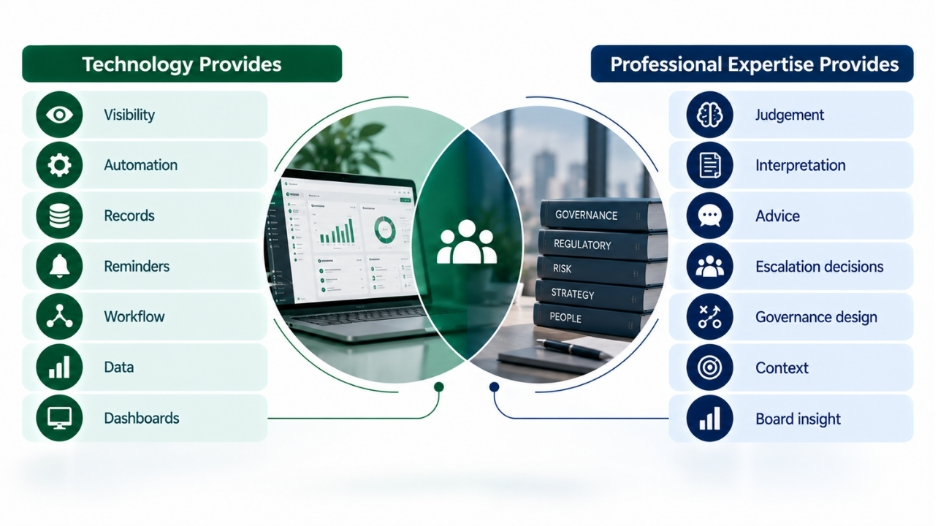
The strongest operating model combines both.
That combination is particularly valuable for organisations that need more governance capability without building large internal Company Secretary teams.
18. Outsourcing is moving from capacity support towards governance infrastructure
Traditional outsourcing often focused on reducing administration.
That proposition is changing.
Organisations increasingly need external providers that can combine:
- Company Secretary expertise
- Entity governance
- Compliance oversight
- Board administration
- Governance technology
- Multi-jurisdiction support
- Regulatory intelligence
- Advisory capability
The value lies less in transferring tasks and more in strengthening the operating model.
A provider should therefore help the organisation become more visible, resilient, consistent, scalable and audit ready.
This changes the outsourcing question.
Instead of asking which tasks can we give away?, boards should ask:
Which governance capabilities do we need to strengthen?
Read More: Company Secretary Outsourcing
19. The Company Secretary is becoming the governance integrator
Perhaps the most important trend is professional rather than technological.
The Company Secretary is increasingly becoming the person who connects the organisation’s governance architecture.
The CGI Governance Market Survey 2026 demonstrates this shift. Governance professionals are becoming more influential in board decision making, succession, organisational change and AI literacy while traditional responsibilities remain.
That makes the role less administrative and more integrative.
The Company Secretary increasingly connects:
- Board and management
- Compliance and strategy
- Local and group governance
- Information and decisions
- Technology and accountability
- Regulation and implementation
This does not mean the function should own every governance risk. Management must remain responsible for delivery, while boards retain oversight.
However, the Company Secretary increasingly helps ensure that the architecture connecting those responsibilities works.
That is a strategically important role.
What the governance infrastructure of 2030 is likely to look like
The direction of travel is already visible.
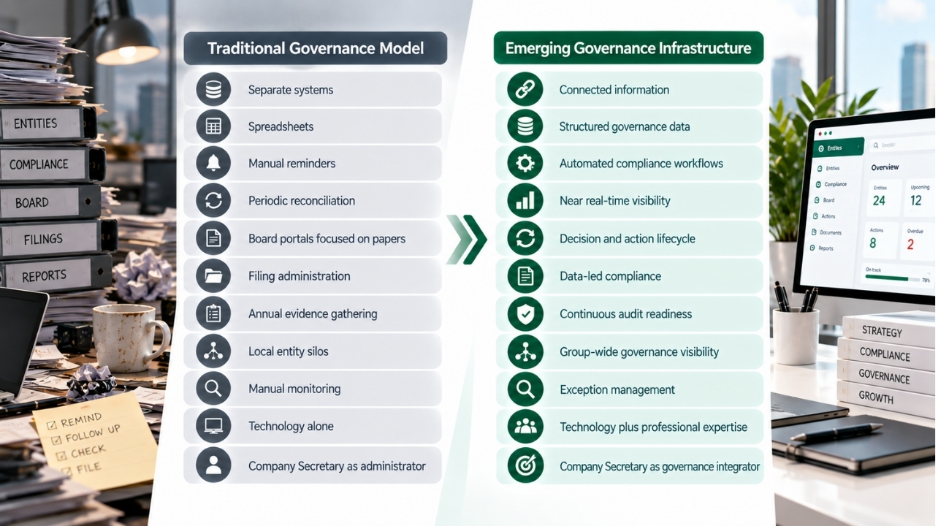
The transition will not happen overnight, nor should every organisation adopt exactly the same model.
However, the underlying principle is becoming difficult to ignore.
Governance infrastructure needs to scale at the same pace as organisational complexity.
Seven questions Company Secretaries should ask about their infrastructure now
1. Do we have one reliable view of our entities?
If different departments hold different answers, the organisation has a data-governance issue.
2. Can we see material obligations before they become urgent?
Forward planning should reduce compliance firefighting.
3. Are board decisions connected to their implementation?
Actions should not disappear after the meeting.
4. Is our governance evidence created continuously?
Audit readiness should be an operating condition rather than a year-end project.
5. Do our technology systems reduce work or simply digitise it?
Automation should create capacity.
6. Could governance continue if a key person became unavailable?
Critical institutional knowledge should not exist only in people’s heads.
7. Are Company Secretaries spending enough time on judgement?
If experienced professionals spend most of their time chasing information, the infrastructure is underperforming.
These questions reveal more than technology maturity. They reveal whether the organisation’s governance operating model is ready for the next phase of complexity.
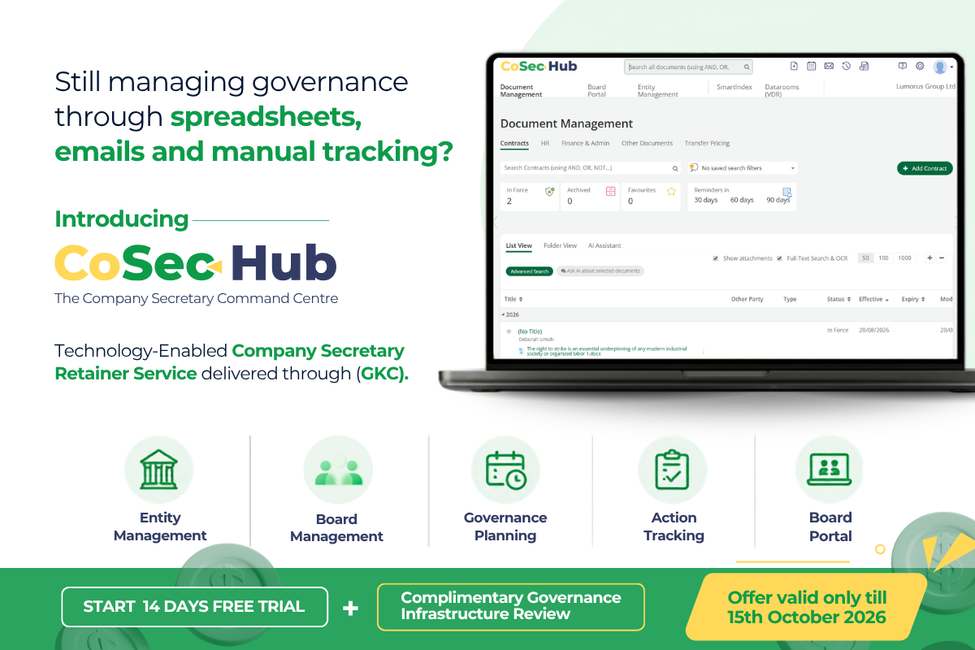
Why CoSec Hub was built for this direction of travel
Many governance platforms begin with software.
CoSec Hub begins with the Company Secretary operating model.
Modern governance teams need technology, but technology becomes more valuable when professional Company Secretary expertise sits behind it.
That is why CoSec Hub combines governance infrastructure with the Governance Knowledge Centre.
The technology layer supports:
- Entity Management
- Compliance Calendars
- Governance Forward Planning
- Board Management
- Contract Management
- Statutory Registers
- Board Action Tracking
- Meeting Lifecycle Management
Alongside that technology, the Governance Knowledge Centre provides access to:
- Chartered Company Secretary expertise
- Governance operations support
- Compliance monitoring
- Board administration
- Governance intelligence
- Multi-jurisdiction governance support
- Governance advisory
Together, the model creates a Technology-Enabled Company Secretary Retainer Service.
The proposition reflects the direction governance infrastructure is moving. Routine obligations become more visible and structured, while experienced professionals remain available where governance requires judgement.
Not software alone. Not outsourcing alone. Governance infrastructure.
Explore: CoSec Hub
What boards should expect from the next generation of Company Secretary support
Boards do not need to understand every governance technology system.
They should expect better governance outcomes.
A strong modern Company Secretary function should allow leadership to understand:
- Which entities exist
- Who governs them
- Who owns them
- Which obligations are approaching
- Which decisions were made
- Which actions remain outstanding
- Which governance risks require attention
- Where controls are weak
- What evidence supports the governance record
That is the real promise of governance infrastructure.
Not more dashboards, but better visibility. Less administration, but better accountability. Less software, but better governance.
The Lumorus View
The most important governance infrastructure trend is not AI, digital filing or entity technology. It is the movement from person-dependent governance towards institutionally resilient governance.
Technology will accelerate that shift, regulation will reinforce it and board expectations will demand it. However, the purpose should remain clear.
Governance infrastructure should allow skilled Company Secretaries to spend less time recovering information and more time interpreting it. It should enable them to spend less time chasing routine actions and more time identifying material exceptions, while reducing the effort required to reconstruct governance after the event.
The profession is becoming more influential precisely because organisations need judgement in an environment of growing complexity.
The answer should not be to automate judgement away.
It should be to build infrastructure that allows professional judgement to operate where it creates the most value.
The Bottom Line
The Company Secretary profession is entering a new stage.
Governance influence is rising, while workloads are increasing and resources remain constrained. AI is becoming a board issue, Companies House is digitising corporate compliance, Provision 29 is strengthening expectations around control evidence and cyber risk remains firmly on the enterprise agenda.
Taken together, these developments point towards a new governance operating model.
Company Secretaries increasingly need infrastructure that combines:
- Reliable governance data
- Real-time entity visibility
- Forward compliance planning
- Board intelligence
- Decision and action tracking
- Audit-ready evidence
- Cyber and AI governance
- Multi-jurisdiction oversight
- Automation
- Professional expertise
The future will not belong to the organisation with the most governance software.
It will belong to the organisation that connects technology, information, accountability and professional judgement most effectively.
Governance infrastructure is no longer simply what sits behind the Company Secretary function. Increasingly, it is what determines whether the function can keep pace with the organisation it is expected to govern.
Continue Exploring
- Strengthen your organisation’s governance infrastructure: Corporate Governance Support
- Build stronger compliance visibility: Statutory & Regulatory Compliance
- Improve board and shareholder governance: Board & Shareholder Meetings
- Create stronger governance structures as you grow: Company Formation & Structuring
- Add scalable Company Secretary capability: Company Secretary Outsourcing
- Strengthen annual governance reporting: Annual Report Services
- Build stronger board records: Minute Taking Solutions
- Connect governance technology and Company Secretary expertise: CoSec Hub
About CoSec Hub
CoSec Hub is the Company Secretary Command Centre.
Built by Company Secretaries for Company Secretaries, CoSec Hub combines governance technology with Chartered Company Secretary expertise to help organisations manage entities, compliance, board administration and governance operations through a more connected operating model.
Through CoSec Hub and the Governance Knowledge Centre, organisations can access a Technology-Enabled Company Secretary Retainer Service designed to strengthen:
- Entity governance
- Compliance visibility
- Governance forward planning
- Board administration
- Statutory records
- Action tracking
- Multi-jurisdiction governance
- Governance intelligence
- Professional Company Secretary support
The purpose is not to digitise an outdated operating model. It is to build governance infrastructure capable of scaling with modern organisations.
CoSec Hub + Governance Knowledge Centre: Where Automation Meets Governance Authority.
Lumorus: Better Business, Built on Purpose
Lumorus is a UK headquartered global governance, ESG, Company Secretary and advisory firm supporting organisations across Europe, Africa, Asia, the Caribbean, Canada, the Middle East and international markets.
We help boards and leadership teams strengthen governance infrastructure, accountability and organisational resilience as regulation, technology and organisational complexity continue to evolve.
Our Company Secretary capabilities include:
For organisations that need governance to scale without creating more fragmentation, CoSec Hub combines governance technology, governance operations and professional Company Secretary expertise.
Is your governance infrastructure evolving as quickly as the responsibilities being placed on your Company Secretary function?
If the answer is uncertain, the issue may not be capacity alone. It may be the operating model.
Explore Lumorus and CoSec Hub to build governance infrastructure designed for the next stage of organisational complexity.
Lumorus: Better Business, Built on Purpose.
Sources
- The Chartered Governance Institute UK & Ireland: Governance Market Survey 2026 – Research examining governance influence, board information, AI literacy, workload and resourcing.
- Diligent: Global State of Entity Compliance 2026 – Research covering expanding governance mandates, entity management, manual systems, workload and compliance near misses.
- Financial Reporting Council: UK Corporate Governance Code 2024 – The current UK governance framework, including Provision 29 and board responsibilities for risk management and internal controls.
- Financial Reporting Council: Provision 29 Guidance – Guidance concerning material controls, monitoring, evidence and board declarations.
- Financial Reporting Council: Auditor Responsibilities and Provision 29 – FRC clarification concerning the relationship between external audit and the board’s Provision 29 responsibilities.
- Financial Reporting Council: Corporate Governance Code Guidance – Guidance covering board information, governance processes, controls and decision making.
- Companies House: ECCTA Transition Plan – Implementation timetable for identity verification and wider Companies House reforms.
- Companies House: Accounts Filing Changes from April 2028 – Information on planned software-based accounts filing reforms.
- Companies House: Using Software to File Company Information – Guidance on software filing and structured corporate information.
- Institute of Internal Auditors: Global Risk in Focus – Global research covering cybersecurity, digital disruption and other major organisational risks.