Governance reporting is changing from describing what boards did to proving what governance achieved
For years, corporate governance reporting followed a familiar pattern.
Companies described the number of board meetings held, listed committee responsibilities, explained director attendance and summarised the activities completed during the year. Much of that information remains necessary, yet investors and regulators increasingly expect something more useful.
They want to understand what the board focused on, why those issues mattered, what decisions were made and what changed as a result.
That shift is already visible in the regulatory environment.
The Financial Reporting Council’s Annual Review of Corporate Governance Reporting 2025 examined governance reporting across 100 UK-listed companies and continued to emphasise meaningful, company-specific explanations rather than formulaic disclosure. The FRC has also made clear that companies should use the flexibility of the UK Corporate Governance Code to explain how governance operates in their particular circumstances rather than simply reproduce Code language.
Meanwhile, Deloitte’s Corporate Reporting Insights 2026 found opportunities for companies to make governance reporting more relevant by focusing on the outcomes of governance arrangements rather than boilerplate descriptions. Deloitte also observed that the first reports under the 2024 UK Corporate Governance Code were beginning to provide greater clarity about board monitoring of risk and internal controls.
These developments matter enormously for Company Secretaries.
The annual report is no longer simply where governance activity is documented. Increasingly, it is where the board must demonstrate that governance structures influenced decisions, controlled risk and supported the organisation’s long-term direction.
Governance reporting is therefore becoming evidence of governance quality.
For Company Secretaries, that makes reporting less of a year-end drafting exercise and more of a year-round governance discipline.
Read More: Annual Report Services
Executive Takeaway
The most important governance reporting trends Company Secretaries should be watching include:
- Greater focus on governance outcomes rather than activity
- More company-specific and less boilerplate disclosure
- Stronger explanations under comply or explain
- Greater transparency around risk and internal controls
- Provision 29 increasing the importance of governance evidence
- Closer alignment between the strategic report and governance report
- Growing disclosure around AI and board technology oversight
- Greater scrutiny of board information and decision making
- More meaningful reporting on culture
- Increasing expectations around sustainability governance
- Stronger links between governance, remuneration and performance
- More emphasis on board and committee effectiveness
- Increasing importance of stakeholder evidence
- Continued movement towards structured digital reporting
- Pressure to make annual reports shorter and more decision useful
- Cautious but growing use of AI in the reporting process
The common thread is clear.
Good governance reporting is becoming less about describing structures and more about explaining how those structures affected decisions, controls and outcomes.
1. Outcomes are replacing activity as the real measure of governance reporting
This may be the most important shift.
Traditional governance reporting often describes activity.
The nomination committee met four times.
The board reviewed strategy.
Directors completed training.
The audit committee discussed risk.
All of these statements may be accurate. However, none necessarily tells the reader what difference the governance process made.
The UK Corporate Governance Code 2024 strengthened the emphasis on reporting outcomes, while the FRC continues to encourage companies to move beyond generic descriptions towards information that explains the impact of governance practices.
Deloitte’s review of first-time reporting under the 2024 Code reached a similar conclusion, noting that companies have opportunities to streamline disclosure by concentrating on governance outcomes rather than repeating Code wording.
For Company Secretaries, this changes the reporting question.
Instead of asking:
What did the board do?
The annual report should increasingly answer:
What happened because the board did it?
Consider the difference.
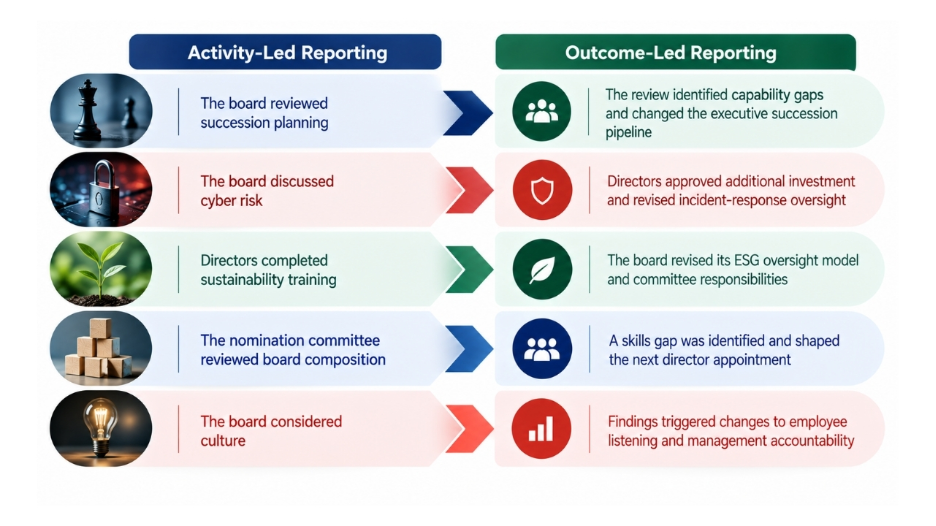
The second column is more informative because it shows governance operating rather than simply occurring.
Read More: Corporate Governance Support
2. Boilerplate governance reporting is becoming harder to defend
Many governance reports still contain technically correct but largely interchangeable language.
The board promotes high standards of corporate governance.
Directors remain committed to stakeholders.
The committee continued to discharge its responsibilities effectively.
These statements reveal very little about the company.
The FRC has repeatedly encouraged organisations to provide meaningful and company-specific explanations. Its March 2026 guidance on comply or explain also reinforced that a thoughtful departure from a Code provision can demonstrate serious governance judgement where the rationale is clearly explained.
That creates an important reporting principle.
Governance reporting should sound like the organisation being governed.
A bank, technology company, mining business and consumer-products group should not produce essentially identical governance reports because their board priorities, risk profiles and strategic decisions are different.
Company Secretaries should therefore challenge language that could appear unchanged in hundreds of other annual reports.
Useful disclosure should explain:
- What mattered this year
- Which issues occupied board attention
- Which decisions were difficult
- What changed in response
- Where governance arrangements evolved
- Which risks affected board priorities
- What directors learned
- What remains unresolved
Specificity creates credibility.
Generic language creates length.
3. Comply or explain is returning to what it was meant to be
The UK governance framework has never required companies to follow every Code provision mechanically.
Its strength lies partly in flexibility.
However, over time, some companies became reluctant to report departures because non-compliance could be interpreted automatically as poor governance.
The FRC addressed this directly in its 2026 guidance on comply or explain, stressing that a clear and well-reasoned alternative approach can demonstrate thoughtful governance rather than failure.
The Annual Review of Corporate Governance Reporting 2025 found that 25 of the 100 companies reviewed reported a departure from at least one Code provision. Importantly, the FRC observed improvement in the quality of meaningful and context-specific explanations.
For Company Secretaries, that creates an opportunity.
A strong explanation should help readers understand:
- Which provision the company departed from
- Why the standard approach was not suitable
- What alternative governance arrangement exists
- Which risks arise from the alternative
- How those risks are managed
- Whether the arrangement is temporary
- What outcome the board believes the approach produces
The objective should never be to disguise non-compliance.
Nor should boards comply with structures that do not suit the organisation simply to avoid explaining themselves.
Good comply or explain reporting demonstrates governance judgement.
4. Provision 29 is making internal control reporting a major governance priority
For companies within scope of the UK Corporate Governance Code, Provision 29 represents one of the most important current developments in governance reporting.
It applies to financial years beginning on or after 1 January 2026.
Boards are required to monitor the risk management and internal control framework, review its effectiveness at least annually and provide a declaration regarding the effectiveness of material controls at the balance-sheet date.
The implications for Company Secretaries extend beyond drafting.
Reporting now depends on the governance process producing sufficient evidence throughout the year.
Boards will increasingly need to understand:
- Which controls are material
- Who owns them
- How their effectiveness is monitored
- What assurance exists
- Which deficiencies were identified
- Whether remediation occurred
- What evidence supports the board’s conclusion
Deloitte’s 2026 corporate reporting analysis noted that some companies reporting for the first time under the 2024 Code were already providing greater clarity about how boards monitored and annually reviewed the effectiveness of their risk management and internal control frameworks.
This marks a wider shift.
Governance reporting is moving closer to evidence-based reporting.
The Company Secretary should therefore be involved early enough to ensure the board’s eventual disclosure reflects governance that actually occurred rather than evidence reconstructed immediately before publication.
Explore More: Statutory & Regulatory Compliance
5. Governance reporting increasingly needs to tell one corporate story
Annual reports often contain several narratives written by different teams.
The strategic report discusses priorities and risks.
The governance report describes board activities.
The sustainability section addresses environmental and social matters.
Remuneration explains incentives.
Financial statements provide the economic outcome.
Readers, however, see one company.
The stronger reporting trend is therefore towards connectivity.
Deloitte’s 2026 analysis recommends that companies ensure different parts of the annual report tell one story, with significant board decisions and activities aligned with the strategic report.
The FRC’s updated Guidance on the Strategic Report, published in February 2026, takes a similar approach. It treats the strategic report within the context of the annual report as a whole and encourages companies to improve clarity, conciseness and cohesiveness.
For Company Secretaries, this means checking whether governance reporting connects visibly with:
- Strategy
- Principal risks
- Capital allocation
- Stakeholder issues
- Sustainability
- Executive remuneration
- Board priorities
- Major transactions
- Future outlook
If the strategic report says cyber risk became critical but the governance section barely explains board oversight, the story is incomplete.
Likewise, if succession is described as strategically important but the nomination committee report contains only generic language, readers cannot see the connection.
The annual report should read as one organisation explaining itself, not several departments publishing beside each other.
6. Risk reporting is becoming more dynamic
Boards are operating in an environment of unusually high uncertainty.
Geopolitics, trade tensions, artificial intelligence, cyber risk, climate exposure and supply-chain disruption can all reshape corporate strategy quickly.
Governance reporting increasingly needs to reflect that environment.
Deloitte’s 2026 review of 75 FTSE 100 annual reports found that 97% referenced geopolitical matters as risks, while only 16% articulated related opportunities. Tariffs appeared in 85% of reports and supply-chain challenges in 79%.
That gap between risks and opportunities is worth considering.
Good governance reporting should not become a catalogue of threats.
Boards govern uncertainty partly by understanding how changes create both downside and strategic opportunity.
A strong report should therefore explain:
- What changed in the external environment
- How the board interpreted the change
- Which assumptions were challenged
- What strategic decisions followed
- How risk appetite responded
- Whether capital allocation changed
- What uncertainty remains
Company Secretaries can add significant value by ensuring board reporting captures this progression rather than simply adding new risks to an annual list.
7. AI is rapidly becoming part of governance reporting
Artificial intelligence has moved from technology commentary into mainstream board reporting.
Deloitte’s 2026 FTSE 100 research found that 96% of companies mentioned AI, while 80% discussed board-level governance of the technology. More than a quarter also referred to Agentic AI.
This reflects a broader governance reality.
Boards increasingly need to oversee:
- AI strategy
- Data
- Cybersecurity
- Model risk
- Workforce implications
- Customer impacts
- Ethics
- Regulatory developments
- Investment
- Human oversight
The reporting challenge is therefore moving beyond statements that the board received an AI presentation.
Readers increasingly need to understand how AI is being governed.
That might include:
- Which committee has oversight
- Whether the board has appropriate expertise
- How management reports AI risk
- What controls govern high-risk applications
- How data and cyber risks are addressed
- Whether board skills are evolving
- How AI affects strategy and the workforce
The Chartered Governance Institute Governance Market Survey 2026 found that 50% of governance professionals believe AI literacy for boards is becoming more important.
Company Secretaries should expect AI governance reporting to develop quickly.
8. AI is also entering the reporting process itself
There is a second AI trend that matters directly to Company Secretaries.
Artificial intelligence is beginning to help prepare corporate reports.
The FRC’s July 2026 research into AI in corporate reporting found that adoption is increasing, particularly in narrative reporting, although implementation remains cautious and uneven. Most use remains focused on lower-risk, task-specific work rather than areas requiring significant professional judgement.
Preparers identified several constraints, including:
- Trust
- Data quality
- Governance controls
- Legal risk
- Reputational risk
- Stakeholder expectations
These concerns are justified.
A governance report may contain sensitive judgements about board performance, culture, controls and risk. Generative AI can assist with drafting or comparison, but accountability for the final disclosure remains human.
Company Secretaries therefore need clear reporting controls governing:
- Approved AI tools
- Confidential information
- Human review
- Source checking
- Data protection
- Version control
- Final approval
AI may make reporting more efficient.
It must not make accountability less clear.
9. Governance reporting is becoming more concise, but the standard is relevance rather than brevity
Annual reports have grown significantly over time.
More regulation, sustainability disclosure, remuneration requirements and stakeholder information have all contributed to greater length.
However, longer does not necessarily mean better.
The FRC’s Simplifying Annual Reporting Sandbox was launched in 2025 specifically to explore how companies can meet reporting requirements while producing more user-friendly annual reports. The first round concluded in April 2026.
The UK Stewardship Code 2026 provides another useful signal. The FRC reported early evidence suggesting a 20% to 30% reduction in reporting volume without loss of quality following changes that sharpened the focus on stewardship activity and outcomes.
The lesson for governance reporting is important.
Companies should not remove useful information simply to reduce page numbers.
Instead, Company Secretaries should challenge:
- Repetition
- Generic explanations
- Duplicated policies
- Historic information available elsewhere
- Code wording reproduced without insight
- Descriptions that do not help readers understand governance
Good reporting can be detailed without being bloated.
The objective is not the shortest governance report. It is the report in which every section earns its place.
10. Culture reporting is becoming more evidence based
Culture remains one of the hardest governance issues to report well.
Most companies can describe their values.
Fewer can demonstrate whether those values shape behaviour throughout the organisation.
The 2024 UK Corporate Governance Code retains board responsibility for assessing and monitoring culture, while current reporting practice is moving towards explaining how boards obtain evidence rather than merely stating that culture was discussed.
Deloitte’s 2026 analysis identified examples of boards explaining how monitoring and assessment activities were used to assess whether desired culture was embedded and reflected in stakeholder experience.
Company Secretaries should therefore expect stronger governance reports to draw on evidence such as:
- Employee engagement
- Whistleblowing
- Conduct incidents
- Customer outcomes
- Health and safety
- Employee turnover
- Ethics investigations
- Speak-up data
- Stakeholder feedback
- Internal audit
- Site visits
No single metric proves culture.
The stronger reporting question is whether directors have enough triangulated evidence to form a judgement.
Read More: Corporate Governance Support
11. Sustainability governance is moving closer to mainstream governance reporting
Sustainability reporting is increasingly connected with board governance.
Deloitte’s review found that 89% of FTSE 100 boards discussed climate, yet only 41% of companies disclosed board oversight of sustainability assurance.
That distinction matters.
Reporting that the board discussed climate is different from explaining how directors govern sustainability information and risk.
Company Secretaries should increasingly expect governance disclosures to explain:
- Board and committee sustainability responsibilities
- Material ESG risks
- Management ownership
- Reporting controls
- Sustainability assurance
- Skills and training
- Capital-allocation implications
- Stakeholder information
- Progress against significant targets
Provision 29 also adds another layer because material reporting controls may include controls over narrative and ESG reporting for companies within the Code’s scope.
Sustainability governance is therefore becoming part of the wider corporate reporting control environment.
Explore More: ESG Reporting and Disclosure
12. Board effectiveness reporting needs to become more useful
Many annual reports describe board evaluation processes in considerable detail.
The methodology is explained.
Topics are listed.
Recommendations appear.
Then the reporting frequently stops.
The more useful question is:
What did the board change?
Good board-effectiveness reporting should connect evaluation with action.
For example:
- The evaluation identified insufficient technology expertise, leading to a new director appointment.
- Directors wanted more strategic discussion time, resulting in a redesigned annual calendar.
- Committee overlap was identified, prompting changes to committee responsibilities.
- Management papers were too operational, leading to revised board-paper standards.
- Succession concerns resulted in a new leadership-development plan.
Reporting those outcomes demonstrates that evaluation influenced governance.
Otherwise, evaluation can appear ceremonial.
Company Secretaries should therefore track recommendations during the year rather than trying to reconstruct progress when the annual report is drafted.
Explore More: Board Skills Audit
13. Stakeholder reporting is moving from engagement volume to decision influence
Another reporting trend concerns stakeholders.
Traditional disclosure may explain that the company held hundreds of meetings, surveys or engagement activities.
That provides evidence of contact.
It does not necessarily demonstrate influence.
More useful governance reporting explains:
- Which stakeholder issues mattered
- How information reached the board
- Where competing interests existed
- What directors considered
- Which decisions changed
- What the board ultimately decided
This is particularly important around section 172 reporting.
The strongest disclosure does not merely state that directors considered stakeholders.
It shows how stakeholder information influenced judgement.
For Company Secretaries, that means stakeholder engagement records should connect with significant board decisions where relevant.
Read More: Stakeholder Engagement
14. Remuneration reporting is becoming more connected to governance outcomes
Executive remuneration remains one of the most scrutinised areas of governance reporting.
The reporting challenge is no longer merely to explain the remuneration structure.
Boards increasingly need to explain the logic behind it.
Deloitte’s 2026 review found that while most companies described their malus and clawback provisions, some did not explain why the selected period was appropriate or whether those provisions had been used during the reporting period.
The wider lesson is important.
Remuneration reporting should help readers understand:
- Why performance measures were selected
- How they relate to strategy
- Whether discretion was used
- How performance outcomes affected awards
- Whether malus or clawback applied
- How wider stakeholder experience informed decisions
- Whether incentives encourage appropriate risk behaviour
Good remuneration reporting is therefore another test of connectivity.
The incentives described should make sense alongside the strategy and governance priorities described elsewhere in the report.
15. Stewardship reporting is increasingly focused on activities and outcomes
For asset owners, asset managers and relevant service providers, the UK Stewardship Code 2026 introduces an important reporting model.
The Code separates reporting into a Policy and Context Disclosure and an annual Activities and Outcomes Report.
The latter is specifically designed to demonstrate how the organisation applied the stewardship principles through the activities undertaken during the year and the outcomes of those activities.
Importantly, the FRC makes clear that outcomes do not always need to be positive or complete.
Ongoing progress, unsuccessful engagement and lessons learned can still provide useful disclosure.
This reflects a broader movement in governance reporting.
Credibility does not require pretending that every governance process succeeded.
Readers can learn more from an organisation that explains what did not work and how it responded than from one in which every governance activity apparently produced perfect results.
Good governance reporting includes learning, not only achievement.
16. Structured digital reporting is becoming part of reporting quality
Corporate reporting is also becoming increasingly machine readable.
The FRC’s Structured Digital Reporting Insights 2025/26 found that structured digital reporting is now well established across the UK listed market. Most reviewed files were appropriately structured, although the FRC continued to identify tagging inconsistencies and areas where basic checks could improve quality.
This may appear primarily technical.
It is not.
As annual reports become more accessible to automated analysis, investors, data providers and AI tools can compare corporate disclosures more easily.
That increases the importance of:
- Accurate tagging
- Consistent terminology
- Reliable data
- Clear reporting structure
- Strong version control
For Company Secretaries, the implication is that governance reporting increasingly serves both human and machine readers.
The underlying information architecture therefore matters more.
17. Governance reporting is becoming an investor-relations asset
Governance reporting should not be viewed only as a compliance cost.
Strong disclosure can help investors understand how the organisation is governed, how directors approach uncertainty and whether accountability is credible.
Deloitte’s 2026 corporate reporting analysis explicitly notes that transparent, context-specific governance reporting can improve understanding of the board’s role and strategic direction, supporting trust and potentially contributing to the company’s ability to attract capital and pursue business opportunities.
That does not mean governance reporting should become promotional.
Quite the opposite.
Investor confidence is strengthened by credible explanations, including areas where governance has changed, controls have failed or the organisation has learned.
Useful governance reporting should therefore answer:
- What is distinctive about this board?
- What did directors focus on?
- Where did they challenge management?
- What changed?
- Which risks concerned them?
- How did governance support strategy?
- What remains difficult?
Those questions make governance reporting worth reading.
18. Reporting quality will depend increasingly on governance infrastructure
Perhaps the least discussed reporting trend is the one beneath all the others.
Good governance reporting depends on good governance records.
If board actions sit in emails, reporting on outcomes becomes difficult.
Where committee activities are poorly tracked, annual reporting becomes a reconstruction exercise.
When entity information is fragmented, corporate disclosures become harder to verify.
Likewise, if governance decisions and stakeholder engagement are not recorded properly, year-end drafting teams must rely on memory.
That is why governance infrastructure increasingly matters to corporate reporting.
A connected governance environment should preserve:
- Board decisions
- Committee activity
- Actions
- Evidence
- Director changes
- Conflicts
- Governance reviews
- Regulatory matters
- Stakeholder information
- Control assessments
The annual report then becomes an output of the governance system rather than a retrospective investigation into what happened during the year.
Explore: CoSec Hub
The governance reporting shift at a glance
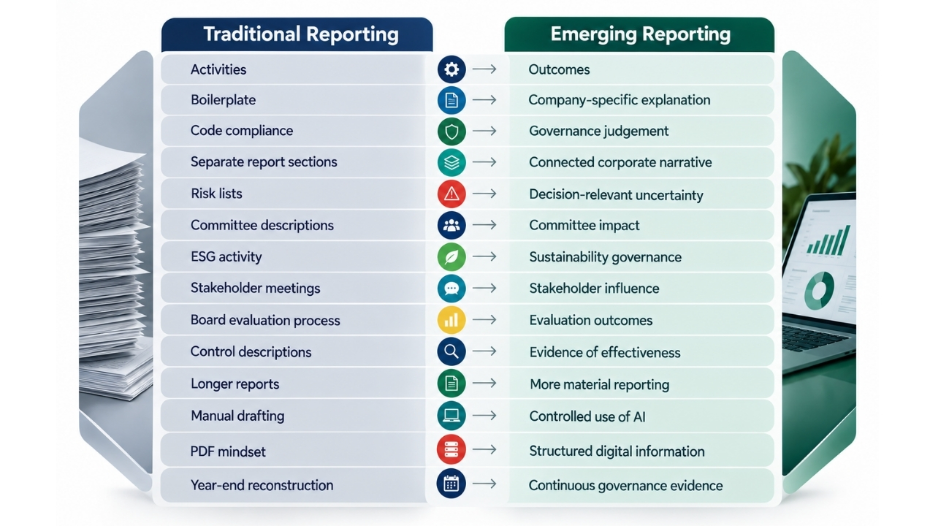
The direction is unmistakable.
Corporate governance reporting is becoming less ceremonial and more analytical.
Seven warning signs your governance reporting is falling behind
1. The governance report could belong to almost any company
Generic disclosure usually means the organisation’s actual governance story is missing.
2. Board activities are described but outcomes are absent
Readers should understand what changed.
3. The strategic and governance reports tell different stories
Important priorities should connect across the annual report.
4. Every committee apparently operated perfectly
Credible reporting should include development, challenge and learning where material.
5. Significant risks appear without explaining board oversight
The report should connect uncertainty with governance response.
6. Governance evidence is gathered only during reporting season
This creates unnecessary risk and pressure.
7. More pages are added every year but little information is removed
Reporting maturity requires editing as well as disclosure.
Several of these signs together indicate that the problem is no longer only drafting.
The underlying governance-reporting process needs attention.
A practical governance reporting health check for Company Secretaries
Before the next annual-report cycle, Company Secretaries should ask:
- Does our governance report explain outcomes rather than only activities?
- Could another company use most of our wording unchanged?
- Do board priorities connect clearly with strategy and principal risks?
- Can readers understand the board’s most significant decisions?
- Are comply or explain departures specific and persuasive?
- Do we have sufficient evidence to support Provision 29 reporting where applicable?
- Does committee reporting explain impact rather than responsibilities alone?
- Can readers see how board evaluation changed governance?
- Is stakeholder information connected with significant decisions?
- Does ESG reporting explain governance and controls?
- Do remuneration disclosures make strategic sense?
- Have we removed repetitive or immaterial disclosure?
- Are AI tools used in reporting subject to appropriate human review?
- Could governance evidence be retrieved without searching through individual inboxes?
- Does the annual report tell one coherent corporate story?
A weak answer to several questions suggests the organisation should review the reporting process before drafting begins.
What Company Secretaries should do before the next reporting cycle
Waiting until year end is increasingly difficult.
A stronger process starts much earlier.
Build the reporting architecture early
Identify which governance outcomes, decisions and evidence will be required before reporting season begins.
Track board outcomes throughout the year
Do not rely on memory when preparing the governance statement.
Connect annual-report owners
Governance, finance, sustainability, investor relations, remuneration and risk teams should understand how their sections interact.
Review Code developments
Ensure the board and committees understand changes affecting the next reporting cycle.
Prepare Provision 29 evidence
Where applicable, control monitoring and assurance should occur throughout the year.
Challenge boilerplate
Remove language that explains governance standards without explaining the company.
Use AI cautiously
Where AI supports drafting or review, maintain clear human ownership of accuracy and judgement.
Design for the reader
Ask what investors genuinely need to understand rather than what the organisation has always disclosed.
The strongest governance report is rarely created by the best writer at the end of the year.
It is created by a governance system that has captured the right information throughout it.
Why governance infrastructure matters to reporting
CoSec Hub is built around the principle that governance information should remain connected throughout the year.
The technology layer can support:
- Entity Management
- Compliance Calendars
- Governance Forward Planning
- Board Management
- Statutory Registers
- Board Action Tracking
- Meeting Lifecycle Management
- Governance Records
Alongside the technology, the Governance Knowledge Centre can provide access to:
- Chartered Company Secretary expertise
- Governance operations support
- Compliance monitoring
- Board administration
- Governance intelligence
- Multi-jurisdiction support
- Governance advisory
Together, these capabilities create a Technology-Enabled Company Secretary Retainer Service.
That operating model can strengthen reporting because decisions, actions and governance evidence are captured closer to the moment they occur.
The Company Secretary spends less time reconstructing the governance year and more time analysing what the board should explain about it.
Explore: CoSec Hub
The Lumorus View
The annual governance report should not be a catalogue of board activity. It should be evidence of how the organisation was governed.
That distinction is becoming increasingly important.
Readers do not need another paragraph saying the board takes governance seriously.
They need evidence.
What occupied directors?
Where did they challenge management?
Which risks changed?
How did the board respond?
What did committees achieve?
Where were controls strengthened?
What did the organisation learn?
Governance reporting becomes valuable when it makes the invisible work of governance visible without drowning the reader in process.
This is where Company Secretaries can have enormous influence.
They sit close enough to the board to understand the year as a governance story, while also understanding the regulatory architecture within which that story must be reported.
The strongest Company Secretaries will therefore resist two extremes.
They will not reduce governance reporting to compliance.
Nor will they turn it into corporate promotion.
They will make it specific, evidenced, connected and useful.
The Bottom Line
Governance reporting is entering a more demanding phase.
The UK Corporate Governance Code 2024 is increasing emphasis on outcomes, while Provision 29 is raising expectations around internal-control evidence. The FRC is encouraging more meaningful comply or explain reporting and exploring how annual reports can become simpler and more useful.
At the same time, new issues are entering the reporting agenda.
AI is becoming a board governance topic and a reporting tool. Geopolitical uncertainty is appearing more prominently in annual reports, sustainability oversight remains important, digital reporting is becoming more established and investors continue to expect clearer information about how governance supports strategy and resilience.
For Company Secretaries, the reporting agenda should therefore focus on:
- Outcomes
- Specificity
- Connectivity
- Risk
- Controls
- Evidence
- AI
- Culture
- Sustainability
- Stakeholder influence
- Board effectiveness
- Conciseness
- Digital quality
The objective is not to create a longer governance report.
It is to create a better one.
The most useful governance reporting tells investors not merely how the governance structure is designed, but how the board actually used that structure when it mattered.
That is the standard Company Secretaries should now be working towards.
Continue Exploring
- Strengthen governance reporting and board disclosures: Annual Report Services
- Improve the governance systems behind your reporting: Corporate Governance Support
- Build stronger board and shareholder meeting records: Board & Shareholder Meetings
- Improve statutory and regulatory oversight: Statutory & Regulatory Compliance
- Create more reliable minutes and decision records: Minute Taking Solutions
- Strengthen board capability and succession planning: Board Skills Audit
- Improve sustainability disclosures: ESG Reporting and Disclosure
- Connect governance technology with Company Secretary expertise: CoSec Hub
Lumorus: Better Business, Built on Purpose
Lumorus is a UK headquartered global governance, ESG, Company Secretary and advisory firm supporting organisations across Europe, Africa, Asia, the Caribbean, Canada, the Middle East and international markets.
We help organisations strengthen both the governance they practise and the governance they report.
Our Company Secretary and governance capabilities include:
For organisations seeking a more connected governance operating model, CoSec Hub brings governance technology together with professional Company Secretary expertise and the Governance Knowledge Centre.
Strong annual-report disclosure begins long before the first draft is written.
It begins with board information, reliable minutes, tracked actions, governance evidence and clear accountability throughout the year.
Could your governance report explain not only what your board did this year, but what changed because of it?
If the answer is uncertain, the problem may sit deeper than the annual-report drafting process.
The governance infrastructure may need attention.
Explore Lumorus and CoSec Hub to strengthen the systems behind better governance reporting.
Lumorus: Better Business, Built on Purpose.
Sources
- Financial Reporting Council: Annual Review of Corporate Governance Reporting 2025. The FRC’s review of governance reporting across 100 UK-listed companies, including findings on company-specific explanations, Code departures and preparation for Provision 29. FRC Annual Review of Corporate Governance Reporting
- Financial Reporting Council: UK Corporate Governance Code 2024. The current UK governance framework, including outcome-based reporting, comply or explain and Provision 29. UK Corporate Governance Code 2024
- Financial Reporting Council: Improving the Quality of Comply or Explain Reporting 2026. Updated guidance encouraging meaningful, company-specific explanations where boards adopt alternative governance approaches. FRC comply or explain guidance
- Financial Reporting Council: Guidance on the Strategic Report 2026. Updated guidance encouraging material, clear, concise and cohesive corporate reporting. FRC Guidance on the Strategic Report
- Deloitte: Corporate Reporting Insights 2026. Research into FTSE annual reports covering governance outcomes, risk and controls, geopolitical uncertainty, AI, sustainability assurance and reporting connectivity. Deloitte Corporate Reporting Insights 2026
- Financial Reporting Council: The Use of Artificial Intelligence Technologies in Corporate Reporting. 2026 research examining how AI is being adopted within corporate-reporting processes and the associated governance, data and accountability issues. FRC research on AI in corporate reporting
- Financial Reporting Council: Structured Digital Reporting Insights 2025/26. Review of structured digital annual reports and current issues involving tagging quality, consistency and digital reporting practice. FRC Structured Digital Reporting Insights 2025/26
- Financial Reporting Council: UK Stewardship Code 2026. Current stewardship framework placing greater emphasis on activities and outcomes while streamlining reporting. UK Stewardship Code 2026
- Financial Reporting Council: How to Report on the UK Stewardship Code 2026. Guidance covering annual Activities and Outcomes Reports and Policy and Context Disclosures. How to report on the UK Stewardship Code 2026
- Chartered Governance Institute UK & Ireland: Governance Market Survey 2026. Research based on 971 governance professionals examining board information, decision support, AI literacy, workload and the expanding influence of governance teams. CGI Governance Market Survey 2026