The greatest risks facing Company Secretaries are often the ones nobody notices until something goes wrong
A board meeting runs smoothly. The minutes are circulated, a statutory filing is submitted, a director appointment is processed and a subsidiary completes its annual obligations. From the outside, the governance function appears controlled.
Behind that appearance, however, the Company Secretary may be managing dozens of overlapping risks at the same time: an approaching regulatory deadline, an incomplete board action, inconsistent entity records, a director conflict, a late board paper, an unverified person with significant control or a subsidiary whose local adviser has not yet confirmed a filing.
Most of these issues will never become crises because an experienced governance professional notices them early. That is both the strength and the danger of the profession.
The Chartered Governance Institute UK & Ireland’s 2026 Governance Market Survey found that 74% of governance professionals had experienced an increase in workload during the previous year, while 42% believed their governance function was not adequately resourced for its current responsibilities. At the same time, 65% said the influence of the governance function was increasing.
Pressure is also visible in entity governance. Diligent’s 2026 Global State of Legal Entity Compliance research found that 51% of surveyed governance professionals had experienced a near-miss compliance event, while 47% identified technology gaps and legacy systems as their biggest challenge.
These findings reveal an uncomfortable reality.
Company Secretaries are becoming more important to organisational decision making while simultaneously carrying more hidden operational risk.
The problem is not simply workload. Many of these risks sit between processes, systems and people, which means they can remain difficult for boards to see until a control fails.
Read More: Corporate Governance Support
Executive Takeaway
The daily risks facing Company Secretaries extend far beyond missing a filing deadline.
They include:
- Incomplete or inaccurate board information
- Weak decision records
- Missed statutory and regulatory obligations
- Inaccurate entity information
- Director and beneficial ownership changes
- Poor conflict management
- Unclear delegated authorities
- Incomplete board actions
- Multi-jurisdiction compliance gaps
- Regulatory change
- Key-person dependency
- Data and cyber risk
- Weak subsidiary governance
- AI-related governance risks
- Excessive reliance on manual systems
- Evidence gaps when auditors or regulators arrive
Individually, many of these issues appear manageable. The danger lies in their interaction.
A director change that is not reflected in the entity record may create a filing problem. An incomplete filing may then produce inaccurate public information, while an overlooked board action can create a control failure that becomes visible only during an audit.
The Company Secretary frequently sits at the point where all of those risks meet.
Therefore, the real question is not whether governance teams are busy. It is whether organisations have built enough governance infrastructure around them to prevent professional judgement from becoming the organisation’s only line of defence.
1. The risk of missing something that appears routine
Some of the most serious governance problems begin with ordinary tasks.
A confirmation statement is due. A director needs to verify their identity. A statutory register requires updating, while an approval must be obtained before a transaction completes.
None of these matters looks dramatic in isolation. However, governance works through consistency, and when routine obligations are repeatedly managed through personal reminders, spreadsheets and email, control becomes fragile.
Diligent’s 2026 research found that more than half of governance professionals surveyed had experienced a near-miss entity compliance event. The finding matters because near misses can reveal weaknesses before a formal breach occurs.
For Company Secretaries, routine compliance therefore carries an unusual risk. The better they become at rescuing weak systems, the less visible those systems’ weaknesses can become to the organisation.
A filing completed at the last minute still looks like a successful filing. Similarly, a board approval rescued by a late email still looks like a completed approval. Yet both may reveal that the governance process is too dependent on individuals.
Read More: Statutory & Regulatory Compliance
2. Companies House reform has raised the cost of inaccurate corporate information
For UK companies, corporate information is receiving greater regulatory scrutiny.
The Economic Crime and Corporate Transparency Act 2023 significantly expanded the Registrar of Companies’ powers. Companies House can now query information, require additional evidence, reject filings in relevant circumstances and take a more active role in protecting the integrity of the register.
This changes the risk profile for Company Secretaries.
Historically, corporate filing could sometimes be viewed primarily as a process obligation. Increasingly, organisations also need confidence that the underlying information is accurate and defensible.
Companies House has described the reforms as the largest changes to its role since corporate registrations began in 1844. Its ECCTA transition plan emphasises improved transparency, more accurate information and new responsibilities for directors, people with significant control and those filing information.
The practical implication is significant. Company Secretaries must increasingly ask not only whether a filing has been made, but whether the information is correct, consistent and supported by the organisation’s records.
That is a much higher governance standard.
3. Identity verification creates another layer of director and ownership risk
Identity verification is now part of UK company governance.
Since 18 November 2025, compulsory identity verification requirements have applied to directors and people with significant control, with implementation taking place through a phased transition. Existing directors generally provide their personal code through the relevant confirmation statement process, while PSCs have separate requirements depending on their circumstances.
For Company Secretaries, this creates another set of dependencies that must be monitored.
The organisation may need visibility over:
- Which directors have verified
- Which PSCs have verified
- Which personal codes remain outstanding
- Which confirmation statements trigger requirements
- Whether names and dates of birth match Companies House records
- Which directors hold appointments across several group companies
- Which PSC reporting periods apply
The risk becomes greater in complex groups.
A director may sit on several boards, while an individual can be both a director and a PSC. Companies House guidance makes clear that these roles can require separate steps even where the same individual is involved.
For governance teams, this is precisely the type of requirement that can become difficult to manage through spreadsheets once the number of entities grows.
Explore More: Company Secretary Outsourcing
4. Poor board information creates risk before the meeting even begins
One of the Company Secretary’s most important responsibilities is also one of the least visible: board information.
Directors cannot exercise effective oversight if information arrives too late, lacks context, avoids uncomfortable issues or overwhelms the board with unnecessary detail.
The FRC Corporate Governance Code Guidance places considerable emphasis on the flow and quality of board information. It recognises that directors need information that allows them to understand the organisation, evaluate issues and provide effective challenge.
That places the Company Secretary in a difficult position.
A paper may technically have been submitted on time but still be poor. Management may want a decision quickly, while directors need more evidence. Equally, a pack may contain hundreds of pages yet fail to make the key judgement clear.
The hidden risk is therefore not always that information is missing. Sometimes it is that information is present but not useful.
Strong Company Secretary support should help ensure board papers are:
- Timely
- Relevant
- Clear
- Decision focused
- Consistent
- Supported by evidence
- Explicit about risks and trade-offs
This is where administration becomes governance.
Read More: Board & Shareholder Meetings
5. Minutes create risk when they record too little or too much
Minutes are often described as administrative records. That understates their significance.
They can become some of the most important evidence available when an organisation needs to demonstrate how directors approached a material decision.
Weak minutes create two opposite risks. If they are too thin, they may fail to show meaningful consideration, challenge, conflicts or agreed actions. If they become near-verbatim transcripts, they can obscure the real governance record and create unnecessary complexity.
The stronger approach captures the substance of the decision.
That generally means recording:
- The material issue considered
- Relevant information before the board
- Significant challenge where appropriate
- Conflicts identified
- The decision reached
- Conditions attached to approval
- Actions arising
The Company Secretary therefore faces a judgement risk every time significant minutes are prepared. The question is not simply whether the discussion was recorded, but whether the record fairly represents the governance that occurred.
Professional Minute Taking Solutions can provide additional independence and consistency where board matters are complex or sensitive.
6. Board actions can quietly become governance liabilities
A decision without implementation is incomplete governance.
Yet board actions frequently receive less control than board papers or minutes. The meeting ends, an action is assigned and the minutes record it. Responsibility then shifts into an email chain or personal task list.
Three months later, the same issue returns to the board.
Sometimes the delay is harmless. In other circumstances, the action may concern regulatory remediation, cyber security, risk controls, an investigation or another material issue.
The Company Secretary therefore needs more than a list of actions.
A strong system should make visible:
- Who owns the action
- When it is due
- Whether it is complete
- What evidence supports closure
- Why it is delayed
- Whether escalation is required
The real governance chain is:
Decision → Responsibility → Implementation → Evidence → Closure
If the organisation controls the decision but loses visibility over implementation, accountability weakens.
7. Conflicts of interest are rarely as simple as filling in a register
Modern boards operate across increasingly complex networks of relationships.
Directors may sit on several boards, represent shareholders, invest personally in other businesses, hold advisory roles or have family relationships with relevant parties. Conflicts are therefore not unusual.
The governance problem begins when they are not identified, disclosed or managed properly.
The Company Secretary may need to determine:
- Whether a declaration is required
- Whether the board should be informed
- Whether the director should receive the paper
- Whether participation in discussion is appropriate
- Whether the director should vote
- How the decision should be minuted
- Whether the conflict should remain under review
These questions often require judgement rather than a simple checklist.
The hidden risk is that everyone may already know about the relationship informally. Informal awareness, however, is not the same as formal governance.
If the organisation cannot later demonstrate how the conflict was managed, the governance process may be difficult to defend.
Explore More: Corporate Governance Support
8. Delegated authority can drift away from formal governance
Organisations rarely remain static.
Businesses grow, executives change and subsidiaries gain greater responsibility. Approval thresholds increase, while local teams begin making decisions that were once handled centrally.
Over time, the practical allocation of authority can move away from the formal governance framework.
That creates a hidden risk for Company Secretaries.
A contract may be approved by someone whose authority is unclear. A subsidiary director may make a decision the parent expected to reserve, while committees may acquire responsibilities not reflected in their terms of reference.
A strong governance framework should keep several elements aligned:
- Articles and constitutional documents
- Matters reserved for the board
- Committee terms of reference
- Delegated authorities
- Financial approval limits
- Powers of attorney
- Subsidiary decision rights
The question is deceptively simple: Who has authority to make this decision?
If answering it requires interpretation across several inconsistent documents, the governance architecture needs attention.
9. Multi-jurisdiction governance creates risk between jurisdictions, not only within them
International groups introduce another layer of complexity.
Each jurisdiction may have different requirements concerning directors, filings, beneficial ownership, registers, board procedures and regulatory reporting. Competent local advisers can manage many of those requirements.
However, the parent group still faces a different problem: visibility.
A subsidiary may be perfectly compliant locally while headquarters has outdated director information. Local filings may be completed without central records being updated, while a corporate action approved by the parent can trigger obligations in several countries that are tracked separately.
The risk therefore sits in the connections.
For Company Secretaries overseeing international groups, good multi-jurisdiction governance requires:
- Local regulatory expertise
- Central entity visibility
- Consolidated compliance planning
- Consistent escalation
- Subsidiary board oversight
- Reliable ownership records
- Clear responsibility between local and group teams
The goal is not to make every jurisdiction identical. Instead, it is to prevent legitimate local differences from becoming group-wide blindness.
Read More: Company Formation & Structuring
10. Regulatory change creates a horizon-scanning risk
Company Secretaries do not simply manage today’s requirements. They also need to understand what is changing.
Companies House reform is a clear example.
Identity verification, enhanced registrar powers and future filing reforms are being introduced in phases. Companies House announced in June 2026 that further accounts-filing reforms, including software-based filing requirements, are planned from April 2028.
The challenge is not reading the update.
It is translating regulatory change into operational action.
Governance teams must often determine:
- Which entities are affected
- What processes need to change
- Which directors must act
- Whether technology requires updating
- What the board needs to know
- Who will own implementation
- When the change must be completed
A regulatory bulletin therefore becomes a governance project.
This is why horizon scanning without implementation discipline creates false comfort. Knowing that a rule is changing is not the same as being ready for it.
11. Provision 29 is increasing the importance of evidence
For listed companies within scope of the UK Corporate Governance Code 2024, Provision 29 raises another important risk.
From financial years beginning on or after 1 January 2026, boards are required to monitor the risk management and internal control framework, review its effectiveness and provide a declaration concerning material controls. These controls can include financial, operational, reporting and compliance controls.
The FRC makes clear that boards should use evidence obtained through monitoring and review when reaching their conclusion. It specifically points to failings, near misses and control weaknesses as matters that may inform the assessment.
This matters for Company Secretaries because governance records increasingly support board assertions.
The annual report cannot credibly describe governance effectiveness if evidence throughout the year is weak. Consequently, board actions, committee oversight, policy reviews, risk reporting and governance decisions need to produce a reliable institutional record.
Audit readiness should therefore not begin at year end. It should be built into the governance process throughout the year.
Read More: FRC Provision 29 Guidance
12. Company Secretaries face an information reconciliation risk
One of the least glamorous but most persistent risks is inconsistent data.
Finance may hold one entity list, while tax maintains another. Legal has a third version, local advisers update director records separately and the board portal contains older information.
The Company Secretary then becomes responsible for establishing which record is correct.
This is not simply administrative duplication.
Different datasets create different versions of organisational reality.
The problem becomes particularly serious during:
- Audits
- Due diligence
- Acquisitions
- Refinancing
- Regulatory reviews
- Restructuring
- Leadership transitions
A mature governance environment should establish which system is authoritative, who owns each data category, who can change information, what evidence supports the change and how discrepancies are resolved.
This moves the organisation from data storage towards information accountability.
13. Technology risk can hide inside a governance solution
Technology can reduce risk, but it can also create new risks if governance teams assume that digitisation automatically produces control.
A platform may contain outdated information. Automated reminders may go to the wrong owner, while permissions can allow sensitive board material to reach inappropriate users. Several systems may also duplicate the same information without a clear authoritative source.
The problem is therefore not whether governance technology is used. It is how technology is governed.
Company Secretaries should understand:
- Who owns system administration
- Who controls permissions
- Which information is authoritative
- How changes are approved
- How audit trails operate
- How data is backed up
- How departing directors lose access
- How cyber incidents are escalated
A governance platform should reduce fragmentation.
If it simply digitises fragmented processes, the underlying risk remains.
14. AI is creating a new governance risk inside the governance function
Artificial intelligence is already entering board and governance workflows.
The CGI Governance Market Survey 2026 found that half of respondents believe AI literacy for boards is becoming more important.
That development creates opportunity. AI can assist with document review, workflow automation, information retrieval and administrative tasks.
However, governance teams need controls around:
- Confidential board information
- Personal data
- Accuracy
- Hallucinated content
- Privileged material
- Human review
- Document retention
- Decision accountability
A generated board summary that contains one incorrect statement may create more risk than several hours of administrative saving.
The principle should therefore remain clear.
AI can support governance judgement. It should not quietly replace accountability for that judgement.
This issue will become increasingly important as boards themselves begin using AI-supported information.
15. Key-person risk is one of the profession’s most underestimated exposures
Experienced Company Secretaries often know an extraordinary amount about the organisations they serve.
They understand the board’s history, personalities, unresolved issues, recurring obligations, entity structures and regulatory relationships.
That institutional knowledge is valuable. It can also become a vulnerability.
Consider what happens if one experienced professional becomes unavailable unexpectedly.
Can the organisation still identify:
- The next 90 days of compliance obligations
- Outstanding board actions
- The current entity structure
- Director verification status
- Pending shareholder approvals
- Local regulatory matters
- Important governance commitments
If not, the organisation has allowed institutional memory to remain personal rather than institutional.
Governance infrastructure should capture what can be systematised so that experienced professionals can concentrate on areas where their judgement genuinely matters.
Expertise should strengthen the system, not become the system.
16. The workload itself can become a governance risk
One of the most important findings from the CGI Governance Market Survey 2026 is the mismatch between the growing importance of governance and the resources available to governance teams.
Almost three-quarters of respondents reported increased workloads, while 42% said their function was not adequately resourced.
Diligent’s findings point in the same direction, with governance mandates expanding while legacy systems and capacity pressures persist.
Boards should pay attention to this.
A governance function operating permanently at maximum capacity has less room for regulatory horizon scanning, quality control, board advice, forward planning, governance improvement, unexpected transactions and complex investigations.
The risk is not simply employee workload. It is organisational resilience.
When everything is urgent, little capacity remains for anticipation.
The answer should not be to ask governance professionals to become endlessly more efficient. The operating model itself needs examination.
17. The Company Secretary can become the owner of risks that actually belong elsewhere
Another hidden danger arises when governance functions become the default home for problems without a clear owner.
A regulatory issue emerges and someone asks the Company Secretary to track it. A board action is overdue, so governance chases management. A policy has not been reviewed, which means the Company Secretary sends reminders.
Over time, the function can become responsible for ensuring that everyone else fulfils their responsibilities.
That is not the same as accountability.
A mature governance model distinguishes between:
- Governance oversight
- Management ownership
- Board accountability
The Company Secretary may facilitate the process, but management should still own delivery. Meanwhile, the board should provide oversight where appropriate.
If those distinctions disappear, governance professionals can end up carrying responsibility without having the authority to deliver the outcome.
That is a structural risk.
18. Sensitive board relationships require judgement that cannot be automated
Company Secretaries sit unusually close to the board.
They may understand tensions between directors before they become visible publicly. Equally, they may know that information is not flowing properly, committee boundaries are unclear or a particular director is not receiving sufficient information.
These situations rarely arrive as formal compliance failures. They begin as weak signals.
A good Company Secretary needs the judgement to recognise when a procedural issue is becoming a board effectiveness issue.
That may require:
- Advising the Chair privately
- Improving information flows
- Clarifying committee responsibilities
- Reconsidering the annual board calendar
- Strengthening induction
- Escalating a conflict
- Supporting an external board evaluation
This is why the profession cannot be reduced to compliance administration.
Many of its most important risks are relational and institutional rather than procedural.
19. Poor annual reporting can expose weaknesses in the governance process
Annual reports increasingly need to explain governance outcomes, board activity, controls and accountability.
The UK Corporate Governance Code 2024 includes a stronger emphasis on reporting outcomes rather than simply listing activities.
That changes the Company Secretary’s challenge.
It is relatively easy to say that the board met eight times, the committee reviewed risk or directors completed training.
The harder question is: What changed because the governance process occurred?
Good reporting should be supported by reliable evidence collected throughout the year.
If the governance team has to reconstruct board activity every reporting season, the underlying system is too weak.
Professional Annual Report Services can strengthen drafting and reporting, but the quality of the final disclosure will always depend on the quality of governance beneath it.
The hidden-risk map for Company Secretaries
The daily risk environment can be summarised across five areas.
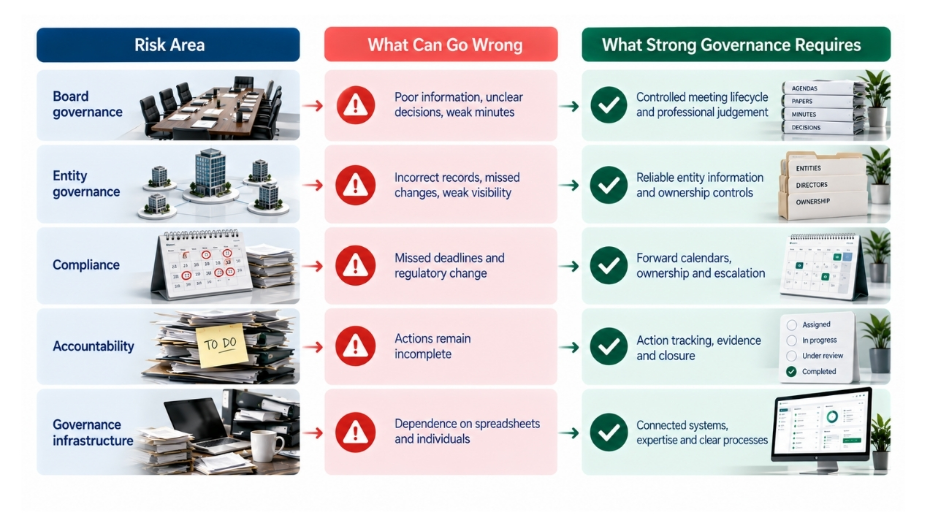
The common thread is connectivity.
Most risks become more dangerous when one part of governance operates separately from another.
Seven warning signs that hidden governance risk is building
1. Everything depends on one experienced person
The organisation may have expertise, but it does not yet have resilient infrastructure.
2. Different systems contain different versions of the truth
Entity, director and ownership information should not require constant reconciliation.
3. Board actions repeatedly return overdue
This points to weak accountability rather than merely poor administration.
4. Compliance feels permanently urgent
Good forward planning should reduce last-minute governance.
5. Subsidiary issues reach headquarters only when they become serious
Group governance needs earlier visibility.
6. Regulatory updates are circulated but implementation is unclear
Awareness without ownership is not control.
7. Senior Company Secretary time is dominated by chasing and reconciliation
Professional judgement is being consumed by weak infrastructure.
Several of these warning signs together suggest that the organisation has moved beyond a workload problem.
It has a governance operating-model problem.
What should good governance infrastructure remove from the Company Secretary’s day?
A strong operating model should not remove judgement. It should remove avoidable friction.
This is the real business case for better governance infrastructure.
It does not make the Company Secretary less important.
It makes professional expertise more valuable.
Why CoSec Hub was built around these risks
Many governance products begin with a software problem.
CoSec Hub begins with the operating problem faced by Company Secretaries.
Modern governance teams need technology, but they also need professional expertise and operational support.
The CoSec Hub technology layer can support:
- Entity Management
- Compliance Calendars
- Governance Forward Planning
- Board Management
- Contract Management
- Statutory Registers
- Board Action Tracking
- Meeting Lifecycle Management
Alongside the technology, the Governance Knowledge Centre provides access to:
- Chartered Company Secretary expertise
- Governance operations support
- Compliance monitoring
- Board administration
- Governance intelligence
- Multi-jurisdiction governance support
- Governance advisory
Together, they form a Technology-Enabled Company Secretary Retainer Service.
The model is designed to address the central tension explored throughout this article.
Technology should control routine governance more reliably, while experienced Company Secretaries should concentrate on issues requiring judgement.
That is the difference between digitising administration and strengthening governance infrastructure.
Explore: CoSec Hub
A practical Company Secretary risk health check
Boards, General Counsel and Company Secretaries can test their existing model by asking:
- Can we identify every material compliance obligation due during the next 90 days?
- Is our entity information consistent across the organisation?
- Can we see every material outstanding board action?
- Are director conflicts documented and managed consistently?
- Can we establish who had authority for a significant decision?
- Do we know whether directors and PSCs have met relevant identity verification requirements?
- Can headquarters see material subsidiary governance issues?
- Are regulatory changes converted into accountable implementation plans?
- Would governance continue reliably if a key person became unavailable?
- Are governance professionals spending more time advising than chasing?
The answers are more valuable than a generic governance checklist.
They reveal whether the organisation is genuinely in control or whether experienced professionals are compensating for structural weaknesses.
The Lumorus View
The hidden risk facing Company Secretaries is not that they will forget how to govern. It is that organisations increasingly depend on them to compensate for governance infrastructure that has not kept pace with complexity.
That distinction matters.
Professional excellence can keep weak systems functioning for years. Deadlines are rescued, board papers are improved, conflicts are noticed, actions are chased and corporate records are reconciled.
From the outside, everything appears controlled.
However, resilience should not depend on professional heroics.
The stronger operating model uses systems to manage what can be standardised while allowing experienced Company Secretaries to focus on judgement, challenge, board effectiveness and emerging risk.
That means:
- Technology for visibility
- Processes for consistency
- Data for evidence
- Accountability for delivery
- Company Secretary expertise for judgement
Governance is strongest when professionals are supported by infrastructure rather than forced to substitute for it.
The Bottom Line
The Company Secretary function sits closer to organisational risk than many boards realise.
A missed filing can become a regulatory problem, while an incomplete board record can become an evidence problem. An unmanaged conflict can become a decision-integrity problem, outdated entity data can affect transactions and weak subsidiary visibility can create group risk.
Poor action tracking can also allow important board decisions to remain unimplemented.
Meanwhile, regulatory reform is increasing expectations around corporate information, director identity, controls and governance evidence. Companies House now operates with stronger powers, while Provision 29 of the UK Corporate Governance Code has increased the importance of evidence supporting board assessments of material controls.
At the same time, governance professionals are carrying greater workloads and broader responsibilities.
The answer cannot simply be more effort.
Company Secretaries need operating models capable of supporting the responsibility they already carry. That requires reliable information, connected technology, clear accountability, forward planning and professional governance judgement.
The greatest hidden governance risk is not the issue the Company Secretary notices. It is the issue the organisation only notices because the Company Secretary was not there to catch it.
Continue Exploring
- Strengthen governance across your organisation: Corporate Governance Support
- Build stronger statutory and regulatory controls: Statutory & Regulatory Compliance
- Improve board and shareholder governance: Board & Shareholder Meetings
- Build the right governance structure from the outset: Company Formation & Structuring
- Add scalable Company Secretary capacity: Company Secretary Outsourcing
- Strengthen governance reporting: Annual Report Services
- Create stronger board records: Minute Taking Solutions
- Connect technology with Company Secretary expertise: CoSec Hub
About CoSec Hub
CoSec Hub is the Company Secretary Command Centre.
Built by Company Secretaries for Company Secretaries, CoSec Hub combines governance technology with Chartered Company Secretary expertise to help organisations manage entity governance, compliance, board administration and governance operations more systematically.
Through CoSec Hub and the Governance Knowledge Centre, organisations can access a Technology-Enabled Company Secretary Retainer Service that connects:
- Governance technology
- Chartered Company Secretary expertise
- Entity management
- Compliance monitoring
- Governance forward planning
- Board administration
- Statutory registers
- Board action tracking
- Governance intelligence
- Multi-jurisdiction support
- Governance advisory
The objective is not to replace professional Company Secretary judgement. It is to remove the fragmented administration that prevents professionals from using enough of it.
Not software alone. Not outsourcing alone. Governance infrastructure.
Lumorus: Better Business, Built on Purpose
Lumorus is a UK headquartered global governance, ESG, Company Secretary and advisory firm supporting organisations across Europe, Africa, Asia, the Caribbean, Canada, the Middle East and international markets.
We help boards and leadership teams strengthen governance infrastructure, accountability and organisational resilience as regulatory expectations and corporate complexity continue to grow.
Our Company Secretary capabilities include:
For organisations seeking a more connected operating model, CoSec Hub combines governance technology, operational support and professional Company Secretary expertise.
How much governance risk is your Company Secretary quietly preventing every day, and how much of that protection would remain if the individual was suddenly unavailable?
That is the question boards should ask before a hidden risk becomes a visible failure.
Explore Lumorus and CoSec Hub to strengthen the infrastructure behind your governance function.
Lumorus: Better Business, Built on Purpose.
Sources
- Chartered Governance Institute UK & Ireland: Governance Market Survey 2026 – Research based on 971 governance professionals examining rising influence, board decision support, AI literacy, workload and governance-team resourcing.
- Diligent: Global State of Legal Entity Compliance 2026 – Research examining governance workload, compliance near misses, legacy systems and changing Company Secretary operating models.
- Financial Reporting Council: UK Corporate Governance Code 2024 – Current UK framework covering board leadership, responsibilities, governance outcomes, risk management and material internal controls.
- Financial Reporting Council: Corporate Governance Code Guidance – Guidance supporting effective board information, governance processes and implementation of the Code.
- Financial Reporting Council: Provision 29 Mythbuster – Explanation of board responsibilities concerning material controls and evidence supporting the board’s effectiveness declaration.
- Companies House: Role and Powers of the Registrar – Explanation of enhanced Companies House powers under the Economic Crime and Corporate Transparency Act 2023.
- Companies House: Identity Verification Requirements – Current guidance covering directors and people with significant control.
- Companies House: ECCTA Transition Plan – Implementation guidance covering the continuing transformation of Companies House and new corporate responsibilities.
- Companies House: Accounts Filing Reform – Update on planned accounts-filing changes from April 2028.