A board meeting is often decided before the first director arrives.
Most discussions about board effectiveness begin with the people around the table.
Do directors have the right skills? Is the Chair effective? Does management receive enough challenge? Are independent directors genuinely independent?
All of these questions matter.
Yet they overlook something fundamental.
A board can contain highly experienced directors and still make poor decisions if the meeting has been badly designed. The wrong issues reach the agenda, papers arrive late, routine reporting consumes the best part of the meeting and significant decisions appear after directors have already spent two hours reviewing historic performance.
By the time everyone enters the boardroom, much of the governance architecture has already been constructed.
Someone helped determine what would be discussed, influenced the sequence or coordinated the papers, surfaced conflicts, identified decision requirements, tracked outstanding actions and preserved the record of earlier decisions.
In well-governed organisations, that person is often the Company Secretary.
This is why the traditional image of the Company Secretary as principally the minute taker has become increasingly misleading. The Chartered Governance Institute UK & Ireland’s Governance Market Survey 2026 found that 65% of governance professionals believe the influence of the governance function is increasing, while 66% said supporting board information quality and decision making is becoming more important.
The Financial Reporting Council’s current Corporate Governance Code Guidance reinforces that wider role. It places responsibility on the Company Secretary for advising the board on governance matters, supporting the Chair, facilitating information flows and helping the board and its committees function efficiently. It also states that the Chair and Company Secretary should periodically review whether board and governance processes remain fit for purpose.
That is not minute taking.
It is board architecture.
The most effective Company Secretaries increasingly help shape the conditions under which directors exercise judgement. Agenda design, information quality, sequencing, challenge, minutes, actions and institutional memory all form part of that work.
Board effectiveness is therefore not created only inside the meeting. A significant part of it is designed beforehand.
Explore Lumorus Board & Shareholder Meetings
Executive Takeaway
The Company Secretary’s contribution to board effectiveness extends across the entire decision lifecycle.
Before the meeting, the role can help determine whether the right issues reach the board, whether the agenda reflects strategic priorities and whether directors receive decision-ready information.
During the meeting, effective governance support helps preserve clarity over decisions, conflicts, challenge and next steps without interfering with the Chair’s leadership or directors’ responsibilities.
Afterwards, minutes, actions and institutional records help ensure that decisions survive beyond the discussion that produced them.
The real operating model looks more like this:
Issue → Agenda → Information → Challenge → Decision → Record → Action → Evidence → Follow-up
Every stage can strengthen or weaken the next.
Seen this way, the Company Secretary is not simply administering meetings.
The role is helping design the decision system around the board.
The agenda is one of the most powerful governance documents nobody talks about
A board agenda looks procedural.
It is anything but neutral.
What appears on it receives board attention.
What does not appear may remain within management.
Sequence determines when directors engage with each subject, while the time allocated reveals which matters the organisation believes deserve serious discussion.
Recent research underlines the problem. Board Intelligence reported in 2026 that only 44% of directors in its research spent more than half their board meeting time looking forward, while more than a third described their boards as predominantly focused on historic actions and performance.
The agenda therefore deserves much more strategic attention.
A board meeting that opens with extensive routine administration, committee reporting and backward-looking performance updates may leave its most important strategic decision until directors are tired and time is disappearing.
Nothing in the formal governance structure has failed.
Yet the design of the meeting has.
A stronger approach places the highest-value discussions where directors have the greatest attention and sufficient time to explore alternatives.
That means asking:
- Which decisions genuinely require board judgement?
- Which issues are strategically important now?
- What can be handled through committees?
- Which reports could be circulated for information?
- Where is management seeking advice rather than approval?
- Which emerging issue needs discussion before it becomes urgent?
The Company Secretary, working closely with the Chair and Chief Executive, is ideally positioned to ask these questions.
Agenda management should not mean fitting everything into the meeting. It should mean protecting the board from spending its finite attention on the wrong things.
Sequencing decisions is a governance discipline
The order of board business can affect the quality of the conversation.
Strategic decisions require concentration. Difficult succession discussions need enough time and confidentiality, while major investment proposals may require directors to absorb uncertainty rather than rush towards closure.
Consequently, sequencing should reflect the cognitive demands of each issue.
A significant acquisition should not be squeezed between routine committee updates and lunch simply because that is where a space appeared on the agenda.
Likewise, a serious culture issue should not automatically sit under any other business because it arose after the initial agenda was drafted.
Strong sequencing also allows related matters to build logically. Directors may need a market update before debating strategy or a risk discussion before approving a major investment.
The Company Secretary can help the Chair design this flow.
Board Intelligence’s 2026 agenda guidance makes a similar point: strategic and decision-led items should generally appear early, while routine updates and approvals should follow rather than lead.
This is a subtle form of governance influence.
The Company Secretary does not decide the outcome.
The role helps create conditions in which directors have a better opportunity to reach a considered outcome.
Good board papers begin before anybody starts writing
Many organisations try to improve board papers through templates.
A new cover sheet is introduced.
Page limits appear.
Writers are told to be concise.
Sometimes that helps.
Often, the deeper problem lies earlier.
The author was never properly briefed about what the board needs from the paper.
Research from Board Intelligence suggests the difference can be substantial. Where report writers receive structured briefs, 64% of directors rated their packs as good or excellent, compared with only 12% where structured briefs were absent.
That finding should change how Company Secretaries think about board reporting.
The governance function should not wait until a finished paper arrives before becoming involved.
A better process begins by clarifying:
- Why the issue is going to the board
- What directors are being asked to do
- Which evidence they need
- What alternatives should be considered
- Which assumptions matter
- Which risks need to be surfaced
- How the issue connects with strategy
Once those questions are clear, writing becomes much easier.
This is another example of the role moving upstream.
The strongest Company Secretary does not simply improve the document. The role improves the thinking that produces the document.
Information quality is now part of board effectiveness
The FRC’s guidance is explicit that non-executive directors need timely, high-quality information sufficiently in advance to allow proper consideration, challenge and debate. Board papers should be accurate, clear, current and explicit about what directors are expected to do.
Yet many boards are struggling with information volume.
Board Intelligence found that the average board pack among the largest organisations in its sample had reached 294 pages, rising to almost 600 pages a month when committee packs were included.
That does not necessarily mean organisations are becoming more transparent.
It may mean they are becoming less disciplined about materiality.
Directors need enough information to discharge their responsibilities, but more information can make the significant issue harder to find.
The Company Secretary can help establish a different standard.
Rather than asking whether every relevant fact has been included, board reporting should ask whether the information helps directors understand:
What changed?
Why does it matter?
Which assumptions drive the conclusion?
What judgement is required?
What could cause management to change course?
This shifts the board pack away from information accumulation and towards decision support.
Read more about Lumorus Corporate Governance Support
The Company Secretary should be the quality gate, not the formatting desk
In many organisations, governance teams enter the paper process too late.
Management prepares the recommendation, frames the issue, decides what evidence to include and submits the paper shortly before the deadline.
The Company Secretary then checks formatting and distributes it.
At that point, the most important decisions about information quality have already been made.
A genuinely strategic Company Secretary function needs sufficient authority to challenge papers earlier.
That might involve asking why a recommendation lacks credible alternatives, whether the risk section is meaningful, whether assumptions are visible or whether the issue actually belongs at board level.
This does not give the governance function ownership of management’s recommendation.
Nor should Company Secretaries become shadow executives rewriting business cases.
Their purpose is to protect the quality of the governance process.
A useful distinction is:
Management owns the recommendation.
The board owns the decision.
The Company Secretary helps protect the process connecting the two.
That is decision architecture.
Board challenge is partly designed before directors begin speaking
Challenge is often treated as a personality issue.
Does the board contain strong independent directors?
Does the Chair invite dissent?
Are executives open to questioning?
Those behaviours matter, but information design can make challenge easier or harder.
A board paper containing one recommendation, no alternatives and assumptions hidden inside detailed modelling narrows the conversation before directors have spoken.
Conversely, a paper that presents the recommendation, significant assumptions, competing options and material uncertainties invites more useful challenge.
Board Intelligence’s work on decision papers argues that robust decision making depends not simply on analysis but on the process through which the decision is reached.
That insight matters for Company Secretaries.
Effective challenge does not begin when the Chair asks whether anybody has questions.
It starts much earlier, when the governance process determines what directors are able to see.
The Company Secretary should know when something important is missing
Board governance is partly about what appears in the papers.
It is equally about what does not.
Perhaps a major recommendation contains financial analysis but no meaningful stakeholder implications.
A proposed acquisition may explain upside thoroughly while giving minimal attention to integration risk.
Another paper could describe several strategic options without explaining why one alternative was ruled out early.
These omissions may be innocent.
They can still shape the decision.
The Company Secretary is not expected to possess management’s technical expertise. However, familiarity with governance allows the role to identify when the decision architecture feels incomplete.
Useful questions include:
- Has the board seen the downside?
- Where are the alternatives?
- Which assumptions matter most?
- Are relevant conflicts visible?
- Does the board need independent advice?
- Have directors’ duties been considered?
- What happens if the recommendation fails?
- How will the board know whether the decision worked?
These questions do not determine the answer.
They improve the board’s ability to reach one.
Meeting time should follow importance, not habit
Boards can become prisoners of recurring agendas.
Finance receives 30 minutes because it always has.
Each committee chair provides a verbal update.
Operational performance consumes an hour.
Strategy receives whatever remains.
Over time, recurring reporting becomes institutionalised regardless of whether it still represents the best use of board time.
This deserves challenge because board attention is scarce.
Board Intelligence’s 2026 Board Value Index found that 86% of directors surveyed said rigid or inconsistent decision-making processes had contributed to a delayed, rushed or poor decision during the previous six months.
Board effectiveness therefore requires more than completing the agenda.
It requires allocating time deliberately.
The Company Secretary can help the Chair analyse how board time is actually being used and whether that pattern reflects strategic priorities.
If digital transformation is one of the organisation’s three largest strategic risks, yet the board spends ten minutes on it every quarter, the agenda is communicating something different from the strategy.
Board time is capital. Good governance allocates it deliberately.
The Chair and Company Secretary form a critical governance partnership
The Chair remains responsible for leading the board.
That should be clear.
However, the effectiveness of that leadership often depends heavily on the Company Secretary.
The FRC recognises this relationship directly, noting that assisting the Chair in developing and implementing processes supporting effective board functioning is a core part of the Company Secretary’s role.
The strongest partnership combines different forms of awareness.
A Chair sees the dynamics around the table.
The Company Secretary sees the governance system around the table.
Together, they can identify whether:
- Papers are deteriorating
- Management reporting is too detailed
- Directors need more development
- Agenda time is misallocated
- Committee boundaries are creating duplication
- Decisions are being revisited without closure
- Actions repeatedly remain overdue
- The board is drifting into management
These observations can be difficult to capture through formal processes alone.
Trust between the Chair and Company Secretary therefore becomes a governance asset.
Minutes should record judgement, not recreate the meeting
Minute taking remains a core Company Secretary responsibility.
That does not make it clerical.
A good minute needs judgement.
It must preserve enough information to show what the board considered, where significant challenge occurred, what was decided and what actions followed, without turning the meeting into a transcript.
The challenge becomes greater as board issues become more complex.
A major acquisition may involve extensive discussion.
An executive succession matter may be highly sensitive.
A regulatory concern could require careful treatment.
Strong minutes preserve the substance without obscuring the decision beneath narrative.
The Company Secretary therefore performs an important act of institutional interpretation.
What matters enough to preserve?
What constitutes material challenge?
How should dissent be reflected?
Which conditions formed part of the approval?
What action did the board actually agree?
The minute becomes part of the organisation’s institutional memory.
Its quality matters long after everyone has left the room.
Explore Lumorus Minute Taking Solutions
The Company Secretary can help the board know when a conversation is actually finished
Meetings frequently produce apparent agreement without precise closure.
Directors discuss an issue.
Several views emerge.
The Chair moves to the next item.
Later, management and governance teams discover that different people left the room believing different things had been decided.
This is avoidable.
CGI’s governance discussions have highlighted the practical value of the Company Secretary helping to crystallise what has been agreed at the end of significant conversations, particularly where the Chair has not already done so explicitly.
A simple intervention can ask:
What exactly has the board decided?
Who owns the next action?
By when?
Does anything return to the board?
Those questions turn discussion into governance.
Without closure, minutes become harder to draft, actions become ambiguous and accountability begins to weaken immediately.
A decision is not complete when the meeting ends
Board effectiveness is often measured inside the meeting.
That is too narrow.
A brilliant discussion followed by weak execution is still weak governance.
Actions need named owners, deadlines and appropriate follow-up. Significant conditions attached to approvals also need to remain visible.
The Company Secretary can help create a disciplined chain from board decision to organisational execution.
For important matters, the record should show:
Decision → Owner → Deadline → Evidence → Escalation → Closure
Routine actions do not all need board-level attention.
However, material actions should not disappear into individual inboxes once the meeting ends.
Where a regulatory remediation item remains outstanding or a major strategic condition has not been delivered, directors need visibility.
The board should not have to rediscover its own decisions several meetings later.
Action tracking is an accountability mechanism, not an administrative list
Many organisations maintain board action logs.
That is useful.
The quality of governance depends on what happens when actions become overdue.
Some delays are trivial.
Others may signal management failure, inadequate resources or emerging control weaknesses.
A simple red status does not explain which is which.
The Company Secretary can help establish escalation rules so the board’s attention focuses on material exceptions rather than routine administration.
This creates a stronger model:
Routine progress stays with management.
Material slippage reaches the Chair or committee.
Significant failure returns to the board.
Professional judgement sits between the system and the escalation.
Technology can track deadlines.
Governance determines significance.
That distinction is central to the evolving Company Secretary role.
Institutional memory protects boards from repeating themselves
Directors change.
Executives leave.
Businesses restructure.
Years later, a board may revisit an issue without anybody remembering why the original decision was made.
The Company Secretary often provides continuity across these changes.
Minutes are part of that memory, but institutional memory involves more than finding an old document.
It requires connecting the context behind decisions.
Why was the committee created?
What assumptions drove the acquisition?
Which concerns influenced the board’s original approval?
Why was a particular authority delegated?
What commitments were made to investors or regulators?
Without accessible institutional memory, boards can unknowingly repeat debates or reverse decisions without understanding their original rationale.
A strong governance environment therefore connects past decisions with current judgement.
That capability becomes especially valuable during succession, transactions and periods of crisis.
Board evaluation should examine the decision architecture
Board evaluations often focus on composition, relationships, skills and individual contribution.
Those remain important.
However, the machinery around the board deserves equal attention.
The FRC identifies board information, meeting processes and the quality of discussions as relevant areas for board performance review.
A deeper evaluation should therefore ask:
- Does the agenda reflect strategic priorities?
- Are the most important decisions receiving enough time?
- Do papers support challenge?
- Are directors seeing the right information?
- Does the board understand what is being asked of it?
- Are decisions closed clearly?
- Do actions receive appropriate follow-up?
- Are committee discussions reaching the main board effectively?
- Has feedback from previous evaluations changed the operating model?
These questions turn evaluation from a review of board personalities into a review of board performance.
Explore Lumorus Board Evaluation and Assessment
The Company Secretary sits at the intersection few other roles can see
A governance professional has a unique vantage point.
The Chair sees board leadership.
The CEO sees organisational execution.
Committee Chairs understand their specific areas.
Executives understand their functions.
The Company Secretary moves across all of them.
That creates visibility over patterns that individual participants may miss.
A recurring reporting problem may affect several committees.
One executive may repeatedly submit papers late.
Important board actions might remain open across multiple meetings.
Directors may repeatedly request information that management never incorporates into regular reporting.
These patterns matter.
They reveal weaknesses in the governance system rather than isolated incidents.
The Company Secretary can therefore become an important source of organisational intelligence for the Chair and board.
CGI’s September 2026 work on board effectiveness similarly identifies the Company Secretary as occupying a distinctive position at the intersection of the Chair, board, organisation and wider governance environment.
That positioning should be used deliberately.
The role should influence process without owning the board’s judgement
There is an important boundary.
Calling the Company Secretary a decision architect does not mean the role should decide for directors.
The Chair leads the board.
Directors exercise judgement.
Management develops recommendations and implements decisions.
A Company Secretary should not become a hidden executive authority sitting between them.
The contribution is structural.
It is about ensuring that:
- The right issues reach directors
- Information supports meaningful challenge
- Decision rights remain clear
- Conflicts are addressed
- Meetings reach clear conclusions
- Actions remain visible
- The institutional record is reliable
This is influence through governance design rather than executive decision making.
The distinction protects both board accountability and the legitimacy of the Company Secretary role.
Technology should strengthen the architecture, not automate judgement away
Board technology continues to improve.
Portals can distribute papers, track actions, manage meeting calendars and preserve records.
AI can now summarise documents, identify recurring themes and assist with drafting.
These tools can create considerable value.
However, the objective should be to reduce administrative friction rather than automate the professional judgement around board effectiveness.
Software can show that a paper is late.
It cannot always determine whether the paper is decision ready.
Technology can record an action.
It may not know whether the delay is significant enough to concern the Chair.
AI can summarise a discussion.
It cannot take responsibility for whether the final minute captures the governance substance fairly.
This is why the future Company Secretary operating model should combine infrastructure with expertise.
Routine work becomes more systematic.
Professional time moves towards judgement.
The more technology handles governance administration, the more valuable the Company Secretary’s decision-architecture role should become.
What the Company Secretary actually designs around a board decision
A useful way to understand the role is to examine the full decision lifecycle.
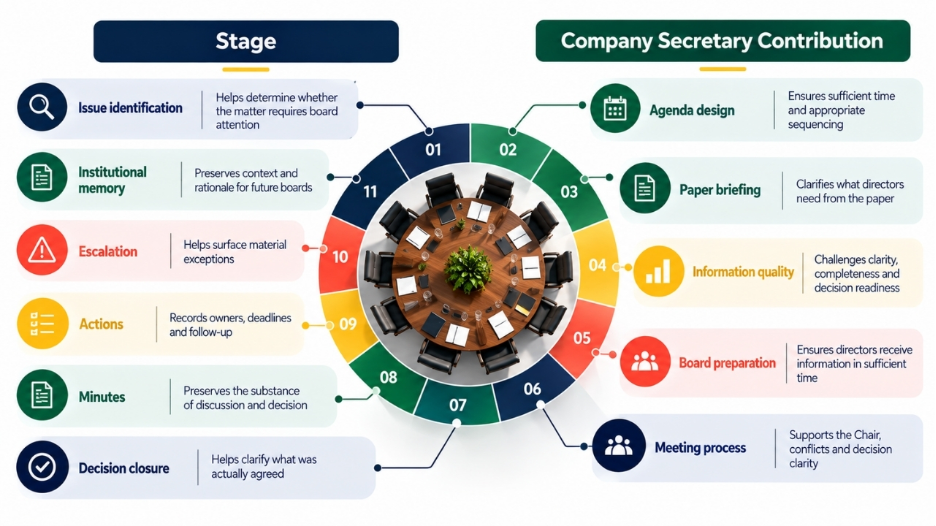
Seen as a whole, the role looks very different from minute taking.
Minutes are one stage in a much larger governance system.
Seven signs the Company Secretary is being used as an administrator rather than a decision architect
Several symptoms are revealing.
First, the governance team sees papers only when they are ready for distribution. By then, meaningful challenge of information quality is almost impossible.
Second, the agenda is built around recurring reports rather than current board priorities. Habit has replaced design.
Third, major decisions arrive late. Directors have insufficient time to prepare, which weakens challenge before discussion begins.
Fourth, the Company Secretary records actions but lacks a clear escalation route when material items remain overdue. Administration exists without accountability.
Fifth, minutes capture discussion but management and directors regularly disagree about what was actually decided. Decision closure needs strengthening.
Sixth, board evaluations repeatedly identify the same process problems. Feedback exists, but governance architecture is not changing.
Finally, experienced governance professionals spend most of their time formatting, chasing and compiling. Professional capacity is being consumed at the least valuable end of the process.
Where several of these patterns appear together, the organisation does not simply need a more efficient board administrator.
It needs to redesign how the Company Secretary function contributes to board effectiveness.
A Board Decision Architecture Health Check
Chairs, Company Secretaries and governance leaders should ask:
- Does our board agenda reflect the organisation’s most important strategic priorities?
- Are major decisions scheduled when directors have sufficient time and attention?
- Do paper writers receive a clear brief before drafting begins?
- Can the governance team challenge whether a paper is ready for the board?
- Do directors understand quickly what they are being asked to decide?
- Are significant assumptions and alternatives visible?
- Does the board spend more time debating than receiving presentations?
- Are decisions summarised clearly before moving to the next item?
- Do minutes preserve the substance without becoming transcripts?
- Does every material action have an accountable owner?
- Can overdue actions be escalated appropriately?
- Could a new director understand why a major decision was made two years ago?
Weak answers across several areas indicate more than a meeting-process problem.
They suggest the architecture around board decision making requires attention.
Board effectiveness starts before the boardroom
The Lumorus Board Health Check provides a practical way for Chairs, boards and Company Secretaries to examine whether the wider governance environment is supporting effective decision making.
A useful assessment should not look only at whether directors possess the right skills.
It should also consider whether the board receives the right information, whether challenge is effective, whether accountability is clear and whether board processes support rather than obstruct judgement.
That distinction matters because a board can look strong on paper while operating through weak processes.
Excellent directors cannot compensate indefinitely for:
- Poor agendas
- Late information
- Weak papers
- Unclear decisions
- Inadequate follow-up
- Repeated governance friction
Where a diagnostic identifies deeper concerns, organisations can move towards a more detailed Governance Review, Board Evaluation and Assessment or Board Skills Audit.
The board should not wait for a poor decision to discover that the decision-making process was weak.
Take the Lumorus Board Health Check
Why CoSec Hub matters to the decision architecture
Modern Company Secretaries are being asked to contribute more strategically while governance administration continues to grow.
That creates an operating-model problem.
If experienced professionals spend large amounts of time searching for documents, managing recurring calendars, tracking actions manually and reconstructing earlier decisions, they have less capacity to improve how boards operate.
CoSec Hub is built around a different principle.
Governance infrastructure should handle more of the repeatable work so Company Secretaries can focus on the points where professional judgement creates greater value.
The technology layer can support areas such as governance forward planning, board management, meeting lifecycle management, board action tracking, entity information, compliance calendars and statutory records.
Alongside that infrastructure, the Governance Knowledge Centre provides access to Chartered Company Secretary expertise, governance operations support and advisory capability.
The connection matters.
Technology can remind the organisation that a meeting is approaching.
A professional determines what the board should discuss.
Software can show that a paper is outstanding.
A Company Secretary helps judge whether the paper is fit for board consideration.
The system can track an action.
Professional judgement determines whether delay has become a governance issue.
Better technology should therefore create more room for decision architecture, not simply enable governance teams to administer more meetings.
The Lumorus View
The Company Secretary’s real contribution to board effectiveness is not what happens after directors have spoken. It begins much earlier, in shaping the conditions under which they are able to think.
An effective board needs capable directors.
It also needs an agenda that reflects what matters, papers that expose the real decision, sufficient time for debate and a process that turns discussion into clear accountability.
Minutes then preserve what occurred.
Actions ensure that decisions travel into the organisation.
Institutional memory allows future directors to understand why earlier boards acted as they did.
The Company Secretary sits across this entire chain.
That is why defining the role principally through minute taking fundamentally understates its value.
A good minute taker records the meeting.
A good governance professional helps make the meeting worth recording.
The distinction is substantial.
This does not require the Company Secretary to become more powerful than the board or management. It requires the organisation to recognise where governance expertise adds value.
The role should have enough standing to challenge weak papers, enough access to work effectively with the Chair and enough infrastructure to avoid wasting scarce professional capacity on tasks that technology can perform.
The strongest Company Secretaries do not tell boards what to decide. They help create a system in which directors have a better chance of making the right decision.
The Bottom Line
The Company Secretary profession is evolving because board governance is becoming more demanding.
The CGI Governance Market Survey 2026 found 65% of governance professionals reporting increasing influence and 66% identifying board information quality and decision making as a growing responsibility.
CGI’s Effective Board Reporting work also highlights a persistent problem: board packs can become barriers to effective discussion when they are dominated by excessive, backward-looking and inward-looking information.
Meanwhile, Board Intelligence’s 2026 research suggests that board process itself remains a significant constraint. Its Board Value Index found 86% of directors saying rigid or inconsistent decision processes had contributed to delayed, rushed or poor decisions during the previous six months.
The FRC’s current guidance provides the institutional foundation. It places the Company Secretary directly within board support, information flow and the periodic improvement of governance processes.
Taken together, these developments point towards a more useful description of the modern role.
The Company Secretary helps design:
- What reaches the board
- When directors consider it
- What information accompanies it
- How decisions are framed
- How challenge is enabled
- What is recorded
- Who acts
- How progress is monitored
- What the institution remembers
That is not administration around the edges of board effectiveness.
It is part of the infrastructure that makes board effectiveness possible.
Board effectiveness does not begin when the Chair opens the meeting. It begins when the organisation decides what deserves the board’s attention, what directors need to know and how their judgement will be turned into accountable action.
That is why the Company Secretary’s real role is moving from minute taker to decision architect.
Continue Exploring
About CoSec Hub
CoSec Hub is the Company Secretary Command Centre, built by Company Secretaries for Company Secretaries.
The platform and Governance Knowledge Centre are designed around the changing role of the profession.
Instead of requiring experienced Company Secretaries to manually connect governance calendars, entity records, board workflows, actions and institutional information, CoSec Hub can bring those activities into a more connected environment.
Technology provides structure and visibility.
Professional Company Secretary expertise provides judgement.
That combination matters because the future of board support is not simply about running more efficient meetings. It is about creating a better decision environment around the board.
Automate the routine. Strengthen the judgement. Improve the decision architecture.
Lumorus: Better Business, Built on Purpose
Lumorus is a UK headquartered global governance, ESG, Company Secretary and advisory firm supporting organisations across Europe, Africa, Asia, the Caribbean, Canada, the Middle East and international markets.
We help boards and governance teams strengthen the structures through which information, challenge, decisions and accountability operate.
Our capabilities include Board & Shareholder Meetings, Corporate Governance Support, Board Evaluation & Assessment, Governance Review and Minute Taking Solutions.
For governance functions seeking a more connected operating model, CoSec Hub combines governance infrastructure with professional Company Secretary expertise.
A useful question for every Chair is simple:
If your Company Secretary disappeared from the meeting process until five minutes before the board pack was distributed, would the board receive exactly the same agenda, information and decision structure?
If the answer is yes, the organisation may be using a potentially strategic governance role far too late in the process.
Take the Lumorus Board Health Check or explore Lumorus to strengthen the architecture behind better board decisions.
Lumorus: Better Business, Built on Purpose.
Sources
Chartered Governance Institute UK & Ireland: Governance Market Survey 2026
Research based on 971 governance professionals showing the increasing strategic influence of governance functions and the growing importance of supporting board information quality and decision making.
Read the CGI Governance Market Survey 2026
Chartered Governance Institute UK & Ireland: Effective Board Reporting
Research examining information overload, backward-looking board reporting and the difficulty directors face identifying the most important issues within large board packs.
Explore CGI Effective Board Reporting
Financial Reporting Council: Corporate Governance Code Guidance
Current FRC guidance covering the quality and timing of board information, board support and the responsibilities of the Company Secretary in enabling effective board functioning and information flows.
Read the FRC Corporate Governance Code Guidance
Board Intelligence: Board Value Index 2026
Research of more than 400 directors, CEOs and CFOs examining decision-making quality, board processes and the effect of rigid or inconsistent decision frameworks.
Read the Board Value Index findings
Board Intelligence: Board Meeting Agenda Design
2026 analysis explaining how agenda sequencing, strategic focus and time allocation affect the quality of board discussion and decision making.
Explore the Board Intelligence agenda guidance
Board Intelligence: State of Board Effectiveness
Research highlighting growth in board-pack length and the effect of excessive, poorly structured board information on director preparation and meeting quality.
Read the board effectiveness research
Board Intelligence: Better Board Papers Start With the Brief
Research illustrating the relationship between structured report briefs and directors’ assessment of board-pack quality.
Read the research on briefing board papers
Chartered Governance Institute UK & Ireland: Company Secretary and Board Effectiveness Research
Emerging 2026 research examining how Chairs shape board effectiveness and highlighting the Company Secretary’s position at the intersection of the Chair, board, organisation and wider governance environment.