The board pack may be one of the most important governance controls in an organisation. Too many companies still treat it as an administrative product.
Boards make decisions using the information placed in front of them.
That sounds obvious. Yet organisations routinely spend enormous effort recruiting experienced directors, building committees and designing governance frameworks while paying far less attention to the quality of the information on which those directors are expected to exercise judgement.
The result is familiar in many boardrooms.
Packs become longer.
Management reports accumulate.
Presentations repeat information already contained in papers.
Performance reporting looks backwards while strategic questions remain buried.
Important risks compete with operational detail for attention, and directors are expected to identify the few pages that genuinely matter inside hundreds of pages of information.
This is not simply inefficient.
It is a governance problem.
The Chartered Governance Institute UK & Ireland’s Governance Market Survey 2026 found that 66% of governance professionals believe supporting board information quality and decision making is becoming more important. The finding sits within a wider shift in which governance professionals are increasingly becoming trusted advisers to boards rather than simply administrators of board processes.
The Financial Reporting Council’s Corporate Governance Code Guidance is equally clear. Non-executive directors need timely, high-quality information far enough in advance to allow proper consideration, challenge and debate. Board papers should be accurate, clear, comprehensive, current and explicit about what directors are being asked to do.
Yet the deeper issue is not the board paper itself.
It is the architecture behind it.
What reaches the board tells directors what management believes matters.
What does not reach the board can matter just as much.
How information is framed affects which alternatives directors consider, which risks they notice and which assumptions they challenge.
Board information is therefore not simply communication. It is part of the governance system through which power and judgement operate.
That places the Company Secretary in a different role.
Not the distributor of papers.
The architect of board information.
Read More: Board & Shareholder Meetings
Executive Takeaway
Poor board information rarely fails because the organisation lacks data.
More often, the organisation has too much information and too little judgement about what directors actually need.
Common problems include:
- Board packs that grow every year
- Excessive operational detail
- Weak executive summaries
- Backward-looking management reporting
- Unclear decisions
- Poor distinction between information, discussion and approval items
- Recommendations presented without credible alternatives
- Risks hidden inside narrative
- Papers arriving too late for serious consideration
- Repeated information across reports and presentations
- Insufficient evidence behind important assumptions
- Few explicit links between strategy, risk and capital allocation
These weaknesses have consequences.
Directors spend time reading rather than thinking. Strategic debate gets crowded out, important assumptions receive insufficient challenge and management can unintentionally control the decision by controlling how the issue is framed.
The Company Secretary can help change that.
A stronger board information system should answer five questions quickly:
What does the board need to know?
Why does it matter now?
What judgement is required?
Alternatives exist?
And what happens next?
Everything else should support those answers.
The problem is not information scarcity. It is information design.
Boards now have access to more corporate information than any previous generation of directors.
Financial data can update continuously. Risk dashboards capture hundreds of metrics, while customer sentiment, employee information, sustainability performance, cyber indicators and market intelligence can all be delivered digitally.
Yet greater access has not necessarily produced better board decisions.
Information volume can create the opposite effect.
The Chartered Governance Institute’s research on effective board reporting notes that board packs can become a barrier rather than an aid to effective discussion. Packs are often dominated by inward-looking and backward-looking detail, while sheer volume makes it difficult for directors to absorb everything or identify the issues requiring greatest attention.
This distinction matters.
Boards do not need to know everything management knows.
They need enough information to discharge their responsibilities effectively.
Good board reporting therefore involves selection.
That makes materiality essential.
A governance team should be prepared to ask whether each paper helps directors understand performance, risk, strategy or a decision requiring their judgement.
If it does not, its place in the board pack should be questioned.
A board pack should not demonstrate how much information the organisation possesses. It should demonstrate how well the organisation understands what directors need.
1. Board packs have become too long because organisations confuse assurance with volume
Long board packs often feel safer.
Management can say the board was informed.
Every business unit has included its update.
Supporting information sits somewhere in the appendix.
Nothing important appears to have been omitted.
Yet volume does not necessarily create assurance.
It can obscure it.
A 400-page pack may technically contain an important warning, but that does not mean the board has been given a fair opportunity to identify and understand it.
Directors operate under time constraints. Even highly committed non-executives cannot absorb unlimited information before every meeting.
The FRC therefore emphasises the quality, timing and clarity of board papers rather than simply their completeness. Its guidance asks boards to examine the quality and timing of papers and presentations as part of board effectiveness, alongside the quality of discussions and the time allowed for major decisions.
The better question is not:
Did we include everything?
It is:
Did we make the material issues sufficiently visible?
That requires professional judgement.
2. A board paper should begin with the decision, not the history
Many board papers make directors work unnecessarily hard to discover why they are reading them.
Several pages of background appear before the actual issue.
Operational history comes first.
The recommendation appears near the end.
By then, the reader has spent considerable time absorbing information without knowing what judgement is required.
A stronger paper reverses the sequence.
Directors should understand early:
- Why the paper is before them
- What decision or discussion is required
- Management’s recommendation
- The principal reasons supporting it
- Material risks
- Credible alternatives
- Consequences of delay or rejection
Supporting analysis can follow.
This structure helps directors read with purpose.
The FRC Corporate Governance Code Guidance expressly states that papers should tell directors what is expected of them on the issue.
That sounds simple.
In practice, many papers still leave directors to infer whether they are being asked to note, discuss, challenge, endorse or approve.
Ambiguity at the beginning often produces weak discussion at the end.
3. Boards need insight, not another layer of management reporting
Management and boards perform different roles.
Their information should reflect that distinction.
Executives need detailed operational information because they run the business. Directors need sufficient depth to understand performance, challenge assumptions and oversee management without becoming another management team.
Problems arise when executive reporting simply travels upwards unchanged.
Monthly operational dashboards become committee reports.
Committee reports then become board papers.
The board receives enormous amounts of data but insufficient interpretation.
A useful board paper should therefore answer:
What does this information mean for the organisation?
A decline in customer retention matters.
The board needs to know why it is happening, whether management understands the cause, what strategic assumptions it challenges and what response is proposed.
A cyber metric deteriorating deserves attention.
Directors need the consequence, trend, control implications and escalation decision rather than an unexplained dashboard indicator.
Data describes. Insight interprets. Governance requires both, but the board creates value mainly through the second.
4. Backward-looking reporting can crowd out future judgement
Historical performance is essential.
Boards need to know whether financial, operational and strategic commitments have been delivered.
However, a board pack dominated by last month’s results can leave too little space for the decisions shaping the next three years.
This is one reason CGI’s board reporting research is so relevant. It identifies the tendency for board information to become inward-looking and backward-looking rather than focused sufficiently on the future.
Boards need a better balance between:
- What happened
- Why it happened
- What is changing
- What could happen next
- What management recommends doing about it
Forward-looking information may include emerging risks, competitive shifts, scenarios, strategic milestones, technological disruption, workforce capability and changing regulatory expectations.
The objective is not prediction.
It is preparedness.
A board that receives excellent historical reporting but inadequate forward insight may understand the business it used to have better than the business it is becoming.
5. Every board paper should distinguish information from judgement
One of the easiest ways to improve board packs is to distinguish between different types of agenda item.
A paper being presented for information requires a different level of attention from one involving a material decision.
Useful categories might include:
- For information
- For discussion
- For challenge
- For recommendation
- For approval
The terminology can vary.
Clarity should not.
This distinction allows directors to allocate attention more intelligently. It also helps Chairs plan agendas and prevents routine matters from consuming discussion time needed for significant decisions.
The Company Secretary should challenge unclear classifications.
A paper labelled for noting may contain a major emerging risk.
An item marked for discussion might effectively ask directors to approve a strategic change without saying so explicitly.
Good governance depends on decision rights being visible.
Agenda labels therefore carry more significance than they first appear to.
6. The recommendation should not make alternatives disappear
Management is expected to make recommendations.
Boards should not receive every issue as an entirely open-ended question.
However, a recommendation becomes weaker when the paper presents only the preferred option.
Directors need to know what credible alternatives management considered and why they were rejected.
Suppose a paper recommends acquiring a business.
The board may need to understand whether management considered organic investment, partnership, a different target or returning capital.
When entering a new market, directors may need to see why that market is preferable to alternatives.
If management recommends restructuring, the board should understand other viable approaches and the consequences of maintaining the status quo.
Alternatives improve challenge because they expose trade-offs.
Without them, directors can end up debating whether management’s answer is acceptable rather than whether it is the best available answer.
Good papers do not simply support a recommendation. They make the recommendation contestable.
7. Assumptions need to be visible enough to challenge
Major decisions are rarely based on facts alone.
They depend on assumptions.
Revenue will grow.
Customers will behave in a certain way.
Integration will take a particular amount of time.
Technology will deliver expected savings.
Regulation will remain manageable.
Financing will remain available.
The paper may contain detailed financial modelling while leaving these assumptions largely invisible.
That creates a governance problem because directors cannot challenge what has not been surfaced.
The FRC specifically states that boards should oversee the flow of information and ensure that the assumptions and models underlying that information are sufficiently clear to be understood and, where necessary, challenged.
This is particularly important as artificial intelligence increasingly enters corporate analysis.
A sophisticated model does not remove assumptions.
It can make them harder to see.
Board papers should therefore identify the assumptions capable of changing the decision.
8. Risk sections often list risks without improving judgement
Many board papers contain a risk section because the template requires one.
Too often it becomes a compliance exercise.
Regulatory risk.
Execution risk.
Financial risk.
Reputational risk.
The labels may be accurate yet provide little help to directors.
Useful risk information should explain:
- What could go wrong
- How material the consequence could be
- How likely management believes it is
- Which controls exist
- What residual exposure remains
- Whether the risk fits board appetite
- What would cause management to reconsider the proposal
The final question is particularly important.
Boards need to understand the conditions under which today’s decision would stop being sensible.
Risk reporting becomes more useful when it helps directors define boundaries rather than merely acknowledge uncertainty.
9. Paper quality should be treated as a management capability
Poor board papers are sometimes blamed on governance teams.
That misses the point.
Management owns much of the information provided to directors.
The governance function should establish standards, provide challenge and manage the process. Executives and business leaders remain responsible for producing analysis of sufficient quality.
This should therefore be treated as a leadership capability.
Executives need to know how to write for a board rather than for another executive.
The difference is substantial.
A strong board paper requires the author to understand:
- The board’s role
- Directors’ duties
- Materiality
- Strategic context
- Risk
- Stakeholder implications
- Decision rights
- The difference between explanation and persuasion
The Chartered Governance Institute’s guidance on section 172 recommends that those writing decision papers understand relevant directors’ duties and that board papers should be reviewed before entering the pack. It identifies the Company Secretary as the natural coordinator of that process.
That is an important governance discipline.
10. The Company Secretary should become the quality gate, not the formatting desk
This is where the role needs to evolve.
In weaker operating models, papers reach the Company Secretary shortly before publication.
The governance team corrects formatting, checks page numbers, combines PDFs and distributes the pack.
By then, the important governance decisions have already been made.
The recommendation has been framed.
Alternatives have either been included or omitted.
Risks have been described.
The decision request has been written.
A Company Secretary cannot improve board information strategically if the function enters the process only at the final administrative stage.
Earlier involvement allows better challenge.
The governance team can ask whether the issue belongs with the board, whether the purpose is clear, whether the paper contains enough evidence and whether directors’ duties or stakeholder considerations require additional treatment.
This does not mean rewriting management’s recommendation.
It means protecting the quality of the decision process.
The Company Secretary should not own management’s argument. The role should help ensure the board receives an argument worth challenging.
11. Late papers are not merely inconvenient
Board papers frequently arrive late because management is still refining them.
Urgency is sometimes unavoidable.
However, routine late submission should be treated as a governance weakness.
Directors need time to read, reflect, compare information and raise questions before the meeting.
The FRC guidance states that non-executive directors need information sufficiently in advance to enable thorough consideration and informed debate.
A paper sent the evening before a meeting may technically have reached the board.
That does not mean directors received a genuine opportunity to govern.
Repeated lateness can also indicate deeper problems:
- Weak management planning
- Unresolved executive disagreement
- Poor governance calendars
- Insufficient accountability for paper deadlines
- A culture that expects directors to absorb urgency created elsewhere
Chairs should support Company Secretaries in enforcing deadlines where possible.
Otherwise, the board process rewards poor preparation.
12. The board pack should show exceptions, not force directors to discover them
Directors should not need to search extensively to identify what has changed.
Exception reporting can improve this significantly.
Instead of reproducing the same detailed information every month, management can make movement visible.
What is off plan?
Which risks have increased?
What assumptions changed?
Which targets will be missed?
Where does management need board input?
What has become more uncertain?
This approach does not mean hiding stable information.
Supporting detail can remain available.
The difference is hierarchy.
Important changes appear first, while evidence sits behind them.
The Company Secretary can help build these principles into reporting templates and board expectations.
A good board pack should direct attention without predetermining judgement.
13. Dashboards are useful only when directors understand what they are looking at
Boards increasingly receive dashboards.
Colour can create the impression of clarity.
Green looks reassuring.
Amber suggests attention.
Red signals concern.
Yet dashboards are not inherently good governance.
A green indicator may conceal a deteriorating trend still inside tolerance.
An amber item may have remained unchanged for months.
Management can also select metrics that make performance appear healthier than alternative measures would.
Directors therefore need to understand:
- Why each metric matters
- What threshold creates each status
- Which trends sit beneath the headline
- Who determines the thresholds
- Whether management has changed measures
- Which indicators are forward looking
The dashboard should accelerate comprehension.
It should not substitute for explanation.
14. Technology can improve board information, but it can also multiply it
Board portals solved an important distribution problem.
Directors can access papers securely, annotate them and receive updated materials without carrying physical packs.
Technology has not necessarily solved the information problem.
Digital distribution can actually make adding material easier.
One more appendix carries almost no physical cost.
Another dashboard fits easily.
A 700-page digital board pack weighs exactly the same as a 50-page one.
That removes a natural constraint.
AI may intensify the problem further because management can generate analysis faster than directors can absorb it.
The future challenge will therefore not be information production.
It will be information curation.
The scarcer resource in the boardroom is increasingly not information. It is attention.
Governance should protect it.
15. AI should help compress information, not hide judgement
Artificial intelligence could materially improve board reporting.
It may help identify repetition, summarise large datasets, compare reports with previous periods or highlight changes and anomalies.
Used well, that can save professional time.
However, boards should be cautious about allowing AI-generated summaries to become another opaque layer between directors and the underlying evidence.
A summary inevitably prioritises some information over other information.
If the algorithm performs that prioritisation, someone should understand the basis on which it occurs.
Material recommendations still require accountable human judgement.
The Company Secretary should therefore treat AI as an information tool rather than an authority over what directors need to know.
Technology can assist curation.
Responsibility for board information remains human.
16. The Chair and Company Secretary should jointly own the information environment
The FRC places responsibility on the Chair for ensuring adequate discussion time and a timely flow of accurate, high-quality and clear information. It also gives the Company Secretary an important role in supporting the Chair and enabling efficient board operation.
Those responsibilities should work together.
The Chair understands how directors are using information.
The Company Secretary sees the reporting process across management, committees and the board.
Together, they can challenge:
- Excessive volume
- Recurring late papers
- Weak recommendations
- Poorly structured agendas
- Repetitive reports
- Missing strategic context
- Inadequate follow-up
This partnership matters because information quality cannot be fixed through templates alone.
Management behaviour changes when the Chair demonstrates that weak papers will not simply be accepted.
17. Board evaluation should test the information system, not merely director behaviour
Board evaluations often consider whether directors work well together.
That is important.
The information environment deserves equal scrutiny.
The FRC’s guidance specifically identifies the quality and timing of board papers, general management information and discussion around individual proposals as areas that may be considered during board performance reviews.
A meaningful review should therefore ask directors:
- Do papers identify the key issue quickly?
- Is there too much information?
- Are papers sufficiently forward looking?
- Do recommendations present realistic alternatives?
- Are assumptions visible?
- Does the board receive enough external information?
- Do committees duplicate material?
- Are difficult issues escalated early?
- Is information arriving in time?
- Has reporting improved after previous feedback?
This makes board evaluation more practical.
If every director complains about the pack but nothing changes, the evaluation process itself has failed to produce an outcome.
Explore More: Board Evaluation & Assessment
18. Committee reporting needs redesign too
Boards are not the only bodies suffering from information overload.
Audit, risk, remuneration, nomination and sustainability committees can each develop their own extensive reporting systems.
The problem then compounds.
Committees receive large packs, produce lengthy reports and feed additional information into the board.
Eventually, the board sees a summary of a summary without necessarily understanding the underlying judgement.
Committee reporting should therefore focus on:
- What the committee considered
- What it concluded
- What requires board attention
- Which issues remain unresolved
- Which recommendations require approval
- What assurance the committee can provide
A committee chair should not need to retell the entire meeting.
The board needs the governance consequence.
19. External information matters because management should not be the board’s only lens
Boards receive most of their information from management.
That is unavoidable and appropriate.
It should not be exclusive.
The FRC notes that boards may seek information from compliance, risk management, internal audit, external auditors and other internal or external sources where necessary.
Independent sources help directors test the management narrative.
Depending on the issue, boards may benefit from:
- Customer evidence
- Workforce information
- Investor feedback
- Regulatory insight
- External market data
- Internal audit
- Independent technical advice
- Site visits
- Direct exposure to senior leaders below executive level
This is especially important when management itself is deeply invested in a particular strategy.
A board cannot challenge effectively if every piece of information has passed through the same interpretive filter.
20. Better papers create better minutes
Board papers and minutes are often treated as separate governance products.
They are closely connected.
If the paper clearly explains the issue, recommendation, risks and alternatives, minutes can focus on discussion, challenge and the decision.
Weak papers create the opposite problem.
The minute taker may be forced to capture background information during the meeting because the paper did not contain it adequately.
This makes the record longer and potentially less clear.
A stronger governance chain looks like this:
Good paper → Better discussion → Clear decision → Focused minute → Trackable action
Each stage improves the next.
That is why board information quality should be treated as part of governance infrastructure rather than merely document quality.
Read More: Minute Taking Solutions
What a decision-ready board paper should contain
A strong paper does not require one rigid template for every issue.
However, material decision papers usually benefit from a consistent architecture.
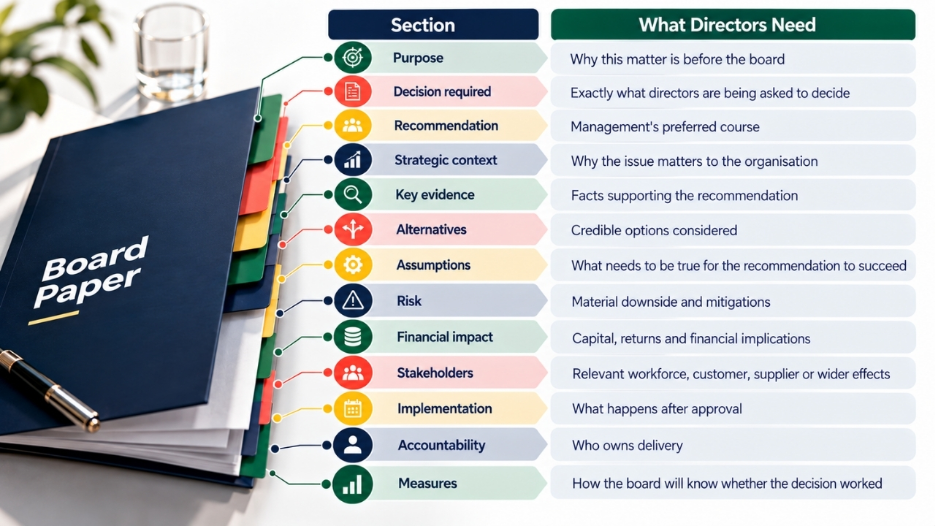
The format should support judgement rather than encourage box ticking.
A small decision may require only a few pages.
A major acquisition will require considerably more evidence.
Proportionality matters.
The board pack needs an information hierarchy
Not every page deserves equal attention.
An effective information hierarchy can separate:
Level One: Decision-critical information
Material issues requiring board judgement.
Level Two: Oversight information
Performance, risk and control information directors need to monitor.
Level Three: Supporting evidence
Detailed information available where directors wish to investigate further.
This structure can reduce clutter without reducing transparency.
Nothing material disappears.
Instead, information is organised around board responsibility.
Directors see the judgement first and evidence second.
That is more useful than treating every appendix as equally important.
Seven warning signs your board pack is weakening board effectiveness
1. The pack gets longer every year
Growing page counts often indicate that information is being added without anything being removed.
2. Directors frequently ask why an item is on the agenda
The purpose of papers and meetings is not sufficiently clear.
3. Important recommendations appear near the end of long papers
The structure prioritises background over judgement.
4. Reporting is dominated by historic performance
Strategic and forward-looking information may be insufficient.
5. Papers list risks without showing trade-offs
Risk disclosure has become descriptive rather than decision useful.
6. Directors receive significant papers shortly before meetings
The process is compromising their ability to prepare and challenge.
7. Management presentations repeat the papers
Valuable board time is being used to reproduce information directors should already understand.
Several of these symptoms together suggest that the organisation does not merely have a writing problem.
It has a board information architecture problem.
A Board Information Health Check
Chairs, Company Secretaries and governance teams should ask:
- Can directors identify the purpose of every major paper quickly?
- Are recommendations visible early?
- Do papers distinguish facts from assumptions?
- Are credible alternatives presented for material decisions?
- Is reporting sufficiently forward looking?
- Do directors receive papers early enough for meaningful preparation?
- Can important exceptions be identified without reading every page?
- Are board and committee packs duplicating information unnecessarily?
- Does management know how to write specifically for the board?
- Does the Company Secretary have authority to challenge poor papers before distribution?
- Does board evaluation produce measurable improvements in information quality?
- Can directors explain what information they need less of as clearly as what they need more of?
Several weak answers suggest the reporting system needs redesign.
Not another template.
A different information philosophy.
The Company Secretary should become the architect of board information
This is perhaps the most important professional implication.
The Company Secretary should not be defined by the final act of distributing the pack.
The higher-value role begins much earlier.
It involves helping the Chair and management determine:
- What belongs on the agenda
- What information directors genuinely need
- Which issues deserve board time
- How decisions should be framed
- Where assumptions need to be exposed
- Whether risks are sufficiently clear
- How papers connect with strategy and directors’ duties
- What should be escalated from committees
- Which actions follow the decision
That role requires judgement and organisational standing.
The governance function should be able to challenge a weak paper without being treated as an administrative obstacle.
This is exactly why the CGI’s finding that 66% of governance professionals see board information quality and decision making as a growing responsibility matters.
The profession is moving from paper management to decision architecture.
Boards should design the role accordingly.
Could your board prove that its information environment supports good decisions?
Information quality is closely connected to board effectiveness.
A skilled board can still struggle if management information is poorly structured. Conversely, improving papers will achieve little if directors do not challenge assumptions or the Chair allows discussions to be dominated by presentation rather than debate.
The wider board system therefore matters.
The Lumorus Board Health Check provides Chairs, directors, Company Secretaries and governance leaders with a practical starting point for assessing whether board processes, information, challenge and decision making are working effectively.
It can help surface questions such as:
- Do directors receive the information they need?
- Are discussions focused on material issues?
- Is challenge sufficiently robust?
- Does the board spend enough time on strategy?
- Are decisions followed through?
- Do committees strengthen rather than duplicate board oversight?
- Is the board’s operating model supporting effective judgement?
The assessment is not a substitute for a detailed board evaluation.
Its value lies in providing a structured first look at where governance may require deeper attention.
Where more detailed analysis is needed, organisations can then consider a Board Evaluation & Assessment or wider Governance Review.
Assess your board: Take the Lumorus Board Health Check
Why CoSec Hub matters to better board information
Better board information depends partly on what happens before the paper is written.
Governance calendars need to identify forthcoming decisions early. Actions from previous meetings should remain visible, while supporting information, approvals and records need to be accessible.
Fragmented governance infrastructure makes this harder.
The CoSec Hub operating model is designed to bring governance information, workflows and professional expertise into a more connected environment.
Its technology layer can support:
- Governance forward planning
- Board management
- Meeting lifecycle management
- Board action tracking
- Entity information
- Compliance calendars
- Statutory records
- Governance documentation
Alongside that infrastructure, the Governance Knowledge Centre provides access to Chartered Company Secretary expertise and governance support.
The connection matters.
Technology can organise information.
Experienced Company Secretaries still need to determine what matters.
A system can show that a board paper is due.
Professional judgement determines whether the paper is good enough to reach directors.
Software can track the action after the meeting.
Governance expertise determines whether the action reflects the board’s decision correctly and whether a delay requires escalation.
Better infrastructure should therefore create more time for information judgement rather than simply enabling governance teams to distribute more information faster.
Explore: CoSec Hub
The Lumorus View
Most board packs are not too long because companies have too much information. They are too long because organisations have not made enough decisions about information before it reaches the board.
That distinction matters.
Someone needs to decide which issues are material.
Management must determine what the evidence means.
The paper should expose assumptions and alternatives.
The Chair needs to protect the board’s time.
Directors must challenge what they receive.
Sitting across those activities is the Company Secretary.
The role should therefore move beyond administrating information towards governing the information environment.
That does not give the Company Secretary ownership of management’s recommendations.
Nor should governance teams become corporate editors rewriting every paper.
Their role is more important.
They should help create the standards, disciplines and challenge through which management turns information into material fit for board judgement.
A good board pack should make the board smarter about the few things that matter most.
It should tell directors where performance has changed, where assumptions may be wrong, where risk is increasing and where their judgement is required.
Everything else is supporting evidence.
If directors need to search through hundreds of pages to discover why the meeting matters, the board paper has already failed.
The Bottom Line
Board information is becoming a more important governance issue because boards themselves are being asked to make increasingly complex decisions.
The CGI Governance Market Survey 2026 found that two-thirds of governance professionals believe supporting board information quality and decision making is becoming more important.
Meanwhile, the FRC Corporate Governance Code Guidance makes high-quality, timely information central to effective board performance. It expects papers to be clear about what directors need to do and encourages boards to examine the quality and timing of information as part of their effectiveness.
CGI’s board reporting research highlights the other side of the problem: packs can become dominated by volume, inward-looking information and historical reporting rather than material that enables future-focused discussion.
Taken together, the direction is clear.
Boards need less:
- Undifferentiated data
- Repetition
- Operational clutter
- Backward-looking narrative
- Hidden recommendations
- Generic risk lists
- Late papers
They need more:
- Materiality
- Prioritisation
- Insight
- Alternatives
- Visible assumptions
- Forward-looking information
- Clear decisions
- Evidence
The Company Secretary should help lead that transition.
Not as the person who sends the papers.
As the professional who helps design the information environment through which the board governs.
Better board decisions do not begin in the boardroom. They begin much earlier, with what directors are shown, what they are not shown and whether the information allows them to see the real decision clearly.
Continue Exploring
- Strengthen board information and meeting governance: Board & Shareholder Meetings
- Assess whether your board processes are supporting good decisions: Lumorus Board Health Check
- Evaluate the effectiveness of board information, challenge and decision making: Board Evaluation & Assessment
- Review the wider governance architecture: Governance Review
- Improve governance support to the board: Corporate Governance Support
- Strengthen the institutional record of board decisions: Minute Taking Solutions
- Build more connected governance infrastructure: CoSec Hub
About CoSec Hub
CoSec Hub is the Company Secretary Command Centre, built by Company Secretaries for Company Secretaries.
Its purpose is not simply to digitise board administration.
CoSec Hub is designed to strengthen the operating environment around governance by connecting governance planning, meeting workflows, entity information, compliance calendars, board actions and governance records.
Alongside the technology, the Governance Knowledge Centre provides access to Chartered Company Secretary expertise where judgement and professional support are required.
For board information, that distinction is critical.
Software can distribute documents.
Governance professionals need to determine whether those documents are decision ready.
Technology can organise information.
The Company Secretary still needs to help the board distinguish information from insight.
The future of board support should therefore combine both.
Better infrastructure, professional judgement & board decisions.
Explore CoSec Hub to strengthen the infrastructure behind your board and Company Secretary function.
Lumorus: Better Business, Built on Purpose
Lumorus is a UK headquartered global governance, ESG, Company Secretary and advisory firm supporting organisations across Europe, Africa, Asia, the Caribbean, Canada, the Middle East and international markets.
We help Chairs, boards and governance teams improve the architecture through which information, challenge, decisions and accountability operate.
Our capabilities include:
For governance functions seeking stronger infrastructure, CoSec Hub combines governance technology with professional Company Secretary expertise.
A useful starting question for every Chair is simple:
If your directors had half the current board pack, would they make worse decisions or would they finally have more time to discuss the information that genuinely matters?
The answer may reveal whether the board needs more information or better information.
Take the Lumorus Board Health Check, explore CoSec Hub or visit Lumorus to strengthen board effectiveness and decision quality.
Lumorus: Better Business, Built on Purpose.
Sources
The Chartered Governance Institute UK & Ireland: Governance Market Survey 2026
Research based on 971 governance professionals found that 66% believe supporting board information quality and decision making is becoming more important, alongside a wider increase in the strategic influence of governance professionals.
The Chartered Governance Institute UK & Ireland: Effective Board Reporting
Research with Board Intelligence examining barriers to effective board reporting, including information overload, excessive inward-looking detail and board packs that can hinder rather than support effective discussion.
Financial Reporting Council: Corporate Governance Code Guidance
Current FRC guidance covering board information, the quality and timing of papers, the role of the Chair and Company Secretary, board effectiveness and the board’s responsibility for determining the information it requires.
The Chartered Governance Institute UK & Ireland: Section 172 and Board Decision Making
CGI guidance discussing board papers, directors’ duties and the value of reviewing decision papers before they enter the board pack, normally coordinated by the Company Secretary.
Financial Reporting Council: Guidance on the Strategic Report 2026
Updated guidance emphasising materiality, clarity, conciseness and cohesive corporate information, principles that are also highly relevant to the quality of information reaching boards.
A practical diagnostic designed to help boards and governance leaders consider board effectiveness, information quality, decision making, challenge and governance maturity.
Lumorus’s technology-enabled Company Secretary operating model, combining governance infrastructure with professional Company Secretary expertise.