Malaysia has put an important question on the global governance agenda: if Company Secretaries are expected to exercise more judgement, are organisations actually giving them the infrastructure to do it?
On 22 September 2026, Securities Commission Malaysia Chairman Dato’ Mohammad Faiz Azmi used his opening keynote at the CGI Global Governance Summit in Kuala Lumpur to signal a potentially significant change in how Company Secretaries of Malaysian listed companies are overseen.
The Securities Commission is exploring a multi-stakeholder taskforce involving regulators and professional bodies to develop a standardised competency framework for Company Secretaries. At the same time, the Commission is also working with Bursa Malaysia on a regulatory framework covering issues such as fit and properness and accountability.
This was not an isolated announcement.
In July, the Securities Commission had already identified enhanced oversight of Company Secretaries as one of four proposals in its consultation on strengthening Malaysia’s corporate governance ecosystem. The consultation specifically proposed measures aimed at improving the quality, professionalism and effectiveness of Company Secretaries in supporting boards and advising on governance matters.
The deeper significance lies in the regulator’s reasoning.
Malaysia is not simply asking Company Secretaries to become better administrators.
The Securities Commission described a role that increasingly involves acting as a trusted adviser, facilitating effective board decision making and providing a critical and constructive internal voice. It also acknowledged that, although the profession is already regulated, expectations around competency are still not applied consistently.
That distinction matters well beyond Malaysia.
Across jurisdictions, boards are facing more complex regulation, artificial intelligence, sustainability demands, geopolitical uncertainty, cyber risk and greater stakeholder scrutiny. At the same time, governance professionals are being asked to interpret more information, challenge more decisions and carry greater accountability.
The emerging direction is clear:
The Company Secretary is being judged less by whether governance administration happened and increasingly by whether governance itself worked.
That should trigger another conversation.
If organisations expect Company Secretaries to exercise more professional judgement, they should stop consuming so much of that judgement through manual reconciliation, fragmented information and repetitive administration.
The profession needs higher standards and also needs better infrastructure.
Explore: CoSec Hub
Executive Takeaway
Malaysia’s proposed reforms are still developing, so the final requirements are not yet settled.
However, the direction announced by the Securities Commission on 22 September is important.
The emerging framework could include:
- A standardised competency framework for Company Secretaries of listed companies
- Stronger expectations around professional capability
- Greater attention to fit and proper requirements
- Clearer accountability
- Closer cooperation between regulators and professional bodies
- Recognition of the Company Secretary as a governance adviser rather than only a compliance professional
The announcement also reflects a wider international trend.
The Chartered Governance Institute’s competency framework already describes effective governance professionals through three connected areas: knowledge, practice and values. It stresses that modern Company Secretaries need specialist knowledge, judgement, emotional intelligence and the ability to understand wider business, regulatory and stakeholder contexts.
Meanwhile, CGI’s 2026 global policy work has advocated stronger recognition of professional Company Secretary capability in markets including Malaysia, Australia, China and Japan.
For organisations, the practical implication is straightforward.
Professional expectations are rising faster than many Company Secretary operating models are improving.
Boards therefore need to think about two things simultaneously:
Raise the quality of professional judgement.
Reduce the low-value administration consuming the people expected to exercise it.
Why Malaysia’s announcement matters
The Securities Commission’s intervention is significant because it challenges an old assumption about the Company Secretary role.
For decades, the profession was often understood primarily through its formal outputs:
- Registers
- Filings
- Minutes
- Resolutions
- Meeting administration
- Corporate records
- Statutory compliance
Those responsibilities remain important.
However, they no longer describe the full role.
In his Summit address, the SC Chairman argued that today’s Company Secretary may need to act as the institutional memory, conscience and compass of the organisation. He also connected the role directly with better board decision making and the willingness to provide constructive internal challenge.
That is a much higher standard.
The difference can be expressed simply.
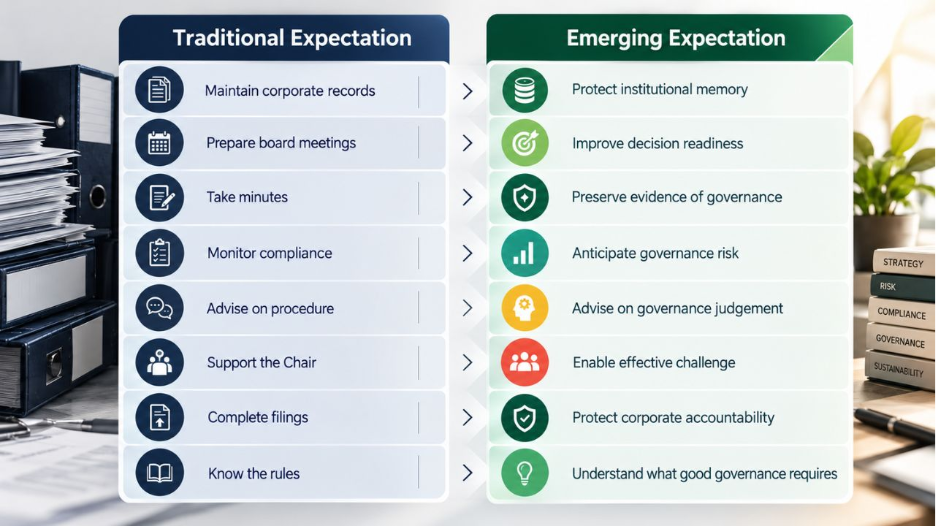
The profession is not abandoning administration.
It is moving beyond being defined by it.
1. Competency is becoming a governance issue, not simply an HR issue
Competency frameworks can sound like professional development tools.
In this context, the issue goes deeper.
Boards depend on Company Secretaries to interpret rules, structure decisions, identify governance risks and advise directors when the easiest course of action may not be the right one.
That means weak Company Secretary capability can become weak board capability.
Malaysia’s regulator acknowledged precisely this concern. During consultations around the forthcoming Malaysian Code on Corporate Governance 2026, feedback highlighted a need to strengthen the competence, capability and professionalism of Company Secretaries.
The Chartered Governance Institute’s existing competency framework provides a useful way to understand what modern professional competence involves.
It divides competency into:
Knowledge
Understanding governance, law, regulation, business and the wider environment.
Practice
Applying expertise through planning, advice, board support, communication and organisational governance.
Values
Using integrity, judgement and professional behaviour to support sound governance.
The framework is important because it recognises something software cannot resolve.
Professional competence is not simply knowing what the rule says. It is knowing how to apply it when the answer is unclear.
2. Fit and proper requirements would raise the accountability bar
The Securities Commission also said it is working with Bursa Malaysia on a regulatory framework addressing, among other matters, fit and properness and accountability for Company Secretaries of listed companies.
The precise requirements remain under development.
Nevertheless, the language is significant.
Fit and proper frameworks usually force organisations to look beyond whether somebody technically qualifies for a role.
They raise questions about:
- Professional competence
- Experience
- Integrity
- Conduct
- Capability
- Continuing development
- Accountability
For Company Secretaries, this could reinforce the idea that appointment should not be treated as a routine corporate formality.
Boards may increasingly need to ask:
- Does this person have the capability required by the organisation’s complexity?
- Do they understand the company’s regulatory environment?
- Can they advise directors confidently?
- Are they sufficiently independent in judgement?
- Can they challenge senior people appropriately?
- Is their professional knowledge current?
- Does the governance function have enough capacity to perform effectively?
These are governance questions, the appointment of a Company Secretary should therefore be considered through the same lens.
3. Greater accountability should come with clearer authority
Increasing accountability without examining authority creates a structural problem.
Company Secretaries may be expected to protect governance standards while lacking sufficient influence to change weak practices.
Consider several familiar situations.
Management repeatedly submits poor board papers.
Important information arrives late, an executive wants a matter approved quickly despite incomplete evidence, a board action remains unresolved, a governance concern is dismissed as procedural.
The Company Secretary may recognise the problem.
However, recognition alone does not create authority, if regulators increasingly expect Company Secretaries to provide a constructive internal voice, organisations should ask whether governance professionals have:
- Appropriate access to the Chair
- Direct access to directors where necessary
- Authority to challenge board processes
- Sufficient organisational standing
- Clear escalation routes
- Protection for professional judgement
- Access to reliable information
- Adequate resources
Accountability without authority is poor governance design.
The stronger the professional expectation, the clearer the institutional mandate should become.
4. The global direction is moving in the same direction
Malaysia is not developing these ideas in isolation.
CGI Global has recently advocated stronger professional recognition of Company Secretaries across several markets.
In its August 2026 response to Securities Commission Malaysia, CGI supported stronger competency and professional standards for Company Secretaries of public listed companies. Its suggestions included stronger competency requirements, a harmonised professional accreditation framework and potentially a registration framework.
During the same year, CGI also:
- Supported regulatory rules clarifying board secretary responsibilities in China
- Called for stronger recognition of the Company Secretary in Japan’s Corporate Governance Code
- Advocated stronger reference to professional qualifications in Australia’s corporate governance principles
The exact structures vary by jurisdiction.
However, the common direction is difficult to miss.
The Company Secretary is increasingly being recognised as part of the governance architecture through which boards exercise their responsibilities.
This has implications for appointment, professional development, reporting lines and resourcing.
5. The profession is becoming more influential at exactly the moment workloads are increasing
Higher professional expectations would be easier to absorb if governance teams had abundant capacity.
Many do not.
The Chartered Governance Institute UK & Ireland Governance Market Survey 2026, based on 971 governance professionals, found that 65% believe the influence of the governance function is increasing. Two-thirds said supporting board information quality and decision making is becoming more important.
At the same time:
- 74% reported increased workloads
- 42% said their governance function was not adequately resourced
- Among those whose responsibilities had expanded, 70% reported no meaningful improvement in recognition
A separate Diligent 2026 legal entity compliance study found that 51% of governance professionals had experienced a near-miss compliance event, while 47% cited technology gaps and legacy systems as their biggest challenge.
This creates a governance paradox.
Boards want more judgement.
Regulators want more accountability.
Organisations still consume significant Company Secretary capacity through administration.
Something has to change.
6. Stronger competency requirements make automation more important, not less
It would be easy to interpret Malaysia’s announcement as an argument for more training.
Training will certainly matter.
Professional qualifications matter.
Continuing development matters.
Yet organisations should also examine how expert time is being used.
A Chartered Company Secretary spending several hours reconciling entity information manually may be performing necessary work.
It is still a poor use of scarce professional capability.
Likewise, highly experienced governance professionals should not need to spend disproportionate time:
- Chasing routine deadlines
- Searching for corporate records
- Manually reconciling entity information
- Formatting repetitive documents
- Tracking board actions through email
- Updating duplicate spreadsheets
- Rebuilding compliance calendars
- Searching for previous decisions
These activities need control.
They do not all require senior professional judgement.
The better model is to automate the infrastructure, information flow and repetitive administration so experienced Company Secretaries can spend more time exercising judgement.
That judgement can then be applied where it creates greater value:
- Advising the Chair
- Improving board decisions
- Interpreting regulation
- Identifying governance risk
- Challenging management
- Supporting directors
- Managing conflicts
- Strengthening subsidiary governance
- Horizon scanning
- Protecting accountability
This is the distinction that matters.
Technology should not replace Company Secretary expertise. It should stop wasting it.
Explore: CoSec Hub
7. The real productivity problem is not how fast governance professionals work
Governance teams are frequently encouraged to become more efficient.
There is a limit to that argument.
A professional can type faster.
Templates can become better.
Processes can be streamlined.
Eventually, however, the real constraint is the operating model.
If information remains fragmented across:
- Shared drives
- Spreadsheets
- Board portals
- Personal calendars
- Local advisers
- Entity databases
- Individual memory
Then professional time will continue to be consumed by reconciliation, the problem is therefore not individual productivity.
It is infrastructure.
A stronger governance environment should allow Company Secretaries to see:
- What needs to happen
- Who owns it
- When it is due
- What has changed
- Which evidence exists
- Where an exception has occurred
- What requires escalation
Without that visibility, governance professionals become the human integration layer between disconnected systems.
That model does not scale.
8. Information quality is becoming part of professional competence
Malaysia’s emphasis on Company Secretaries facilitating effective board decision making deserves particular attention.
Boards do not make decisions in isolation.
They depend on information.
The Company Secretary frequently sits at the centre of the process through which that information reaches directors, good board governance therefore requires more than sending papers on time.
It requires attention to:
- Agenda design
- Paper quality
- Decision clarity
- Timeliness
- Supporting evidence
- Conflicts
- Appropriate challenge
- Actions
- Follow-up
CGI’s own competency framework recognises planning, organising, recording and information management as important professional capabilities. It also stresses the appropriate and efficient use of electronic systems within governance functions, the technology question should therefore be framed carefully.
The purpose of digitisation is not to send information faster.
It is to improve the infrastructure through which reliable information reaches the right decision maker at the right time.
9. Better infrastructure can make professional accountability more defensible
Greater accountability inevitably raises another question.
What evidence exists?
Imagine a Company Secretary advised that an issue required board attention.
Can that escalation be demonstrated?
A statutory obligation was assigned to management.
Can the governance record show the owner and follow-up?
A director declared a conflict.
Can the organisation demonstrate how it was managed?
A significant board action was completed.
Where is the evidence? Professional accountability becomes difficult when governance operates through informal conversations and fragmented records.
A stronger system should preserve:
Issue → Advice → Decision → Owner → Action → Evidence → Closure
10. Competency frameworks should change how boards hire Company Secretaries
A standardised competency framework can create a useful challenge for boards.
What exactly are they hiring the Company Secretary to do?
If the role is defined primarily through meeting administration and filings, recruitment will naturally focus on technical delivery.
Where the organisation expects the Company Secretary to become a trusted board adviser, different capabilities matter.
Boards may need to assess:
- Professional qualification
- Governance knowledge
- Regulatory understanding
- Commercial awareness
- Communication
- Emotional intelligence
- Courage
- Independence of judgement
- Boardroom credibility
- Strategic understanding
- Technology literacy
- Ability to manage complexity
The CGI competency framework already reflects much of this breadth, noting that effective governance professionals need technical expertise alongside values, emotional intelligence and the ability to apply knowledge in organisational context.
This is an important shift.
The board is not simply appointing somebody to maintain governance records. It is appointing part of its own governance capability.
11. Professional judgement becomes more important as AI enters governance
Malaysia’s governance reform is also unfolding as boards confront artificial intelligence.
The Securities Commission’s July 2026 consultation included a separate proposal concerning board oversight of technology and AI. It sought feedback on governance expectations and disclosure relating to the use and governance of technology.
That is highly relevant to Company Secretaries.
AI may increasingly assist with:
- Regulatory monitoring
- Entity-data reconciliation
- Document preparation
- Board administration
- Meeting workflows
- Information retrieval
- Draft minutes
- Compliance monitoring
Used properly, this can create substantial capacity.
However, automation increases rather than removes the need for professional accountability.
Somebody still needs to decide:
- Whether an AI output is reliable
- Whether confidentiality has been protected
- Whether human review is required
- Whether an exception is material
- Whether a regulatory interpretation is correct
- Whether information should reach the board
This is why the future is unlikely to be AI versus the Company Secretary.
It is much more likely to be:
AI and automation for repeatable work.
Experienced professionals for judgement.
12. Regulation should not accidentally create more administration for the people it wants to become more strategic
There is an important policy tension here.
Greater competency and accountability requirements can improve governance.
However, additional regulation often creates additional documentation, monitoring and reporting.
If reforms intended to strengthen Company Secretary judgement simply generate another layer of administration, some of the intended benefit may be lost.
Good regulatory design should therefore distinguish between:
- Evidence and paperwork
- Competency and credentials
- Accountability and blame
- Professional oversight and process ownership
- Necessary control and administrative burden
The goal should not be to make governance professionals busier.
It should be to make governance better.
That requires regulators and organisations to think about operating models alongside professional standards.
13. What should boards do before stronger requirements arrive?
Boards should not need to wait for the final Malaysian framework to examine the capability of their governance function.
Several questions are useful now.
Is the Company Secretary role properly defined?
Does the role description reflect strategic governance responsibilities or mainly administrative outputs?
Does the Company Secretary have sufficient access?
Can material concerns reach the Chair and board without unnecessary organisational barriers?
Is professional development structured?
Does the organisation regularly assess capability against the changing demands of the role?
Is governance sufficiently resourced?
Can the team deliver routine responsibilities without sacrificing board advice and horizon scanning?
Is technology reducing low-value work?
Automation should create professional capacity rather than another system requiring manual administration.
Can governance evidence be retrieved easily?
Accountability requires an institutional record.
Does the board understand the value of the function?
Company Secretaries should not need a governance failure to demonstrate why their work matters.
The Competency to Infrastructure Gap
The Malaysia announcement exposes a wider problem that organisations everywhere should examine.
Professional expectations and governance infrastructure are often developing at different speeds.
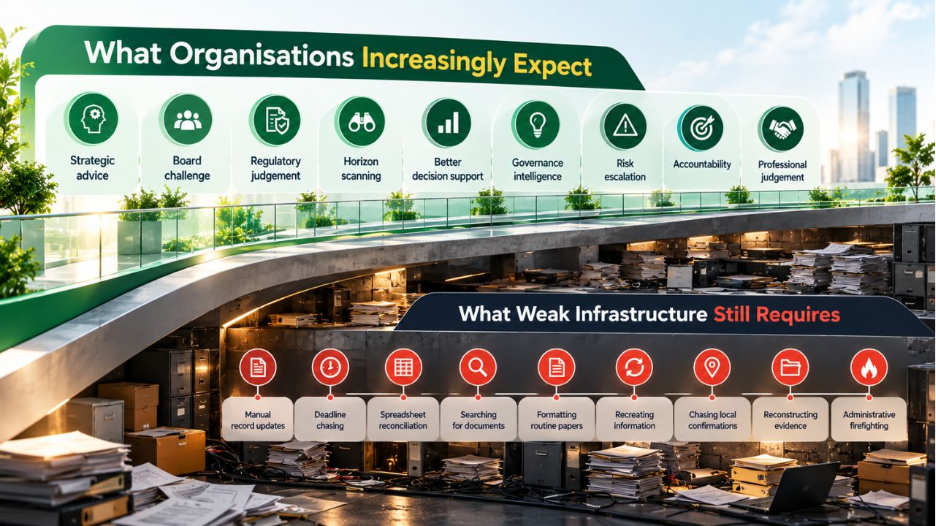
This is the real operating-model challenge.
No amount of professional development will create enough capacity if skilled people remain trapped in unnecessary manual work.
Likewise, technology alone cannot create the judgement regulators increasingly expect.
The organisation needs both.
What should be automated and what should remain professional judgement?
A useful distinction looks like this.
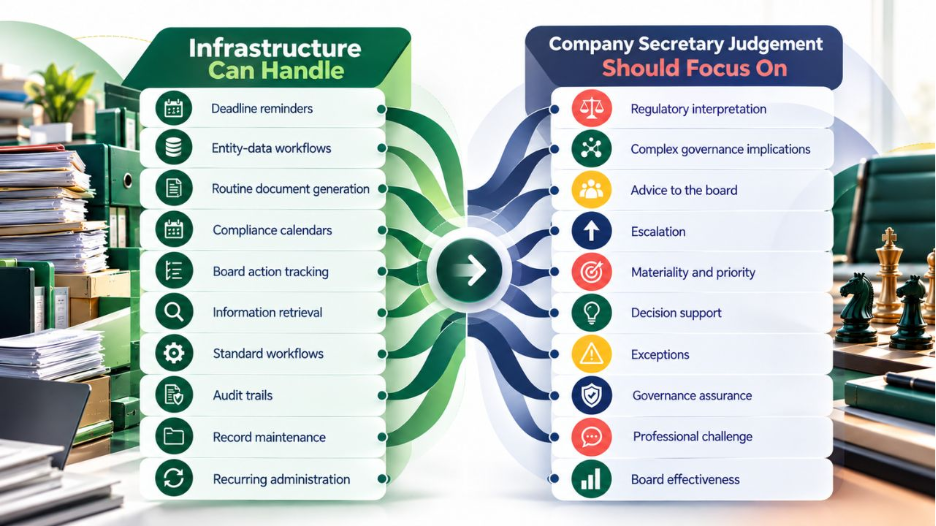
The objective is not automation for its own sake.
It is to redesign governance work around where human expertise produces the highest value.
Why CoSec Hub is built for this shift
The regulatory discussion in Malaysia reinforces the operating principle behind CoSec Hub.
Company Secretaries should spend more time exercising judgement and less time acting as the manual operating system for governance.
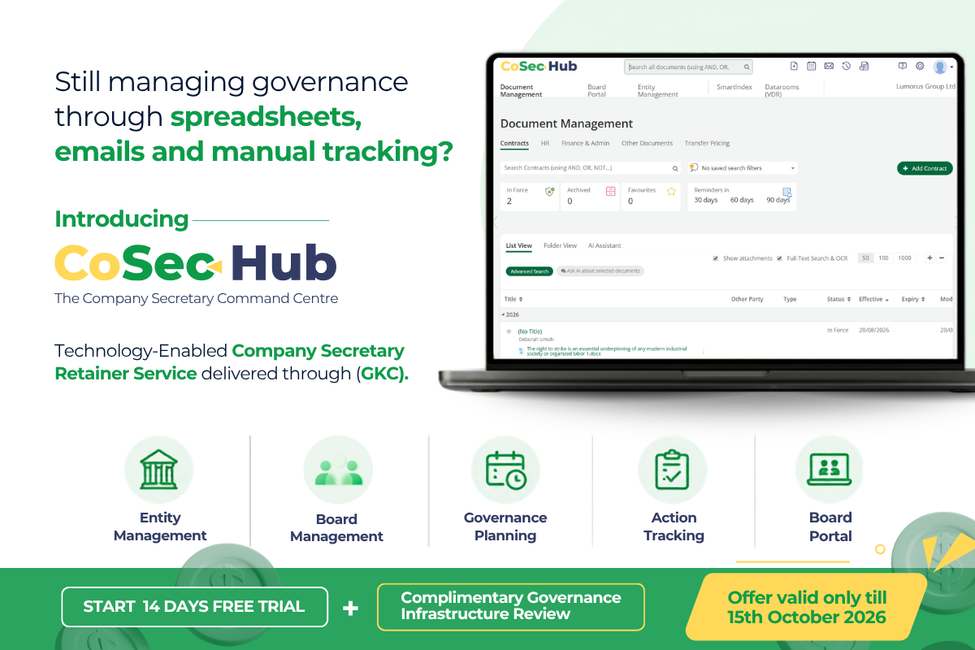
CoSec Hub combines governance technology with professional Company Secretary capability.
The technology layer can support
- Entity Management
- Compliance Calendars
- Governance Forward Planning
- Board Management
- Contract Management
- Statutory Registers
- Board Action Tracking
- Meeting Lifecycle Management
These capabilities help automate the infrastructure, information flow and repetitive administration surrounding governance.
The purpose is capacity.
When routine information is controlled systematically, experienced professionals have more time to interpret, advise and challenge.
The Governance Knowledge Centre adds professional capability
Alongside the technology, organisations can access:
- Chartered Company Secretary expertise
- Governance operations support
- Compliance monitoring
- Board administration
- Governance intelligence
- Multi-jurisdiction support
- Governance advisory
Together, these capabilities form a Technology-Enabled Company Secretary Retainer Service.
The operating model reflects where the profession is heading.
Technology manages structure.
Professionals exercise judgement.
The board receives stronger governance.
Explore: CoSec Hub
Why software alone is not the answer
Malaysia’s focus on competence should also caution organisations against assuming that technology can replace professional capability.
A system can tell you that an action is overdue.
It cannot always judge whether the delay creates material board risk.
Software can display the corporate structure.
It cannot determine whether subsidiary governance is effective.
AI may help summarise a board paper.
It cannot take responsibility for whether directors received enough information to make a sound decision.
A compliance engine can surface regulatory changes.
It cannot automatically interpret their impact on the organisation.
The future therefore belongs neither to manual governance nor software-only governance.
It belongs to augmented governance.
Automation should handle repeatable work.
Professional expertise should handle ambiguity.
Boards should retain accountability.
That is a more resilient model.
Seven warning signs your Company Secretary operating model has not kept pace
1. Senior professionals spend most of their time chasing routine tasks
Professional capability is being consumed by weak infrastructure.
2. Governance depends heavily on personal memory
Institutional knowledge should belong to the organisation.
3. Entity information requires regular reconciliation
A source of truth should not require constant verification.
4. Board actions disappear after meetings
Decision making without follow-through weakens accountability.
5. Regulatory updates are circulated but implementation is unclear
Awareness is not the same as governance.
6. Technology has been purchased but shadow spreadsheets remain everywhere
Digitisation has not solved fragmentation.
7. The board sees the Company Secretary mainly as an administrator
The role may be underused precisely when governance complexity is increasing.
Several of these signs together suggest the organisation has a deeper problem than workload.
It has an operating-model problem.
A Company Secretary capability health check
Boards, General Counsel and governance leaders should ask:
- Does our Company Secretary have the professional competence required by the complexity of the organisation?
- Is there direct access to the Chair and board when required?
- Can the function provide constructive challenge without organisational penalty?
- Do governance professionals spend enough time advising directors?
- Is continuing professional development structured and relevant?
- Are board information flows reliable and timely?
- Can material governance issues be escalated quickly?
- Does technology reduce repetitive administration?
- Could governance continue if a key person became unavailable?
- Can we demonstrate how the governance function contributes to better board decisions?
If several answers are uncertain, raising competency expectations alone will not solve the problem.
The board should examine the environment in which that competency is expected to operate.
The wider global lesson from Malaysia
The significance of the Securities Commission’s announcement extends beyond Malaysian listed companies.
It reflects a larger evolution in corporate governance.
Board responsibilities are expanding.
Technology is changing faster.
Stakeholders expect greater accountability.
Regulation is becoming more complex.
As those pressures increase, the role connecting the board with the organisation becomes more important.
The Company Secretary sits precisely at that intersection.
This helps explain why jurisdictions are increasingly reconsidering how the profession should be recognised, qualified and held accountable.
The next stage of the debate should therefore consider more than competency.
It should ask:
What governance infrastructure enables competent professionals to perform at their best?
That question will matter in Kuala Lumpur, London, Nairobi, Johannesburg, Singapore, Dubai and every other market where boards are being asked to govern more complexity with greater accountability.
The CoSec Hub View
Malaysia’s proposed reforms recognise something the governance profession has understood for some time: the Company Secretary role is becoming more demanding because board governance itself is becoming more demanding.
Higher competency standards are a logical response.
Clearer accountability can strengthen the profession.
Professional qualifications and continuing development matter.
However, organisations should not stop there.
Asking experienced Company Secretaries to become more strategic while leaving them buried beneath fragmented systems is contradictory.
Expecting greater judgement while consuming professional capacity through repetitive administration is inefficient.
Demanding accountability while evidence sits across individual inboxes and spreadsheets is poor institutional design.
The profession needs stronger capability.
It also needs an operating environment worthy of that capability.
That means automating what can be automated, structuring information properly and ensuring that routine governance does not consume the people needed for difficult governance.
The future Company Secretary should not be the organisation’s most sophisticated reminder system.
The role should be where boards turn when the rules are unclear, the trade-offs are difficult and somebody needs the judgement to ask whether the convenient decision is actually the right one.
Malaysia’s reform conversation is important because it makes that evolution visible.
The Bottom Line
On 22 September 2026, Securities Commission Malaysia sent an important signal to the governance profession.
The regulator is exploring a multi-stakeholder taskforce to develop a standardised competency framework for Company Secretaries of Malaysian listed companies. It is also working with Bursa Malaysia on a regulatory framework addressing areas including fit and properness and accountability.
The proposals follow the Securities Commission’s July consultation, which explicitly identified stronger oversight of Company Secretaries as part of Malaysia’s wider corporate governance reform agenda.
CGI Global has broadly supported the direction and has advocated stronger competency, accreditation and professional standards.
The underlying message extends well beyond Malaysia.
Company Secretaries are increasingly expected to:
- Advise
- Interpret
- Challenge
- Anticipate
- Escalate
- Facilitate
- Protect accountability
- Strengthen board decisions
Those responsibilities require high professional standards.
They also require time.
Boards should therefore ask whether experienced Company Secretaries are actually spending enough of their working day on the activities for which judgement matters.
If not, the answer should not simply be more training or more people.
It should include better infrastructure.
Automate the information flow.
Systematise the routine.
Control the evidence.
Give experienced Company Secretaries more time to exercise judgement.
That is how stronger competency becomes stronger governance rather than simply another regulatory requirement.
Continue Exploring
- Build governance infrastructure around professional Company Secretary expertise: CoSec Hub
- Add scalable professional Company Secretary capacity: Company Secretary Outsourcing
- Strengthen corporate governance support: Corporate Governance Support
- Improve statutory and regulatory oversight: Statutory & Regulatory Compliance
- Strengthen board and shareholder meeting governance: Board & Shareholder Meetings
- Create stronger board records: Minute Taking Solutions
- Build better governance structures as organisations grow: Company Formation & Structuring
About CoSec Hub
CoSec Hub is the Company Secretary Command Centre, built by Company Secretaries for Company Secretaries.
It combines governance technology with Chartered Company Secretary expertise so organisations do not have to choose between automation and professional support.
The operating principle is straightforward:
Automate the infrastructure, information flow and repetitive administration so experienced Company Secretaries can spend more time exercising judgement.
Through CoSec Hub and the Governance Knowledge Centre, organisations can bring together:
- Entity governance
- Compliance calendars
- Governance forward planning
- Board management
- Statutory registers
- Board action tracking
- Meeting lifecycle management
- Governance intelligence
- Chartered Company Secretary expertise
- Multi-jurisdiction governance support
- Governance advisory
This creates a different Company Secretary operating model.
Technology does the repetitive work technology is good at.
Experienced professionals concentrate on the work that requires expertise, context and judgement.
As regulators place greater emphasis on Company Secretary competence and accountability, that distinction becomes increasingly important.
Not software alone. Not traditional outsourcing alone. Connected governance infrastructure.
Explore CoSec Hub to build a Company Secretary operating model designed for higher expectations.
Sources
Securities Commission Malaysia: Opening Keynote Address at the CGI Global Governance Summit 2026
Primary source for the 22 September announcement concerning the proposed multi-stakeholder taskforce, standardised competency framework, fit and proper expectations and accountability for Company Secretaries of listed companies. Read the Securities Commission Malaysia keynote address
Securities Commission Malaysia: Consultation on Strengthening the Corporate Governance Ecosystem
The July 2026 consultation identified enhanced oversight of Company Secretaries as one of four proposals for strengthening Malaysia’s corporate governance framework. Read the Securities Commission Malaysia consultation announcement
CGI Global: Response to Securities Commission Malaysia
CGI supported stronger competency and professional standards and proposed options including enhanced competency requirements, professional accreditation and registration arrangements. Explore CGI Global policy submissions
Chartered Governance Institute UK & Ireland: Competency Framework for Governance Professionals
Framework covering values, practice and knowledge and describing the progression of modern Company Secretaries from technical specialists towards trusted governance advisers. Explore the CGI competency framework
Chartered Governance Institute UK & Ireland: Governance Market Survey 2026
Research involving 971 governance professionals showing greater influence, rising board decision-support responsibilities, increased workloads and continuing resource constraints. Read the CGI Governance Market Survey findings
Diligent: Global State of Legal Entity Compliance 2026
Research showing expanding governance mandates, technology and legacy-system challenges and significant levels of near-miss compliance events. Read Diligent’s 2026 findings
CGI Global Governance Summit 2026
The Summit took place in Kuala Lumpur on 22 and 23 September 2026 under the theme Governance, Sustainability & Value Creation, bringing together governance professionals, boards and regulators from across the CGI network. Explore the CGI Global Governance Summit