Company Secretary software can automate governance administration. It cannot govern the organisation.
Governance technology has improved dramatically.
Modern Company Secretary software can centralise entity records, automate compliance reminders, manage board documents, maintain statutory information, track actions and provide visibility across complex corporate structures.
These capabilities matter, particularly because governance teams are under growing pressure.
The Chartered Governance Institute UK & Ireland Governance Market Survey 2026 found that 65% of governance professionals believe the influence of the governance function is increasing. Based on responses from 971 professionals, the research also shows that the traditional perception of the Company Secretary as primarily responsible for board papers, minutes and compliance no longer reflects the reality of the role.
Technology should therefore be part of the answer.
However, it is not the whole answer.
A platform can tell you that a filing deadline is approaching. It cannot always determine whether a complex corporate change creates a wider governance issue.
Software can distribute a board paper. It cannot decide whether the paper gives directors enough information to make a responsible decision.
An automated workflow can identify an incomplete action. It cannot judge whether the issue should be escalated to the Chair.
AI can summarise a meeting. It cannot assume responsibility for whether the resulting minutes accurately capture a sensitive board discussion.
These distinctions matter because governance is not simply a collection of administrative processes.
Governance is the system through which power is allocated, decisions are made, risks are challenged and accountability is enforced.
Software can support that system.
It cannot replace it.
Explore: CoSec Hub
Executive Takeaway
The debate around Company Secretary software is often framed incorrectly.
Organisations are encouraged to choose between technology and professional support when the stronger operating model requires both.
Technology is particularly effective at:
- Centralising entity information
- Automating reminders
- Managing compliance calendars
- Maintaining records
- Tracking board actions
- Controlling document access
- Supporting board workflows
- Creating audit trails
- Improving visibility
- Reducing repetitive administration
Professional Company Secretary expertise is needed for different reasons:
- Interpreting governance requirements
- Advising boards
- Applying judgement
- Managing ambiguity
- Identifying conflicts
- Challenging weak processes
- Escalating significant issues
- Supporting directors
- Navigating regulatory change
- Designing governance arrangements
- Understanding organisational context
The strongest model connects the two.
Technology provides structure and visibility. Professional expertise provides interpretation, judgement and accountability.
Organisations that understand this distinction can automate more confidently because they know which work should be automated and which decisions still require experienced human judgement.
Why the software-only model is so attractive
The appeal is understandable.
Governance teams are being asked to do more while resources remain constrained. Digital tools promise efficiency, consistency and better control.
According to the CGI Governance Market Survey 2026, governance professionals are becoming more influential advisers to boards and executive teams. Their work increasingly extends into decision quality, succession, organisational change and stakeholder expectations.
As responsibilities expand, repetitive administration becomes harder to justify.
The technology market has responded accordingly.
Modern governance platforms can now support workflows ranging from board-pack preparation and entity management to filings, resolutions, compliance records and audit trails. Diligent’s current Company Secretary platform, for example, illustrates how extensively board and entity governance processes can now be centralised and automated.
That development is positive.
The mistake occurs when digitisation is confused with governance transformation.
Installing software does not automatically improve:
- Board challenge
- Accountability
- Decision quality
- Governance culture
- Regulatory judgement
- Director behaviour
- Risk ownership
- Escalation
- Organisational ethics
Those outcomes depend on people and institutional design as much as technology.
The question is therefore not whether governance teams need software. They increasingly do. The question is what software cannot do for them.
1. Software cannot decide what good governance looks like for your organisation
Every organisation has a different governance context.
A listed multinational, regulated financial institution, family business, investment fund and rapidly growing private company may all need entity records, board calendars and compliance workflows.
Yet their governance challenges are not identical.
Ownership structures differ.
Regulatory obligations vary.
Risk appetite changes.
Board composition matters.
Founder influence may be significant.
International subsidiaries create additional complexity.
Software can provide a framework for recording this information. However, somebody still needs to determine whether the governance architecture itself is appropriate.
That requires questions such as:
- Are decision rights clear?
- Does the board receive the right information?
- Are committees structured appropriately?
- Is authority delegated sensibly?
- Where do conflicts arise?
- Are subsidiary boards genuinely effective?
- Is the Chair creating sufficient challenge?
- Do directors understand their responsibilities?
- Can significant issues reach the board quickly?
A platform cannot answer these questions simply because the relevant documents have been uploaded.
Governance design requires professional judgement.
Read More: Governance Review
2. A compliance reminder cannot interpret regulatory complexity
Automation works particularly well when the requirement is clear.
A return is due on a known date.
A board meeting needs scheduling.
A director’s term is approaching expiry.
A statutory event requires filing.
Software can monitor these obligations efficiently.
Governance becomes harder when interpretation is required.
Regulation may change. Different requirements can apply across jurisdictions, while a transaction may trigger several obligations simultaneously. An apparently routine corporate action could also affect beneficial ownership, director responsibilities, regulatory permissions or shareholder approvals.
At that point, the question is no longer:
When is the filing due?
It becomes:
What does this development mean for the organisation?
That distinction separates workflow automation from professional Company Secretary advice.
The strongest technology therefore does not attempt to eliminate expertise. Instead, it helps experts identify the situations in which their judgement is most valuable.
Read More: Statutory & Regulatory Compliance
3. Software can store board papers. It cannot guarantee board information quality
Board portals have transformed the distribution of board information.
Secure digital access is clearly preferable to paper packs, unsecured email attachments and fragmented document repositories.
Nevertheless, a beautifully organised board portal can still contain a poor board paper.
Technology cannot automatically correct:
- Excessive length
- Missing analysis
- Weak recommendations
- Selective management information
- Unclear risks
- Poorly framed decisions
- Inconsistent financial assumptions
- Missing stakeholder implications
- Insufficient alternatives
The distinction is fundamental.
Information availability is not information quality.
The CGI Governance Market Survey 2026 found that governance professionals increasingly support the quality of information on which board decisions are made.
That responsibility requires judgement.
An experienced Company Secretary can question why a paper is arriving late, challenge whether the recommendation is sufficiently clear and advise management when directors need additional information.
Software can deliver the document.
Good governance determines whether the document deserves to reach the board in its current form.
Explore More: Board & Shareholder Meetings
4. Technology cannot create effective board challenge
Board effectiveness depends partly on relationships.
Directors need to challenge management without turning every meeting into confrontation. Chairs must create space for dissent while maintaining collective responsibility. Executives should provide sufficient information without overwhelming directors.
The Company Secretary operates close to these dynamics.
That proximity can reveal problems no dashboard will necessarily detect.
Perhaps one director consistently dominates discussion.
Maybe management responds defensively to challenge.
A committee could be receiving important information too late.
The Chair may be closing debate before alternative views have been properly considered.
None of these issues is primarily technological.
They concern power, behaviour and board culture.
Technology can record meeting attendance, distribute papers and track decisions. However, it cannot guarantee that directors asked the right questions before approving a major acquisition, entering a new market or accepting a significant risk.
That is why board effectiveness requires more than efficient administration.
Read More: Board Evaluation & Assessment
5. Automated minutes still require professional judgement
AI is rapidly entering meeting workflows.
Tools can record discussions, create transcripts, summarise conversations and produce first drafts of minutes.
Used appropriately, these capabilities can reduce administrative work.
However, board minutes are not transcripts.
They are governance records.
A high-quality minute needs to capture the substance of discussion without reproducing every contribution. It should demonstrate appropriate challenge, record significant decisions and preserve a defensible account of the meeting.
Sensitive judgement may also be required around:
- Conflicts of interest
- Legal advice
- Dissent
- Regulatory issues
- Executive performance
- Investigations
- Remuneration
- Risk decisions
- Matters considered in private session
AI can assist.
It should not become the unaccountable author of the corporate record.
Current research reinforces the importance of human oversight as AI adoption expands. Morgan Stanley’s 2026 analysis of corporate AI governance found that 69% of surveyed executives said AI outputs should receive separate human review in higher-risk situations, while 41% identified that safeguard as the single most important employee guidance.
Board minutes are precisely the kind of high-consequence governance record where professional review matters.
Read More: Minute Taking Solutions
6. A dashboard can identify an overdue action. It cannot always judge its significance
Board action tracking is one of the strongest use cases for governance technology.
Actions can be assigned to named owners, deadlines established and reminders automated.
That creates valuable accountability.
Yet overdue actions are not equally important.
A delayed administrative update may carry little consequence.
Failure to remediate a material control weakness is different.
So is an unresolved cyber vulnerability, regulatory commitment or board instruction following a serious incident.
The system can flag all four as overdue.
Professional judgement determines which one should reach the Chair tomorrow morning.
That is why exception management works best when technology and expertise are connected.
Software identifies the exception.
The Company Secretary interprets its governance significance.
Together, they create a stronger control environment than either could provide alone.
7. Entity management software cannot govern subsidiaries by itself
Entity-management platforms can provide an invaluable group-wide view of legal structures.
They can hold:
- Director information
- Shareholder records
- Statutory registers
- Ownership structures
- Filing dates
- Corporate documents
- Compliance obligations
For multinational organisations, that visibility is increasingly essential.
However, a subsidiary is not governed simply because its information appears correctly in a database.
Effective subsidiary governance also requires clarity around:
- Local board responsibilities
- Reserved matters
- Delegated authority
- Parent-company oversight
- Director duties
- Escalation
- Local regulatory obligations
- Conflicts
- Group policies
- Information flows
Technology can reveal who sits on the subsidiary board.
It cannot ensure those directors understand whether they owe duties to the subsidiary rather than simply following instructions from headquarters.
Likewise, a system may record delegated authorities while management practice gradually moves beyond them.
Entity visibility is therefore a necessary component of subsidiary governance.
It is not the whole of subsidiary governance.
8. Software cannot resolve conflicts of interest
Conflicts illustrate the limits of automation particularly well.
Technology can maintain a director-interest register.
It can issue declarations before meetings.
A workflow may even flag that a director has disclosed a connection with a counterparty.
What happens next requires judgement.
Is the conflict material?
Should the director receive the paper?
Can they participate in discussion?
Should they vote?
Does the conflict need to be recorded in the minutes?
Are additional approvals required?
Could the appearance of conflict matter even where no technical prohibition exists?
These are governance questions rather than database questions.
The software helps surface information.
The board, supported by appropriate professional advice, must decide what that information means.
Good governance begins where automated processing reaches the limits of context.
9. Technology cannot decide when the board needs to know
Escalation is one of the most important governance capabilities in any organisation.
Boards cannot receive every operational detail.
Equally, management should not retain significant information until it becomes a crisis.
Someone therefore needs to determine when an issue crosses the line between management responsibility and board concern.
Examples include:
- Regulatory investigations
- Serious compliance failures
- Major litigation
- Whistleblowing allegations
- Cyber incidents
- Control failures
- Conflicts
- Significant stakeholder disputes
- Material subsidiary problems
- Executive conduct issues
Software can help create escalation thresholds and workflows.
Yet unusual circumstances will always arise.
An experienced Company Secretary understands both formal governance requirements and the board’s information needs.
That judgement is difficult to encode completely because governance is contextual.
The most dangerous governance issue is often not the one the system failed to record. It is the one somebody recorded but failed to recognise as significant.
10. A governance platform cannot create accountability where accountability is unclear
One of the most common misconceptions about workflow software is that assigning an owner creates accountability.
It does not.
A system can attach a name to a task.
Real accountability requires that the individual:
- Understands the responsibility
- Has sufficient authority
- Possesses the necessary information
- Has resources to deliver
- Knows when escalation is required
- Faces consequences if delivery repeatedly fails
Where decision rights are poorly designed, software may simply digitise the ambiguity.
A workflow might show that three people appear responsible for the same issue.
Alternatively, an action can remain overdue because the nominal owner lacks authority to resolve it.
The governance challenge therefore comes first.
Technology should reflect a clear accountability structure.
It cannot manufacture one.
11. Poor governance data can make good software unreliable
Software depends on data.
That sounds obvious, but the implications are substantial.
Suppose the platform contains an outdated director record.
Perhaps an entity structure is incomplete.
A compliance obligation may have been configured incorrectly.
The board action owner could have changed roles months ago.
Once incorrect information enters the system, automation can distribute that error efficiently.
AI creates an additional challenge because its outputs depend heavily on the information available to it.
Morgan Stanley’s 2026 AI governance research found that 56% of surveyed executives involved in AI governance identified data risks as their most pressing current AI governance concern.
The lesson extends well beyond AI.
A single source of truth only has value if it is actually true.
Governance teams therefore need clear arrangements for:
- Data ownership
- Validation
- Access
- Changes
- Reconciliation
- Review
- Audit trails
Software provides the container.
Governance determines whether the information inside it can be trusted.
12. Buying software does not automatically fix a broken process
Technology projects often begin with an understandable objective.
Automate the existing process.
Sometimes that is exactly the wrong starting point.
If the existing process contains unnecessary approvals, duplicated records, unclear ownership or weak escalation, automation simply makes a poor process digital.
Before implementation, governance teams should therefore ask:
- Why does this process exist?
- Which risks is it controlling?
- Who needs to participate?
- Which steps add value?
- Where does duplication occur?
- What can be automated safely?
- Where is professional judgement required?
- Which evidence should the process create?
Only then should the workflow be configured.
This principle is particularly important because governance technology increasingly incorporates AI and sophisticated automation.
The faster the technology becomes, the more important process design becomes.
Automation should remove unnecessary governance friction, not accelerate unnecessary governance.
13. Software cannot create governance culture
Culture is ultimately about behaviour.
Does management welcome challenge?
Do people escalate bad news?
Are conflicts disclosed early?
Can employees raise concerns safely?
Do executives follow governance processes when commercial pressure increases?
Does the Chair invite dissent?
Do directors challenge assumptions?
No software platform can guarantee these behaviours.
Technology can reinforce culture through transparent workflows, clear responsibilities and accessible reporting. However, people determine whether those systems are respected or circumvented.
Recent evidence from the wider AI governance field illustrates this gap between formal systems and actual behaviour. A 2026 EY survey of senior AI executives found that 98% of respondents reported formal AI governance policies, yet 47% said their organisations had previously bypassed the governance process for urgent deployments.
The technology context is different, but the governance lesson is universal.
A policy can exist.
A system can exist.
People can still work around both.
Good governance therefore requires culture, leadership and consequences alongside technology.
14. AI makes professional Company Secretary judgement more valuable, not less
The rise of generative and agentic AI has intensified questions about which professional roles technology may replace.
Governance should be approached differently.
AI can already assist with:
- Document summarisation
- Meeting preparation
- Regulatory monitoring
- Draft minutes
- Entity-data analysis
- Board-paper review
- Compliance workflows
- Information retrieval
Those capabilities will improve.
Yet governance professionals work in an environment where context, confidentiality, legal duties and organisational politics matter.
Morgan Stanley’s 2026 research found that around 90% of surveyed executives said their organisations had defined, or were in the process of defining, where responsibility for AI governance and risk management sits. Only just under half reported that responsibility was already fully allocated across functions, executives and the board.
That finding reveals the enduring governance problem.
Technology evolves quickly.
Accountability takes longer.
The Company Secretary increasingly sits at the point where those two worlds meet.
The future role is not to compete with technology at administrative work. It is to use technology to create more capacity for judgement.
15. Cybersecurity makes the software decision itself a governance decision
Company Secretary platforms can contain some of the organisation’s most sensitive information.
Board papers may cover:
- M&A
- Strategy
- Litigation
- Investigations
- Executive remuneration
- Succession
- Regulatory matters
- Personal director information
- Financial performance
Security therefore cannot be treated as an IT procurement detail.
Boards and governance teams should consider:
- Data hosting
- Encryption
- Access controls
- Multi-factor authentication
- Single sign-on
- Audit logs
- Vendor resilience
- Data retention
- Incident response
- Permissions
- Offboarding
- Third-party access
- AI functionality
The more governance becomes digital, the more technology selection itself becomes part of governance risk management.
Convenience is important.
Security and accountability matter more.
16. Software alone cannot solve key-person risk
At first glance, software should eliminate dependence on individuals.
Sometimes it does.
Centralised records, automated calendars and documented workflows can prevent critical knowledge from remaining in one person’s inbox or memory.
However, key-person dependency can survive digitisation.
Perhaps only one administrator understands how the platform works.
Maybe workflows have been configured around undocumented assumptions.
The system could contain records without explaining why particular governance decisions were taken.
Technology therefore reduces key-person risk only when it is accompanied by:
- Clear processes
- Documented responsibilities
- Appropriate access
- Professional coverage
- Governance knowledge
- Succession planning
A system can preserve information.
An organisation still needs people capable of interpreting and acting on it.
Read More: Company Secretary Outsourcing
17. Software cannot keep governance current without professional oversight
Governance arrangements should evolve.
A structure suitable for a private company with two shareholders may become inadequate after external investment.
International expansion introduces new regulatory and subsidiary governance requirements.
A listing changes expectations again.
Acquisitions, joint ventures, regulated activities and leadership changes can all alter the governance environment.
Software does not independently redesign the organisation’s governance architecture as these developments occur.
Someone needs to ask:
- Are reserved matters still appropriate?
- Should committee structures change?
- Does the board need different expertise?
- Are delegated authorities still fit for purpose?
- Has the risk profile changed?
- Are governance policies still proportionate?
- Do new jurisdictions require additional oversight?
Technology is strongest at operating a defined system.
Professional governance expertise is needed to determine whether the system itself remains appropriate.
18. The real opportunity is augmentation, not replacement
The most productive technology debate is therefore not whether software can replace the Company Secretary.
It is how technology can make the Company Secretary more effective.
Used well, software can reduce time spent on:
- Manual record updates
- Routine reminders
- Document searches
- Compliance tracking
- Board-pack administration
- Repetitive reconciliation
- Action chasing
- Information retrieval
That releases capacity for higher-value work such as:
- Board advice
- Regulatory interpretation
- Governance improvement
- Director support
- Subsidiary oversight
- Horizon scanning
- Board effectiveness
- Complex corporate actions
- Strategic governance
This is where the business case becomes stronger.
An experienced Company Secretary spending hours manually reconciling registers is not an efficient use of professional capability.
Equally, replacing that Company Secretary with a platform would remove precisely the judgement the organisation needs when something unusual happens.
The better model automates the routine and strengthens the professional.
What software does well and where professional expertise still matters
The distinction should not be interpreted as technology versus people.
It is about designing each role around what it does best.
The Company Secretary software maturity trap
Organisations often move through several stages of governance technology.
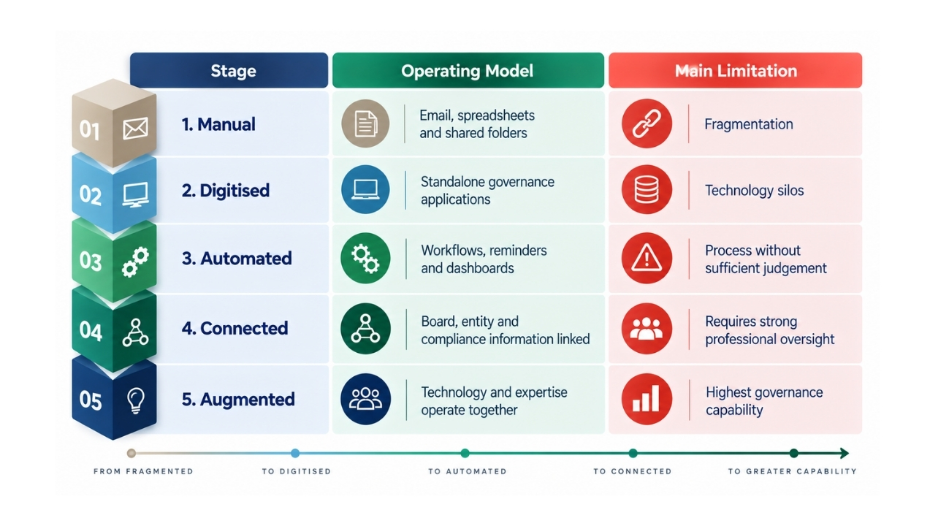
The danger lies in assuming stage three is the destination.
Automation is valuable.
Connected governance is better.
However, the strongest model is augmented governance, where technology handles repetitive processing while experienced professionals interpret exceptions, advise boards and improve the governance system itself.
Seven signs your governance software is not solving the real problem
1. The team has software but still maintains shadow spreadsheets
This often indicates weak implementation, poor integration or low confidence in system data.
2. Board packs are digital but still poor
Distribution technology cannot compensate for weak information quality.
3. Actions are tracked but remain repeatedly overdue
The problem may be accountability rather than reminders.
4. Entity records exist but subsidiaries remain poorly governed
Entity management and subsidiary governance are related but different disciplines.
5. Compliance alerts are plentiful but nobody prioritises them
More information can create more noise without professional interpretation.
6. Governance professionals still spend most of their time administering the platform
Technology should release capacity rather than create another administrative burden.
7. Nobody can explain what governance has actually improved
Digitisation is not an outcome.
If several of these conditions exist, buying additional software may not solve the underlying problem.
The organisation should examine its operating model.
Ten questions to ask before buying Company Secretary software
Before choosing another platform, boards, General Counsel and Company Secretaries should ask:
- Which governance problem are we actually trying to solve?
- Which processes should be automated and which require judgement?
- Who will own the underlying governance data?
- How will the platform connect with existing systems?
- Can it support multiple jurisdictions and entities?
- What security controls protect board and corporate information?
- How will exceptions be escalated?
- What professional expertise will still be required?
- How will we measure whether governance actually improves?
- Will this platform reduce dependence on individuals or simply create a new dependency?
These questions change the procurement conversation.
Instead of asking which software has the most features, the organisation begins asking which operating model will produce stronger governance.
That is a much better starting point.
Why software plus traditional outsourcing is not automatically enough
There is another potential trap.
An organisation may purchase technology and separately outsource Company Secretary tasks.
That can improve capacity.
However, if the two operate independently, fragmentation remains.
The external provider may use different records.
Internal teams may maintain separate workflows.
Technology alerts may not reach the professionals responsible for interpreting them.
The board may still lack a coherent view.
The stronger model integrates technology and expertise around the same governance environment.
That allows information to move from:
Event → System → Professional review → Escalation → Board or management action → Evidence
The value comes from the connection.
This is why governance infrastructure matters more than either software or outsourcing considered separately.
Why CoSec Hub takes a different approach
CoSec Hub is built around a simple proposition:
Company Secretary software is valuable, but software alone cannot deliver governance.
The operating model therefore combines a technology layer with professional governance capability.
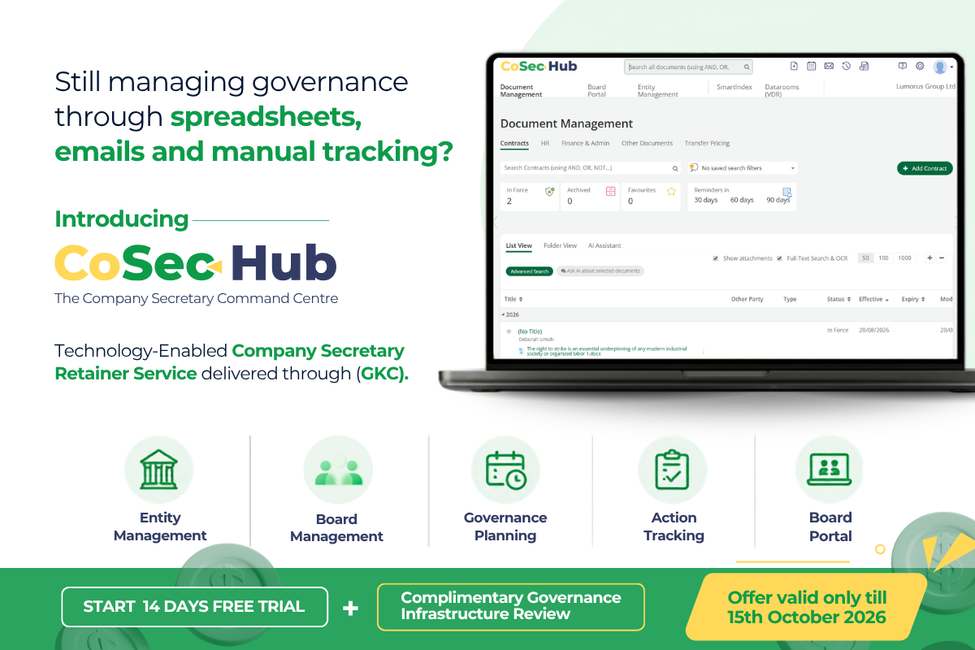
The CoSec Hub technology layer can support
- Entity Management
- Compliance Calendars
- Governance Forward Planning
- Board Management
- Contract Management
- Statutory Registers
- Board Action Tracking
- Meeting Lifecycle Management
These capabilities create structure, visibility and automation.
However, technology is only one part of the model.
The Governance Knowledge Centre can provide
- Chartered Company Secretary expertise
- Governance operations support
- Compliance monitoring
- Board administration
- Governance intelligence
- Multi-jurisdiction governance support
- Governance advisory
Together, the two layers create a Technology-Enabled Company Secretary Retainer Service.
The distinction matters.
When a deadline approaches, technology can identify it.
When the obligation is ambiguous, professional expertise can interpret it.
If an action becomes overdue, the system can flag it.
When that delay creates a material governance risk, an experienced professional can escalate it.
Where corporate records change, technology can preserve the information.
When the change affects wider governance arrangements, expertise can advise on the implications.
CoSec Hub + Governance Knowledge Centre: Where Automation Meets Governance Authority.
Explore: CoSec Hub
What a stronger governance operating model looks like
The difference is subtle but important.
One model helps the organisation administer governance.
The other helps it govern.
The commercial case for combining technology and expertise
Boards should not view this operating model simply as an additional governance cost.
There is a commercial argument.
Better integration can help reduce:
- Manual administration
- Duplicated work
- Compliance near misses
- Key-person dependency
- Information gaps
- External advisory costs for routine issues
- Time spent reconstructing governance evidence
At the same time, it can increase:
- Governance visibility
- Board support
- Regulatory readiness
- Audit readiness
- Institutional knowledge
- Scalability
- Professional capacity
- Decision support
The return therefore comes from using expensive professional capability more intelligently.
Technology should handle the work technology does well.
Governance professionals should concentrate on the work that requires judgement.
That is not replacing expertise with technology. It is redesigning the operating model around the strengths of both.
A practical governance technology health check
Organisations that already use Company Secretary software should ask:
- Has the platform genuinely reduced manual work?
- Do governance professionals trust the data inside it?
- Are board decisions connected to follow-up actions?
- Can significant exceptions be identified quickly?
- Does the system support rather than complicate regulatory compliance?
- Can governance continue when key people are unavailable?
- Are board and entity records appropriately protected?
- Do professionals spend more time advising because of the technology?
- Is there clear human accountability for AI-assisted outputs?
- Can we identify a measurable improvement in governance quality?
If the answer to the final question is unclear, the organisation should reconsider what it expects the technology to achieve.
Software implementation is not governance transformation.
The Lumorus View
The central mistake in governance technology is believing that administration and governance are the same thing.
They are not.
Administration records the decision.
Governance determines whether the right people made it.
Administration schedules the meeting.
Governance determines whether directors received the information needed to exercise judgement.
Administration records the conflict.
Governance decides how that conflict should be managed.
Administration tracks the overdue action.
Governance determines whether the delay should concern the board.
Software is becoming exceptionally good at administration, information management and workflow.
That is precisely why the future of the Company Secretary should be more strategic rather than less.
As technology takes greater responsibility for repetitive processing, governance professionals can spend more time on the areas where organisations actually need human judgement: board advice, challenge, escalation, accountability and institutional design.
The winners will therefore not be organisations that choose between people and technology.
They will be organisations that understand where automation should stop and professional judgement should begin.
The Bottom Line
Company Secretary software is becoming an essential component of modern governance infrastructure.
It can centralise corporate records, automate compliance workflows, support boards, track actions and improve organisational visibility.
Those benefits are real.
Yet current evidence also shows why the professional governance function remains essential.
The CGI Governance Market Survey 2026 shows governance professionals becoming more influential advisers to boards and executive teams as the profession moves beyond its traditional administrative perception.
Meanwhile, Morgan Stanley’s 2026 AI governance research demonstrates the continuing importance of human oversight as organisations automate increasingly sophisticated processes.
The lesson for governance technology is straightforward.
Use software to:
- Automate
- Centralise
- Track
- Alert
- Record
- Analyse
Use professional Company Secretary expertise to:
- Interpret
- Challenge
- Advise
- Escalate
- Design
- Judge
Then connect both.
The future of governance is not software replacing the Company Secretary. It is technology removing low-value friction so that Company Secretaries can spend more time doing the work software cannot do.
That is the difference between digitising governance administration and building genuine governance capability.
Not software alone. Not traditional outsourcing alone. Connected governance infrastructure.
Continue Exploring
- Connect governance technology with professional Company Secretary expertise: CoSec Hub
- Strengthen the governance architecture behind your technology: Corporate Governance Support
- Add professional Company Secretary capacity: Company Secretary Outsourcing
- Improve statutory and regulatory oversight: Statutory & Regulatory Compliance
- Strengthen board processes and decision records: Board & Shareholder Meetings
- Create more reliable board minutes: Taking Solutions
- Test whether the wider governance architecture remains fit for purpose: Governance Review
- Assess board effectiveness beyond the technology: Board Evaluation & Assessment
About CoSec Hub
CoSec Hub is the Company Secretary Command Centre, built by Company Secretaries for Company Secretaries.
It combines governance technology with Chartered Company Secretary expertise to help organisations manage entity governance, compliance, board administration and governance operations through a connected operating model.
Rather than asking organisations to choose between software and professional support, CoSec Hub brings the two together.
The technology layer provides structure, automation and visibility.
The Governance Knowledge Centre provides interpretation, professional support and governance intelligence.
Together, they can help organisations reduce manual administration while preserving the judgement and accountability on which good governance depends.
Built by Company Secretaries for Company Secretaries.
CoSec Hub + Governance Knowledge Centre: Where Automation Meets Governance Authority.
Visit CoSec Hub to explore a governance operating model that combines technology with professional expertise.
Lumorus: Better Business, Built on Purpose
Lumorus is a UK headquartered global governance, ESG, Company Secretary and advisory firm supporting organisations across Europe, Africa, Asia, the Caribbean, Canada, the Middle East and international markets.
We help organisations build governance systems that combine technology, professional expertise, accountability and strategic clarity.
Our Company Secretary capabilities include:
For organisations seeking to combine governance technology with professional Company Secretary expertise, CoSec Hub provides a connected model built around both.
Has your governance technology genuinely strengthened governance, or has it simply moved the administration onto a screen?
The distinction matters.
A better platform can improve efficiency.
A better governance operating model can improve the organisation.
Explore Lumorus and CoSec Hub to build governance infrastructure that combines automation with professional judgement.
Lumorus: Better Business, Built on Purpose.
Sources
- Chartered Governance Institute UK & Ireland: Governance Market Survey 2026 – Research based on 971 governance professionals examining the expanding influence of governance teams, board decision support, workload, technology and the changing nature of the profession.
- Diligent: Company Secretary Board and Entity Governance Technology – Current industry example illustrating the range of board, entity, compliance, workflow, AI and audit-trail capabilities available through modern governance technology.
- Morgan Stanley Institute for Sustainable Investing: How Boards and Executives Are Governing the Rise of AI – August 2026 research examining board AI expertise, corporate AI accountability, model controls, data risks and the continuing importance of human review.
- Deloitte: How Boards Are Using AI Today – July 2026 research examining the emerging use of AI in board activities and the continuing gaps between adoption and formal governance arrangements.
- EY: AI Risk and Governance Survey 2026 – September 2026 research illustrating the gap that can arise between formal governance policies and actual behaviour as organisations adopt increasingly autonomous AI systems.
- Nasdaq Governance Solutions: AI In and Around the Boardroom – Research into AI adoption by governance professionals and boards, including emerging use cases, unsanctioned AI activity and the need for policies, education and guardrails.
- Lumorus CoSec Hub: Why Governance Software Alone Cannot Fix Weak Governance – Related analysis of the limitations of software-only governance models and the case for combining technology with professional Company Secretary expertise.