The hardest governance question created by AI may not be whether the technology made the right decision. It may be who actually made the decision at all.
Imagine a board considering a major investment. Management presents a detailed recommendation supported by market forecasts, competitor analysis and several financial scenarios. Directors challenge the assumptions, debate the risks and eventually approve the proposal.
On the surface, this looks like an ordinary board decision. Beneath it, however, the decision may have been shaped extensively by artificial intelligence. An AI system analysed the market, another produced forecasts, executives used generative AI to test strategic options, and management incorporated those outputs into the recommendation presented to directors.
Who, then, made the decision?
Legally and formally, human accountability remains. Operationally, the answer is becoming more complicated because AI can influence which information people see, which options receive attention and which recommendation appears most convincing long before a decision reaches the board.
This is no longer a theoretical governance problem. In September 2026, the Chartered Governance Institute UK & Ireland reported that AI adoption is advancing faster than governance oversight. Its research found widespread use of AI across reporting, analysis, compliance and governance activities, while many boards still lack clear visibility over how the technology is being used.
More significantly, the Institute found that formal governance structures, assurance mechanisms and board capabilities are not developing at the same pace. Awareness may be increasing, yet confidence in challenging AI-generated outputs and overseeing AI-enabled decisions remains comparatively weak.
That gap creates an important new responsibility for the Company Secretary.
The profession does not need to become the organisation’s AI engineering function. Nor should Company Secretaries attempt to replace technology, risk, legal, data or internal audit specialists. Their distinctive contribution lies elsewhere: helping the organisation preserve clear human authority, challenge and accountability as machines become more influential in how decisions are formed.
For a profession already concerned with decision rights, board information, delegated authority, accountability, evidence and institutional memory, AI is not simply another technology issue.
It is a governance issue in its purest form.
Read More: Corporate Governance Support
Executive Takeaway
AI is changing corporate decision making before it changes formal accountability. Boards may remain legally responsible, executives may retain formal authority and committees may continue approving decisions, yet algorithms can increasingly influence the information, analysis and recommendations behind those decisions.
This creates a new governance challenge. Organisations need to know where AI is being used, which decisions it influences, who remains accountable, what meaningful human review looks like and what evidence can demonstrate how judgement was exercised.
For Company Secretaries, this creates an important opportunity to help boards design the governance architecture around AI. That includes decision rights, escalation thresholds, board information, committee responsibilities, evidence, assurance and institutional records.
The principle should remain simple:
The more influence machines acquire over corporate decisions, the clearer human accountability must become.
AI is changing how organisations reach decisions
Much of the corporate AI debate has concentrated on productivity. Organisations want to know whether generative AI can draft documents faster, analyse larger datasets, reduce administrative work or allow employees to accomplish more with fewer resources.
Those questions matter commercially, but they do not capture the most consequential governance change.
The deeper shift begins when AI influences judgement.
A recruitment system can determine which candidates reach an interview. Fraud software may decide which transactions receive investigation, while an investment model can rank potential acquisitions. Elsewhere, AI may analyse regulatory developments, recommend pricing, assess suppliers, identify strategic risks or summarise evidence before a management decision.
At that point, technology is no longer simply accelerating work. It is shaping the environment within which human judgement occurs.
The Chartered Governance Institute’s September 2026 research identifies precisely this transition. It argues that governance increasingly needs to move beyond reviewing individual decisions and towards overseeing the systems that generate and influence them.
For boards, that changes the governance question. Directors must increasingly understand not only who has authority to make a decision, but also what systems influenced the judgement before that authority was exercised.
A decision can remain formally human while becoming operationally algorithmic
Traditional corporate governance depends on identifiable lines of accountability. Directors approve reserved matters, executives exercise delegated authority, committees oversee defined areas and management remains responsible for implementation.
AI complicates that structure because formal authority can remain unchanged even while practical influence shifts significantly.
Consider an executive who technically approves every investment below a specified threshold. If an algorithm identifies the opportunities, ranks them, assesses the risks and recommends whether to proceed, the executive may remain the formal decision maker while the system exercises considerable influence over the substance of the decision.
The same dynamic can emerge in recruitment, lending, insurance, procurement, compliance and risk management. Humans may still approve outcomes, but their decisions increasingly begin with machine-generated recommendations.
This distinction matters because governance should reflect how decisions actually happen, rather than merely how authority appears on an organisational chart.
The Company’s delegated authority framework may say one thing while its decision architecture increasingly says another.
The human in the loop must exercise judgement, not merely provide legitimacy
One of the most common responses to AI risk is to require human oversight.
That sounds reassuring. However, the presence of a person does not automatically mean meaningful human judgement exists.
Imagine that an employee reviews hundreds of AI recommendations every week and approves 99 per cent of them. Perhaps the system is exceptionally accurate. Alternatively, the employee may have become reluctant to disagree with technology perceived as more sophisticated than their own judgement.
Time pressure can reinforce the problem. So can weak technical understanding, organisational incentives or uncertainty about whether challenging the model is encouraged.
Consequently, boards should look beyond whether a human appears somewhere in the workflow. They need to understand whether that individual has enough information, competence, authority and time to make an independent judgement.
A meaningful human reviewer should be able to challenge the recommendation, understand its limitations and override it where appropriate. Just as importantly, the organisation should be interested in when those overrides occur and why.
Otherwise, human oversight risks becoming procedural theatre.
AI can quietly rewrite delegated authority
Delegated authority frameworks usually identify who may approve expenditure, transactions, contracts, appointments and other significant decisions.
AI introduces a less visible form of delegation.
A system may not possess formal authority to approve anything, yet it can determine which information reaches the human decision maker, which alternatives are prioritised and which risks appear most significant. Over time, this can give the technology considerable practical influence without any formal change to the delegation framework.
For example, an AI system might determine which customer complaints are serious enough for escalation. Another may identify which suppliers require enhanced due diligence. A third could decide which strategic scenarios appear in management’s recommendation to the board.
None of these systems formally makes the final decision. Nevertheless, each influences the boundaries within which human judgement occurs.
Company Secretaries should therefore begin asking whether existing decision-rights frameworks still describe reality. If AI has changed how authority operates in practice, governance architecture needs to catch up.
Read More: Governance Review
Before boards can govern AI, they need to know where it is being used
Visibility is the first governance requirement.
Yet the CGI research found that many boards still lack clear visibility over AI use, particularly where adoption happens informally outside approved governance processes. The Institute describes a widening gap between operational adoption and governance maturity.
This should not be surprising. AI can spread through an organisation without a major technology programme. Employees begin using general-purpose tools, departments purchase specialised applications and existing software providers quietly introduce AI functionality into familiar platforms.
Corporate reporting provides an instructive example. Financial Reporting Council research published in 2026 found that 39 per cent of surveyed organisations were already using generative AI, while another 31 per cent were piloting it. The research also identified differences between senior and junior staff perceptions of how extensively AI was already being used.
That creates what might reasonably be called shadow AI.
Governance cannot begin with a sophisticated policy if the organisation does not first understand where AI already exists.
An AI tool inventory is not enough
Many organisations are responding by building inventories of approved AI systems. That is sensible, but boards need something more useful: an AI decision inventory.
A technology register tells the organisation which applications exist. A decision inventory explains what those applications actually influence.
For example, knowing that the organisation uses an AI-enabled recruitment platform is useful. Understanding that the platform ranks candidates before any human reviewer sees them is considerably more important from a governance perspective.
Likewise, a generative AI tool used by thousands of employees for basic administrative work may create less board-level governance risk than a specialised model used by five people to influence multimillion-pound capital decisions.
The Company Secretary can help move the conversation from software ownership towards decision consequence. Instead of simply asking where AI exists, governance teams should ask where AI can materially affect people, capital, risk, reputation or regulatory obligations.
Boards should govern impact, not software count.
Every material AI-assisted decision needs a human owner
AI creates an unusual accountability problem because responsibility can become distributed across several participants.
Technology teams select systems. Vendors build models. Data teams supply information. Business units configure workflows. Employees interpret outputs. Executives approve recommendations and committees provide oversight.
When the outcome is successful, this distributed model can appear sophisticated.
When something goes wrong, responsibility can become remarkably difficult to locate.
The OECD AI Principles place accountability at the heart of responsible AI, alongside transparency, robustness and mechanisms that allow AI actors to be held accountable for systems and outcomes. NIST’s AI Risk Management Framework similarly provides a structured approach for managing AI risks across design, development, deployment and use.
For governance purposes, the principle should be straightforward. Every material AI-assisted decision needs an identifiable human owner.
That person may not understand every mathematical component of the model. They should, however, understand enough about the system’s purpose, limitations and evidence to accept responsibility for relying upon it.
If the organisation can identify who owns the software but cannot identify who owns the judgement, the governance architecture is incomplete.
The Company Secretary can help design AI decision rights
AI governance will inevitably involve several functions. Technology teams understand systems, legal teams interpret regulatory obligations, risk professionals assess exposure, internal audit provides assurance and data specialists understand information architecture.
The Company Secretary brings something different.
Governance professionals understand how institutional authority is structured. They know how matters reach the board, where committees fit, how delegated powers operate, when escalation is necessary and what evidence should remain after important decisions.
That makes the Company Secretary well placed to help connect the different parts of AI governance.
The task might include determining which AI-related matters require board oversight, which committee should monitor material risks, when incidents require escalation and what information directors should receive before approving AI-enabled decisions.
This is not an argument for creating another committee automatically. In many organisations, AI governance should be integrated into existing risk, audit, technology, people and strategy structures.
What matters is that responsibility does not disappear between them.
Board papers will increasingly contain reasoning shaped by machines
Company Secretaries already spend considerable time improving the information reaching directors. AI makes that responsibility more significant because management may increasingly use AI to prepare the analysis behind board recommendations.
Market research may be machine-assisted. Scenario modelling can involve algorithms, while generative AI may summarise competitors, analyse customer sentiment or help management compare strategic alternatives.
The final board paper may look entirely conventional.
Directors could therefore receive AI-shaped reasoning without knowing how materially the technology influenced the analysis.
Not every use of AI needs disclosure in every paper. Materiality should remain the guide. However, where AI has significantly influenced a major recommendation, directors may reasonably need to understand that fact.
A well-designed paper could explain the nature of the AI contribution, the evidence supporting it, significant limitations, how management validated the output and where human judgement altered the recommendation.
That information does not turn directors into engineers.
It gives them enough context to govern the decision.
Read More: Board & Shareholder Meetings
Override data may become an important governance signal
AI governance should pay attention not only to what machines recommend, but also to how people respond.
Suppose employees regularly override a model. That might indicate poor system performance, changing business conditions or information unavailable to the algorithm. Alternatively, human reviewers could be resisting valid recommendations because they conflict with established habits.
The reverse pattern can be equally revealing. If a material AI system operates for a year without anyone challenging its recommendation, the board should ask whether the technology is genuinely exceptional or whether meaningful human oversight has disappeared.
Monitoring overrides, exceptions, appeals and disagreements can therefore provide useful evidence about how human judgement operates around AI.
Rather than asking only whether human review exists, governance reporting can examine whether that review is active.
This produces a more meaningful form of assurance.
Explainability should increase with the significance of the decision
Not every AI-generated output deserves extensive board scrutiny.
A tool that helps employees schedule meetings presents a very different governance problem from one influencing recruitment, lending, investment, insurance or strategic capital allocation.
The level of explanation should therefore follow the significance of the decision.
Directors do not necessarily need to understand the mathematics behind a complex model. They should understand why the organisation trusts it, where it can fail, how it was validated and who is responsible when the output influences an important decision.
Corporate reporting demonstrates why this matters. The FRC’s 2026 research found that organisations remain more cautious about using AI for activities involving substantial judgement. Risks identified included errors, fragmented data, limited explainability and uncertainty about appropriate use.
That caution is instructive.
As the consequence of a decision rises, so should the quality of human challenge and evidence.
AI changes what a good governance record may need to preserve
Board minutes exist partly because organisations need an institutional record of how significant decisions were made.
AI complicates that record.
Imagine directors approving a restructuring after considering workforce modelling substantially produced through AI. The minutes do not need to become a technical transcript of the model, but the governance record may need to preserve enough context to explain what information mattered and how directors exercised judgement.
Depending on the significance of the issue, that could include the principal assumptions considered, uncertainties discussed, management’s validation of the analysis, relevant challenge and any conditions attached to the decision.
The purpose is not defensive record keeping.
It is institutional accountability.
When decision formation becomes more technologically complex, preserving evidence of human judgement becomes more important rather than less.
Read More: Minute Taking Solutions
The greatest risk is a decision everyone influenced but nobody owns
This is where the governance problem becomes most serious.
Imagine a material AI-assisted decision later produces significant harm.
Management explains that the model recommended the outcome. Technology confirms that the system performed according to specification, while the vendor points out that the organisation determined how the product was configured. Human reviewers say they remained in the loop, and the board explains that it relied on management’s assurance.
Every participant contributed.
Nobody feels fully responsible.
That outcome should be unacceptable in a well-governed organisation.
Sophisticated technology cannot become a mechanism through which human responsibility dissolves. Indeed, the more complex the technology becomes, the stronger the accountability architecture around it should be.
A machine can analyse.
It can recommend.
Increasingly, it may even act.
What it cannot do is carry corporate responsibility in place of the people entrusted with authority.
Boards increasingly need to govern systems, not merely outcomes
Traditional board oversight often begins after an event.
What happened?
Why did it happen?
Who was responsible?
AI requires boards to move further upstream.
The Chartered Governance Institute argues that governance is increasingly shifting towards oversight of the systems that generate and influence decisions. This places greater emphasis on transparency, auditability, assurance and organisational controls.
NIST takes a similarly systemic approach. Its AI Risk Management Framework is designed to help organisations incorporate trustworthiness considerations throughout the design, development, use and evaluation of AI systems.
For boards, this means asking questions before an incident occurs. How was the system approved? Which data does it rely upon? Who monitors performance? What human intervention exists? When does an exception require escalation? How is the system retired when it is no longer appropriate?
Good AI governance starts before the bad outcome.
AI incidents need a clear route to the board
Most mature organisations already have escalation frameworks for cybersecurity, fraud, whistleblowing, regulatory breaches and serious control failures.
AI requires similar discipline.
A material incident could involve discriminatory outcomes, confidential information being exposed, significant hallucinated content, manipulation of a model, inappropriate autonomous behaviour or failure of a critical human-control mechanism.
Not every event belongs on the board agenda. Escalating everything would quickly make oversight ineffective.
Instead, organisations need thresholds that determine when an AI incident becomes sufficiently significant to reach a committee or the full board.
The Company Secretary can help translate those thresholds into governance practice, ensuring that responsibilities are clear and significant issues do not remain trapped inside technology teams.
A workable chain might move from operational ownership through risk assessment and committee escalation to board oversight, remediation and formal closure.
Clarity matters before the incident, not afterwards.
Agentic AI raises the stakes further
Generative AI largely changed what machines could produce.
Agentic AI is beginning to change what machines can do.
As organisations experiment with systems capable of executing multi-step tasks, interacting with software and initiating actions, the governance question becomes considerably more serious.
The issue is no longer simply whether an AI recommendation is reliable.
Boards may increasingly need to decide what authority an AI system should possess.
Can an agent contact suppliers?
May it initiate a payment workflow?
Can it modify a customer record?
What systems may it access?
Which actions require human approval?
Where are financial thresholds set?
How quickly can its authority be withdrawn?
These questions resemble delegated authority because, functionally, that is what organisations may be creating.
The Company Secretary should therefore have a seat in the governance conversation. The issue concerns not only technology risk but also the allocation, exercise and constraint of institutional power.
AI literacy is becoming a board capability
Directors do not need to become data scientists.
They do need enough understanding to challenge management intelligently.
CGI’s research found that although board awareness of AI is relatively high, confidence in challenging AI-generated outputs and overseeing AI-enabled decisions remains lower. The Institute consequently calls for stronger practical competence and board-level AI literacy.
Useful AI literacy should focus on governance questions rather than technical vocabulary.
Why are we using AI for this activity? What information does it rely upon? Where might the system fail? How has management tested it? Which decisions remain human? Who monitors deterioration? What would cause us to stop using it?
These questions are accessible to directors.
More importantly, they are questions boards are supposed to ask.
Explore More: Board Skills Audit
Corporate reporting offers an early warning
The FRC’s research provides one of the clearest illustrations of how quickly the governance challenge can develop.
Its 2026 study found 39 per cent of organisations already using generative AI, with another 31 per cent piloting it. Among respondents using GenAI, 61 per cent reported using it for narrative drafting and 57 per cent for copyediting. Yet mandated human oversight was present at only 44 per cent of companies surveyed.
At the same time, 24 per cent of respondents using GenAI said they were also using public AI tools, raising additional concerns around data and cyber risk. The FRC also observed that junior staff sometimes reported greater use of AI in narrative drafting than senior management recognised, suggesting a possible visibility gap.
Corporate reporting matters because accountability is already explicit. Boards, executives, auditors, regulators and investors all understand that published information must be reliable and defensible.
If governance can struggle to keep pace with AI in such a controlled environment, boards should consider what may be happening in less visible areas of the organisation.
The Company Secretary can become the institutional interpreter between AI and the board
The profession’s value does not lie in competing with technical specialists.
Its advantage lies in connecting technical developments with institutional accountability.
Company Secretaries understand how board decisions are structured, where authority sits, how committees interact, what information directors require and how significant decisions should be recorded.
AI governance needs precisely that connective capability.
A technical team can explain how a model works. Risk specialists can assess exposure, while lawyers interpret regulatory requirements and internal audit examines control effectiveness.
Someone still needs to connect those insights with the board’s decision architecture.
The Company Secretary can help translate:
technical capability into governance consequence, governance consequence into board information, and board information into accountable decision making.
That is a natural extension of the profession rather than a departure from it.
The new responsibility requires a better Company Secretary operating model
There is, however, an obvious constraint.
Company Secretaries cannot continually absorb new responsibilities while retaining every old administrative burden.
AI governance joins an already expanding list that includes cybersecurity, sustainability, board effectiveness, regulatory change, subsidiary governance and increasingly complex reporting requirements.
If senior governance professionals remain occupied by manual entity updates, compliance reminders, document searches and fragmented board-action tracking, organisations will struggle to create capacity for this more sophisticated work.
That is why better governance infrastructure matters.
Routine information and repeatable processes should increasingly be systematised, allowing professional time to move towards judgement, interpretation, challenge, escalation and board advice.
The Company Secretary cannot become the guardian of increasingly complex decision systems while remaining the organisation’s manual reminder system.
Explore: CoSec Hub
A practical AI decision accountability framework
Boards do not need another abstract AI principle. They need a way to follow accountability through a material decision.
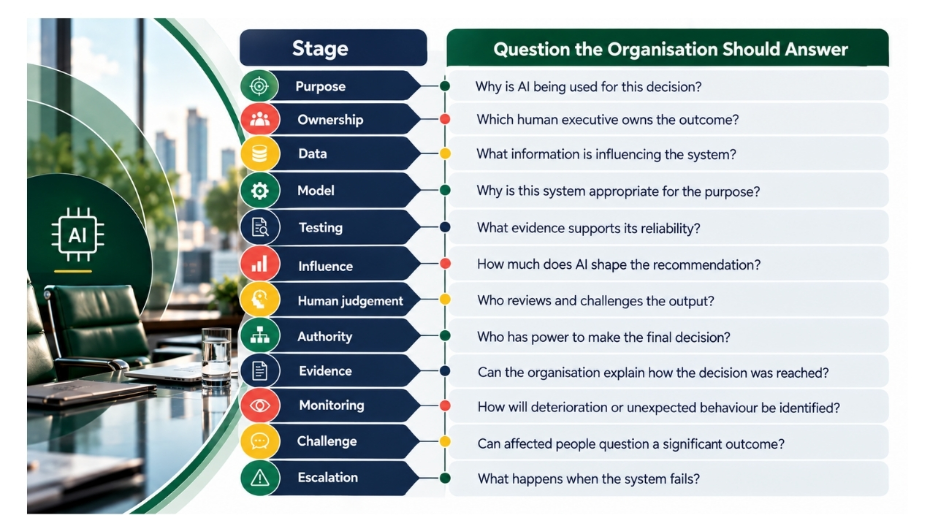
The framework is deliberately simple.
Its purpose is to prevent sophisticated technology from producing ambiguous responsibility.
What should Company Secretaries do now?
The profession does not need to wait for every AI rule to be finalised before strengthening governance.
A sensible first step is to work with technology, legal, risk, compliance and business teams to identify where AI already influences material decisions. Once that map exists, the organisation can determine which decisions deserve stronger governance and who should remain accountable.
Delegated authorities should then be examined through an AI lens. Existing frameworks may need adjustment where systems materially shape decisions without holding formal authority themselves.
Board information also deserves attention. Where AI substantially influences a recommendation, directors should receive enough information to understand the nature of that influence, the material assumptions involved and the human validation applied.
Governance teams can then help establish escalation thresholds, evidence requirements and appropriate assurance. The goal is not to create paperwork around every use of AI. It is to apply governance proportionately where the consequences matter.
Finally, board development should move beyond generic AI awareness. Directors need practical confidence in challenging AI-enabled decisions.
Seven warning signs AI has moved ahead of your governance
Several indicators should concern boards.
If directors cannot identify where AI materially influences decisions, effective oversight is unlikely. The same applies where human review exists formally but rarely alters outcomes, because that may indicate weak challenge rather than exceptional model performance.
Another warning sign appears when nobody can identify the individual accountable for an AI-assisted outcome. Fragmented adoption across departments can compound this problem, particularly when different teams operate under different standards.
Board papers containing materially AI-generated analysis without appropriate context should also attract attention. Likewise, AI incidents without clear escalation routes indicate that technology has developed faster than governance architecture.
Perhaps the clearest warning sign is an organisation with a sophisticated AI policy but no clear answer to a simple question:
Who owns the decision?
Policy alone cannot resolve accountability.
Ten questions every board should be able to answer
A useful board conversation can begin with ten questions:
- Which material decisions are currently influenced by AI?
- Who remains accountable for each decision?
- How materially does AI shape the recommendation?
- Where is meaningful human review required?
- Can reviewers reject AI recommendations without organisational penalty?
- What evidence tells us that material systems remain reliable?
- Which AI incidents would reach the board?
- Can significant outcomes be challenged or appealed?
- Does the board receive enough information to oversee the organisation’s most consequential AI uses?
- Could we explain our decision process confidently to a regulator, investor, employee or customer after something went wrong?
A board unable to answer several of these questions does not necessarily have an AI technology problem.
It has an accountability problem.
Does your board have the governance foundations to oversee AI?
AI often exposes weaknesses that existed before the technology arrived.
Poor information flows become more dangerous when management relies on machine-generated analysis. Weak delegated authority becomes more consequential when systems influence decisions, while unclear committee responsibilities can leave AI somewhere between technology, risk, audit and strategy.
Board effectiveness is therefore part of AI readiness.
The Lumorus Board Health Check provides Chairs, directors, Company Secretaries and governance leaders with a practical starting point for examining whether the board’s underlying governance architecture is ready for greater technological complexity.
Areas such as board capability, information quality, challenge, decision making, accountability, committee effectiveness and risk oversight all matter because AI governance cannot be stronger than the board governance beneath it.
Where the assessment identifies deeper concerns, organisations can consider a Governance Review, Board Evaluation & Assessment or Board Skills Audit.
Assess your governance foundations: Take the Lumorus Board Health Check
Why CoSec Hub matters in the AI accountability era
AI adds another strategic responsibility to a profession already experiencing a broader mandate.
That makes the Company Secretary operating model increasingly important.
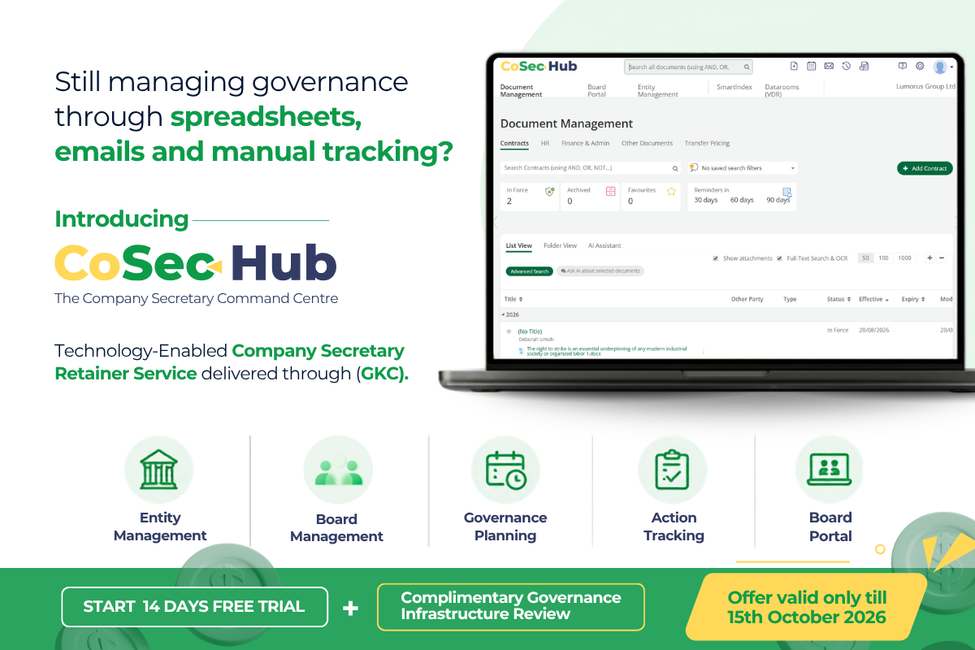
CoSec Hub is built around the principle that governance technology should reduce repetitive administration so experienced Company Secretaries can spend more time exercising professional judgement.
Its technology layer can support entity management, compliance calendars, governance forward planning, board management, statutory registers, board action tracking, meeting lifecycle management and governance records.
Alongside that infrastructure, the Governance Knowledge Centre provides access to Chartered Company Secretary expertise, governance operations support, compliance monitoring, governance intelligence, multi-jurisdiction support and governance advisory.
Together, these capabilities create a Technology-Enabled Company Secretary Retainer Service designed around where the profession is heading.
As AI assumes more routine work and influences more organisational decisions, professional governance capacity should move towards the areas machines cannot own: accountability, interpretation, challenge, escalation and institutional judgement.
Technology should automate governance work where appropriate. It should never automate governance accountability away.
Explore: CoSec Hub
The Lumorus View
AI is creating decisions with more contributors, more data and increasingly complex chains of influence. Corporate accountability, however, cannot become equally distributed.
That is the central governance challenge.
The greatest danger is not simply that an algorithm makes a bad recommendation. Human beings make poor judgements too. What makes AI different is its ability to create enough distance between analysis and decision that responsibility begins to dissolve.
Management may say the model recommended the outcome. Technology can confirm that the system worked as designed, while the vendor points to the organisation’s configuration. A reviewer may say that a human remained involved, and the board may explain that it relied on management’s assurance.
Everyone participated, yet nobody appears to own what happened.
Corporate governance exists precisely to prevent that outcome.
For the Company Secretary, this creates an important new responsibility. The profession should not try to determine how every model works or replace technical specialists. Its task is to help ensure that technological complexity never makes institutional accountability unclear.
Every material AI-assisted decision should ultimately allow the organisation to answer five questions.
Who had authority?
Exercised judgement?
Challenged the recommendation?
What evidence supported the decision?
Who remains accountable for the outcome?
If those answers are clear, AI can strengthen organisational capability without weakening governance.
If they are not, the technology has moved faster than the institution around it.
The Bottom Line
The Chartered Governance Institute’s September 2026 research offers a timely warning. AI adoption is advancing faster than many governance systems, while boards can lack visibility over how the technology is being used and confidence in challenging AI-generated outputs.
Evidence from the Financial Reporting Council points in a similar direction. Generative AI is already becoming embedded in corporate reporting, yet governance practices remain uneven, including significant variation in mandated human oversight.
International frameworks reinforce the same underlying principle. The NIST AI Risk Management Framework places governance within the lifecycle of AI risk management, while the OECD AI Principles emphasise accountability alongside transparency and responsible stewardship.
For Company Secretaries, the implications are substantial.
Their emerging role is not to govern algorithms in isolation. It is to help boards govern the institutional systems through which algorithms increasingly influence human decisions.
That means greater attention to decision rights, board information, delegated authority, evidence, human oversight, escalation and accountability.
The defining question is therefore not whether AI made the decision.
In most organisations, reality will be more complicated.
The better question is:
How did AI influence the decision, where did human judgement enter, and who ultimately owns the outcome?
If nobody can answer clearly, the organisation has created something corporate governance should never tolerate.
A material decision without clear human accountability.
Continue Exploring
- Build connected governance infrastructure for the modern Company Secretary: CoSec Hub
- Strengthen governance structures around AI and emerging risk: Corporate Governance Support
- Assess whether your board is ready for AI-era oversight: Lumorus Board Health Check
- Review whether governance architecture remains fit for purpose: Governance Review
- Assess board capability for AI, technology and emerging risk: Board Skills Audit
- Evaluate board oversight, challenge and decision quality: Board Evaluation & Assessment
- Improve board information and meeting governance: Board & Shareholder Meetings
- Strengthen the institutional record of significant decisions: Minute Taking Solutions
About CoSec Hub
CoSec Hub is the Company Secretary Command Centre, built by Company Secretaries for Company Secretaries.
It combines governance technology with Chartered Company Secretary expertise to help organisations create the capacity required for a more complex governance environment.
Rather than relying on experienced professionals to manually connect fragmented entity information, compliance calendars, board processes, actions and governance records, CoSec Hub provides infrastructure that can bring those activities into a more connected environment.
Through the Governance Knowledge Centre, organisations can also access professional expertise when governance requires interpretation, context and judgement.
The operating principle is increasingly important in the AI era:
Automate the repeatable work so experienced Company Secretaries can spend more time governing the difficult work.
AI should create capacity for better governance.
It should not create ambiguity about accountability.
Explore CoSec Hub to strengthen the governance infrastructure behind increasingly technology-enabled decisions.
Lumorus: Better Business, Built on Purpose
Lumorus is a UK headquartered global governance, ESG, Company Secretary and advisory firm supporting organisations across Europe, Africa, Asia, the Caribbean, Canada, the Middle East and international markets.
We help boards and leadership teams strengthen the structures through which authority, decisions, accountability and oversight operate.
As AI becomes more influential, boards need greater clarity around decision rights, human accountability, information flows, delegated authority, escalation, evidence and assurance.
Our governance capabilities include Corporate Governance Support, Governance Review, Board Evaluation & Assessment, Board Skills Audit and Board & Shareholder Meetings.
For governance functions managing greater operational complexity, CoSec Hub combines governance infrastructure with professional Company Secretary capability.
One question provides a useful starting point for every board:
Can we identify every material decision AI currently influences and the human being who remains accountable for it?
Where the answer is unclear, governance work is already required.
Take the Lumorus Board Health Check, explore CoSec Hub or visit Lumorus to strengthen governance for an increasingly AI-enabled organisation.
Lumorus: Better Business, Built on Purpose.
Sources
The Chartered Governance Institute UK & Ireland: AI Adoption Is Outpacing Governance Oversight
Published on 10 September 2026, the research finds that AI is becoming embedded in organisational decision making faster than governance frameworks, assurance mechanisms and board capability are developing. It also highlights limited board visibility and low confidence in challenging AI-generated outputs.
Financial Reporting Council: The Use of Artificial Intelligence Technologies in Corporate Reporting
The FRC’s 2026 research examines AI adoption across corporate reporting, including generative AI use, human oversight, management visibility, data risks and the continuing importance of human judgement in higher-risk reporting activities.
NIST: Artificial Intelligence Risk Management Framework
NIST’s voluntary framework provides an established approach for incorporating trustworthiness considerations into the design, development, use and evaluation of AI systems.
The OECD principles provide an international framework for trustworthy AI, including accountability, transparency, robustness and responsible stewardship.
A practical board diagnostic for examining wider governance foundations including board capability, information, decision making, challenge and accountability.