Audit readiness begins long before the auditor asks for evidence.
The evidence problem
A board approves a major transaction.
Six months later, someone needs to establish exactly what directors approved, which papers they considered, whether they declared conflicts, what conditions they attached to the decision and whether anyone completed the resulting actions.
How quickly can the organisation answer?
That question gets to the heart of audit ready governance.
A well governed organisation should not have to reconstruct its governance history when an auditor, regulator, investor, lender or new director asks for evidence. Decisions, responsibilities, approvals, filings, conflicts and actions should already form part of a reliable governance record.
Where organisations fall short
Yet many organisations still operate differently.
The Diligent Global State of Legal Entity Compliance 2026 surveyed more than 300 senior practitioners across 38 jurisdictions and found that 55% still manage entity information through spreadsheets, Word documents and SharePoint. Meanwhile, 52% spend at least six hours each week tracking filings, deadlines and record updates, while 51% experienced a near miss in which an entity obligation almost went unmet.
The problem is not simply inefficient administration. It is weak governance infrastructure.
Rising expectations
At the same time, expectations are rising. The UK Corporate Governance Code 2024 now requires boards within its scope to monitor their risk management and internal control framework, review its effectiveness at least annually and, under Provision 29, make a declaration about the effectiveness of material controls. Provision 29 applies to financial years beginning on or after 1 January 2026.
Although those requirements do not apply to every organisation, they reflect a wider direction of travel. Boards are increasingly expected not merely to govern, but to demonstrate how governance operated.
What this means for Company Secretary services
That changes what organisations should expect from Company Secretary services.
The strongest providers do more than organise meetings and complete filings. They create the governance infrastructure that allows a board to demonstrate what was decided, who was accountable, what happened next and whether the organisation met its obligations.
Read More: Company Secretary Outsourcing
What does audit-ready governance actually mean?
Audit-ready governance does not mean turning every board meeting into an audit exercise.
Nor does it mean creating excessive paperwork.
Instead, it means that the organisation’s governance evidence is accurate, current, controlled and retrievable when scrutiny arrives.
A board should be able to establish a clear line between:
Authority → Information → Decision → Action → Evidence
That chain matters because governance failures often appear in the gaps.
Perhaps the board approved something, but the minutes do not clearly record the decision. An action may have been assigned, although nobody can demonstrate that it was completed. A subsidiary could have made a filing, but the group has no central evidence. Alternatively, directors may have discussed a conflict without the governance record showing how it was managed.
Audit-ready governance reduces those gaps.
It creates a reliable institutional record of how authority was exercised.
For boards, that is more than good administration.
It is evidence of control.
The governance profession itself is becoming more important to board decision-making
The traditional image of the Company Secretary as primarily responsible for board papers, minutes and statutory compliance is increasingly outdated.
The Chartered Governance Institute UK & Ireland Governance Market Survey 2026, based on responses from 971 governance professionals, found that 65% believe the influence of the governance function is increasing. Moreover, 66% said supporting board information quality and decision-making is becoming more important.
Pressure is increasing alongside that influence.
Almost three-quarters of respondents reported greater workloads over the previous year, while 42% said their governance function was not adequately resourced for its existing responsibilities.
This creates an important question for boards.
If governance expectations are becoming more demanding while internal teams remain stretched, what operating model provides reliable support without simply adding more administration?
Increasingly, the answer lies in combining professional Company Secretary expertise with better governance systems.
The Company Secretary services that matter most for audit-ready governance
Not every organisation needs the same service model.
A listed multinational, private group, investment business, regulated firm and fast-growing founder-led company will face different governance requirements.
Nevertheless, boards that want stronger governance evidence should expect several core capabilities.
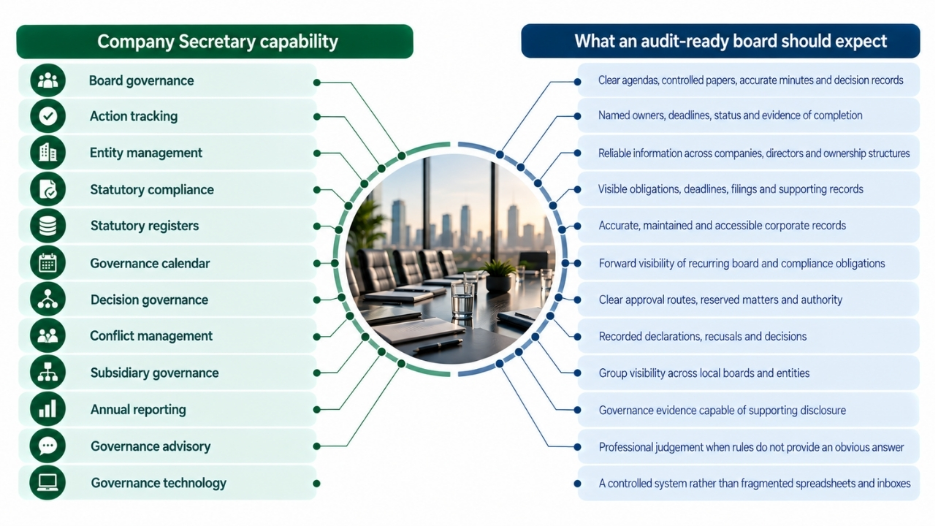
The distinction is important.
Audit-ready governance is not a single service. It is the result of these capabilities working together.
1. Board and shareholder meeting support should preserve the decision trail
Board meetings create some of an organisation’s most important governance evidence.
Consequently, meeting support should involve much more than sending invitations and taking minutes.
Before the meeting, directors need timely and appropriate information. During the meeting, significant decisions, challenge, conflicts and agreed actions need to be captured properly. Afterwards, approved actions should move into a reliable follow-up process.
The FRC Corporate Governance Code Guidance states that boards should oversee the flow of information to and from the board, including its nature, source, format and frequency. It also emphasises that boards should monitor whether the information they receive is of sufficient quality to support effective decision-making.
Good Company Secretary support therefore strengthens the entire meeting lifecycle:
- Annual board planning
- Agenda development
- Board-paper coordination
- Paper quality and timeliness
- Conflict declarations
- Meeting administration
- Decision recording
- Minute preparation
- Action tracking
- Follow-up reporting
When these elements operate consistently, the organisation can demonstrate not only that a meeting happened, but how governance operated within it.
Read More: Board & Shareholder Meetings
2. High-quality minutes should provide evidence without becoming transcripts
Minutes are one of the most important components of the governance record.
Weak minutes can leave the organisation unable to demonstrate how a significant matter was considered. However, excessively detailed minutes can create a different problem by becoming unwieldy transcripts rather than useful governance records.
Good minutes should capture the substance.
That generally includes the issue considered, material challenge where appropriate, conflicts identified, the decision reached and actions arising from the discussion.
Context matters as well.
If directors challenge a significant assumption before approving an investment, the governance record should provide enough evidence to demonstrate that meaningful consideration occurred.
The objective is not to record every sentence.
It is to preserve the decision trail.
For organisations with limited internal governance capacity, professional Minute Taking Solutions can strengthen both the quality and consistency of that record.
3. Board action tracking turns decisions into accountability
A board decision is not complete simply because the meeting has ended.
Someone usually has to act.
That person may need to revise a policy, investigate a risk, negotiate a contract, provide additional information or return to the board with an update.
Without structured action tracking, those commitments can disappear into meeting minutes and email chains.
An audit-ready process should record:
- The agreed action
- The responsible owner
- The due date
- Current status
- Evidence of completion
- Revised deadlines where necessary
- Escalation of overdue material actions
This provides something boards frequently lack: visibility over whether their decisions are actually being implemented.
The governance chain then becomes stronger:
Decision → Owner → Deadline → Action → Evidence → Closure
That is not administrative neatness.
It is accountability made visible.
4. Entity management should create one reliable governance record
Complexity increases quickly when organisations operate through multiple legal entities.
Each company may have its own:
- Directors
- Shareholders
- Ownership structure
- Registered office
- Statutory filings
- Licences
- Board meetings
- Local obligations
- Powers of attorney
- Governance documents
When this information is spread across spreadsheets, shared drives, emails and individual knowledge, reconciliation becomes unavoidable.
Diligent’s 2026 benchmark found that 55% of surveyed governance teams were still using spreadsheets, Word documents and SharePoint to manage entity information, while only 33% used a dedicated platform.
For boards, the risk is straightforward.
If nobody is certain which record is authoritative, governance decisions may be based on stale information.
Strong entity management should therefore create a dependable source of governance data while maintaining the supporting evidence behind it.
The aim is not merely centralisation.
It is control over corporate information.
5. Compliance calendars should prevent surprises
Weak compliance systems often operate backwards.
A deadline becomes urgent, someone searches for the required information, documents are assembled and the filing is completed just before time runs out.
Occasionally, the deadline is missed.
A stronger Company Secretary service operates prospectively.
Compliance calendars should provide forward visibility over:
- Confirmation statements
- Annual accounts
- Regulatory filings
- Board approvals
- Licence renewals
- Director changes
- Shareholder actions
- Governance reviews
- Policy reviews
- Recurring statutory obligations
Responsibility should also be visible.
A calendar that shows a deadline without identifying the person accountable for meeting it provides only partial control.
This is particularly important for groups with several entities because compliance risk increases as obligations multiply.
Read More: Statutory & Regulatory Compliance
6. Companies House reform has raised the importance of accurate entity governance
The UK’s corporate transparency regime is changing significantly under the Economic Crime and Corporate Transparency Act 2023.
Since March 2024, Companies House has gained enhanced powers to query information and request supporting evidence. Companies must also maintain an appropriate registered office address, provide a registered email address and confirm lawful purpose requirements.
Identity verification represents another major change.
From 18 November 2025, identity verification became a legal requirement for new directors and people with significant control, with existing directors and PSCs brought into the regime through a phased transition. Current directors generally provide their personal code through the company’s confirmation statement, while PSC requirements depend on their circumstances.
These reforms matter because the role of Companies House is changing.
Historically, organisations could sometimes think about filing primarily as an administrative process. The registrar now has stronger powers directed at improving the accuracy and integrity of register information.
For boards, accurate entity records are therefore becoming even more important.
The governance system should know who the directors are, who controls the company, which filings are due and whether the underlying information is correct before it reaches the public register.
7. Statutory registers should not become a year-end reconstruction exercise
Registers and corporate records are easy to neglect because they rarely feel urgent until someone needs them.
Then they become very urgent.
A transaction, due diligence exercise, audit, refinancing, investment round or regulatory request may require the organisation to establish historical information quickly.
If the underlying records have not been maintained, teams may spend significant time reconstructing the corporate history.
That is avoidable.
A stronger approach maintains governance records as events happen rather than trying to recreate them months or years later.
This principle applies beyond statutory registers.
It should cover:
- Director changes
- Ownership changes
- Board approvals
- Shareholder decisions
- Corporate authorities
- Material governance documents
- Supporting evidence
Audit readiness is therefore largely a question of timing.
Evidence created when governance happens is usually stronger than evidence reconstructed when scrutiny arrives.
8. Conflict-of-interest governance needs a visible process
Boards increasingly operate in complex networks of investments, appointments, advisers, shareholders and commercial relationships.
Conflicts are therefore not unusual.
The governance failure occurs when they are unidentified or poorly managed.
An effective Company Secretary service should help establish a process for:
- Periodic director declarations
- Transaction-specific declarations
- Conflict registers
- Board consideration
- Recusal where appropriate
- Minute evidence
- Continuing review
This becomes particularly important for private companies, investment businesses, joint ventures and family-controlled organisations where directors may hold several overlapping interests.
The purpose is not to eliminate every potential conflict.
Often that would be impossible.
Instead, governance should make the conflict visible and demonstrate how it was handled.
9. Reserved matters and delegated authorities should show who can decide what
Audit-ready governance depends on traceable authority.
If an executive signs a significant contract, the organisation should be able to establish that the person had authority to do so.
Likewise, matters reserved for the board should actually reach the board.
As organisations grow, this becomes more difficult because decision-making spreads across subsidiaries, functions and jurisdictions.
A strong governance framework should connect:
- Articles and constitutional documents
- Matters reserved for the board
- Committee terms of reference
- Delegated authorities
- Financial approval limits
- Local subsidiary authority
- Powers of attorney
Without that architecture, organisations can become uncertain about who possesses authority.
The board may then discover that the practical allocation of power no longer matches the formal governance structure.
That is precisely the type of weakness audit-ready governance should expose before an external reviewer does.
Explore More: Corporate Governance Support
10. Subsidiary governance should give the parent board visibility
A parent board cannot govern a group effectively if material subsidiary information remains trapped locally.
As groups expand, subsidiary governance often becomes fragmented.
One entity may have an active board, another may approve decisions by written resolution, while a third depends heavily on local advisers. Records may be stored differently in every jurisdiction.
The result is legal structure without governance coherence.
Audit-ready subsidiary governance should help the parent understand:
- Which entities are active
- Who sits on their boards
- What authority local directors hold
- Which significant decisions have been made
- Whether filings are current
- Which risks require escalation
- Where governance exceptions exist
Central visibility does not require every subsidiary to operate identically.
Local requirements matter.
However, the group should still have a coherent governance framework.
What boards should look for when choosing a Company Secretary service
The phrase Company Secretary services covers very different operating models.
Some providers focus mainly on statutory filings. Others provide entity administration at scale, while governance advisers may concentrate more heavily on boards, controls and decision-making.
A board seeking audit-ready governance should therefore look beyond the service list.
The more useful question is:
What governance capability will this provider actually create?
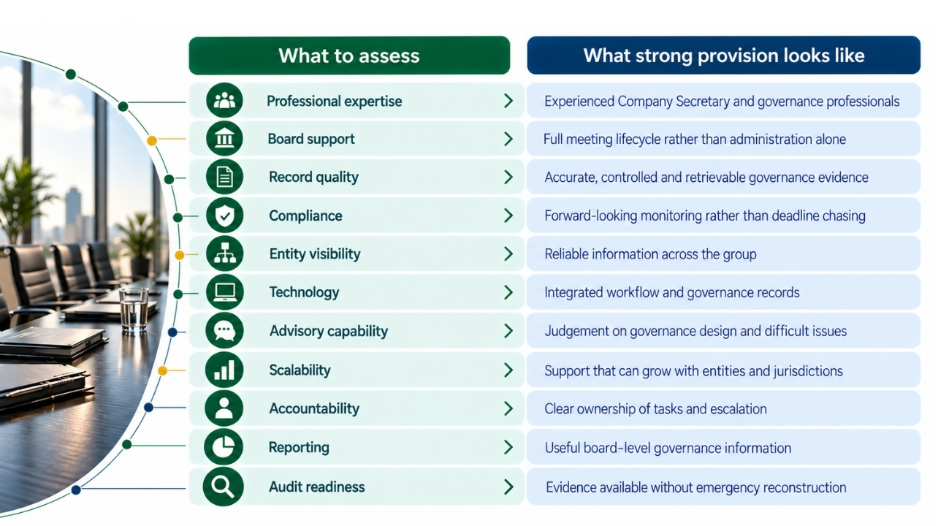
Price matters.
However, the cheapest filing service may become expensive if senior management later spends weeks reconstructing records, correcting filings or explaining gaps during due diligence.
Why software alone does not create audit-ready governance
Technology is an essential part of modern Company Secretary delivery.
It can centralise records, automate reminders, track actions, manage entities and improve visibility.
However, software does not decide whether a conflict has been handled properly.
It cannot independently determine whether a board paper gives directors enough information to make a difficult decision. Nor can a platform decide whether a governance issue should be escalated, whether minutes fairly capture a sensitive discussion or whether the governance structure remains appropriate as the organisation changes.
Those decisions require judgement.
The strongest operating model therefore combines:
Technology + Professional expertise + Governance process + Accountability
Technology creates structure.
Professional expertise determines how that structure should be used.
Read More: Why Company Secretary Software Alone Cannot Solve Governance Challenges
Audit-ready governance and Provision 29: why the direction matters
Provision 29 of the UK Corporate Governance Code 2024 deserves particular attention because it illustrates the changing relationship between boards, controls and evidence.
For companies within the Code’s scope, the board should monitor the risk management and internal control framework and review its effectiveness at least annually. From financial years beginning on or after 1 January 2026, the annual report should include a declaration regarding the effectiveness of material controls at the balance sheet date, alongside relevant information about ineffective material controls and remedial action.
Importantly, the FRC makes clear that material controls are not confined to financial controls. They can include operational, reporting and compliance controls, including controls relating to narrative and ESG reporting.
The board must make its assessment using evidence obtained through monitoring and review.
That word matters.
Evidence.
Even organisations outside the Code’s formal scope should pay attention to the underlying governance principle.
Assertions are weaker than evidence.
A board that says its governance is effective should be able to demonstrate why it believes that.
The audit-ready governance test
Boards can conduct a simple test.
Imagine that tomorrow morning an auditor, regulator, investor or lender requests evidence concerning ten areas.
Could the organisation produce it quickly?
1. Board decisions
Can you locate the relevant paper, minutes, resolution and approval?
2. Board actions
Can you show who owned each material action and whether it was completed?
3. Director information
Are appointments, resignations, interests and relevant records current?
4. Entity structure
Can you produce an accurate group structure and ownership record?
5. Statutory compliance
Can you demonstrate which filings were required and when they were completed?
6. Conflicts
Can you show how director conflicts were identified and managed?
7. Delegated authority
Can you establish who was authorised to make a particular decision?
8. Subsidiary governance
Can headquarters see significant decisions and obligations across the group?
9. Governance controls
Can you identify the controls governing material governance processes?
10. Evidence
Can the supporting record be produced without searching through individual inboxes?
If several answers depend on one person’s memory, governance is not genuinely audit ready.
It is person dependent.
The hidden cost of poor audit readiness
Weak governance records rarely remain a governance-team problem.
Eventually, they consume senior management time.
Imagine a refinancing or acquisition due diligence exercise begins.
The organisation suddenly needs historical board approvals, statutory records, ownership information, director appointments, shareholder resolutions and evidence of key decisions.
If records are fragmented, lawyers become involved.
Finance teams start searching.
Directors receive old emails asking whether they remember what happened.
Documents are compared against spreadsheets.
Missing approvals need explanation.
The immediate cost is time.
The deeper cost is confidence.
An investor or lender seeing weak corporate records may reasonably ask what other controls are equally weak.
Good governance therefore has transaction value.
It allows the organisation to respond to scrutiny without appearing surprised by its own corporate history.
Why governance teams need more capacity, not simply more tasks
The pressure on governance professionals is already substantial.
The CGI Governance Market Survey 2026 found that 74% of respondents had experienced increased workloads, while 42% believed their governance function was not adequately resourced.
Diligent’s research points in the same direction. Its 2026 benchmark found that 74% of governance professionals said their scope had expanded over the previous two years, while 63% reported workload growing faster than their teams or teams being reduced.
Adding another spreadsheet is not a credible answer.
Neither is expecting a small governance team to absorb unlimited complexity.
Boards should instead ask which activities require professional judgement and which can be systematised.
Technology can handle recurring workflows, reminders, records and structured information.
Governance professionals should spend more time on board judgement, challenge, risk, decision quality and emerging governance issues.
That is a better allocation of scarce expertise.
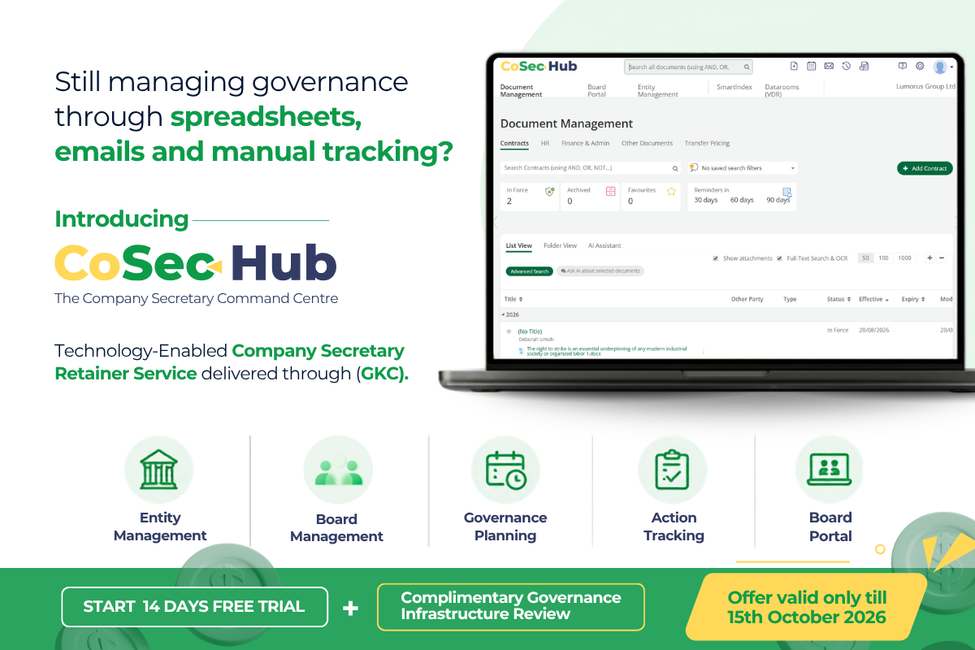
Why CoSec Hub is built around audit-ready governance
CoSec Hub is designed around a simple idea:
Company Secretary support should create governance capability, not simply process transactions.
The model combines governance technology with professional Company Secretary expertise, allowing organisations to strengthen both the administrative foundation and the judgement required around it.
The technology layer can support:
- Entity management
- Compliance calendars
- Governance forward planning
- Board management
- Statutory registers
- Board action tracking
- Meeting lifecycle management
- Governance records
Alongside that infrastructure, professional support can provide:
- Company Secretary expertise
- Governance operations support
- Compliance monitoring
- Board administration
- Governance intelligence
- Multi-jurisdiction support
- Governance advisory
The distinction matters.
Software alone can organise information.
Traditional outsourcing can complete tasks.
A connected governance model should do both while giving the board better visibility over the organisation’s governance position.
CoSec Hub + Governance Knowledge Centre: Where Automation Meets Governance Authority.
Explore: CoSec Hub
What an audit-ready governance operating model looks like
A mature organisation should be moving from fragmented administration towards connected governance.
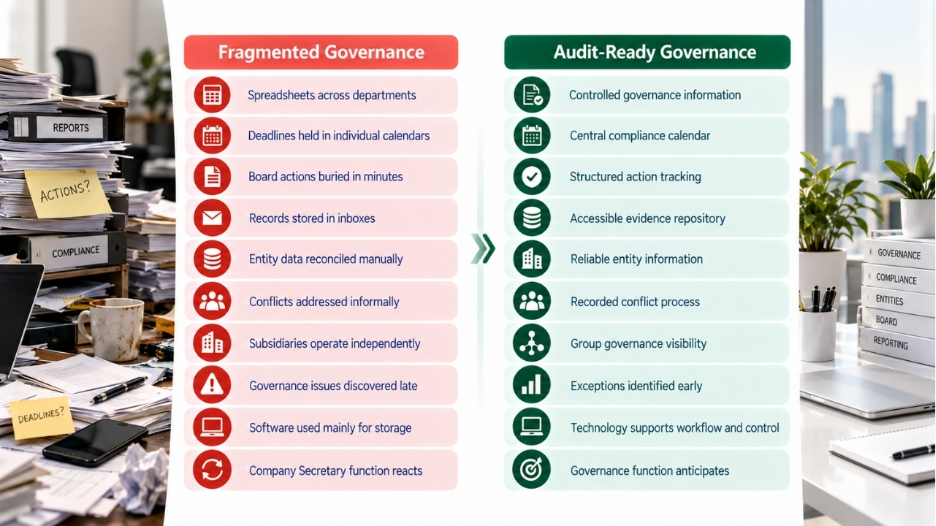
The objective is not perfection.
It is reliability.
A good governance system should make routine obligations predictable and unusual issues visible.
When should a board consider outsourced Company Secretary support?
Outsourcing does not necessarily mean replacing an internal governance function.
For many organisations, the strongest model combines internal leadership with specialist external capacity.
Additional support becomes particularly valuable when:
- The group is adding legal entities
- International expansion is accelerating
- The board calendar is becoming more demanding
- Compliance obligations are increasing
- Governance records are fragmented
- A transaction or investment round is approaching
- The organisation is preparing for greater regulatory scrutiny
- Internal governance resources are stretched
- Subsidiary oversight is inconsistent
- The board wants stronger governance reporting
- The business is moving towards listing or institutional investment
In these circumstances, the question is not simply whether tasks can be outsourced.
It is whether the governance operating model can be strengthened.
Read More: Company Secretary Outsourcing
Seven warning signs your governance is not audit ready
Boards should pay attention when any of the following becomes normal.
1. Finding a board approval requires an email search
Important decisions should have an institutional record.
2. Compliance deadlines depend on one person’s calendar
That is key-person risk disguised as a process.
3. Nobody trusts the entity spreadsheet completely
A source of truth that requires constant verification is not a source of truth.
4. Board actions repeatedly return as overdue
The problem may be accountability rather than administration.
5. Subsidiary information arrives only when requested
Group governance should provide visibility before questions arise.
6. Governance evidence is assembled mainly before audits or transactions
That suggests the organisation is reconstructing governance rather than maintaining it.
7. The board receives activity reports but little governance insight
Knowing how many meetings or filings occurred is useful. Knowing where governance risk is increasing is more valuable.
When several of these signs appear together, another checklist will rarely solve the problem.
The governance infrastructure needs attention.
Questions to ask a Company Secretary service provider before appointing them
Boards and governance leaders should test potential providers carefully.
Ask:
- Who will actually provide our Company Secretary support?
- What professional governance expertise sits behind the service?
- How will you maintain our entity information and supporting evidence?
- How do you monitor statutory and regulatory obligations?
- How are board decisions and actions tracked?
- How do you support governance across multiple jurisdictions?
- What technology supports the service?
- Who owns and controls our governance data?
- How quickly can records be produced for an audit or transaction?
- How are governance exceptions escalated?
- Can you support the board beyond routine administration?
- How does the service scale as our organisation grows?
The answers reveal whether the provider is selling administrative capacity or genuine governance capability.
That distinction should drive the buying decision.
The Lumorus View
The best Company Secretary services do not prepare organisations for an audit. They keep the organisation in a condition where governance can withstand scrutiny at any time.
That is a materially different standard.
Audit readiness should not begin when somebody sends a document request.
It should emerge naturally from how governance operates every day.
Board papers are controlled.
Decisions are recorded.
Actions are followed.
Entity information is reliable.
Compliance obligations are visible.
Conflicts are managed.
Authority can be traced.
Subsidiary governance is connected.
Evidence exists because the process created it.
For boards, this is the real value of a strong Company Secretary function.
The function preserves institutional memory while strengthening accountability. More importantly, it helps ensure that the organisation can explain not merely what it did, but how authority was exercised and controlled.
That is governance.
The Bottom Line
Boards are operating in an environment where governance evidence matters more.
The FRC’s 2024 Corporate Governance Code has strengthened expectations around evidence supporting the effectiveness of material controls for companies within its scope. Meanwhile, Companies House reforms are increasing scrutiny over corporate information, directors and beneficial ownership.
At the same time, governance teams are under pressure.
Diligent reports that 51% of surveyed governance professionals experienced a near-miss entity compliance event, while CGI’s 2026 survey found that 42% believe their governance functions are not adequately resourced.
Boards should not respond by creating more fragmented administration.
They need better governance infrastructure.
The best Company Secretary services therefore combine:
- Professional expertise
- Board governance
- Entity management
- Compliance monitoring
- Reliable records
- Action tracking
- Governance technology
- Multi-jurisdiction support
- Governance advisory
- Evidence and accountability
A board should never have to recreate its governance history in order to prove that governance happened.
The evidence should already exist.
Continue Exploring
- Strengthen your day-to-day governance infrastructure: Company Secretary Outsourcing
- Improve board meeting governance and decision records: Board & Shareholder Meetings
- Build stronger statutory and regulatory controls: Statutory & Regulatory Compliance
- Strengthen the quality of your board minutes: Minute Taking Solutions
- Improve governance structures and board support: Corporate Governance Support
- Build governance into a new corporate structure: Company Formation & Structuring
- Explore technology-enabled Company Secretary support: CoSec Hub
About CoSec Hub
CoSec Hub is the Company Secretary Command Centre, built by Company Secretaries for Company Secretaries.
It combines governance technology with professional Company Secretary expertise to help organisations manage governance more systematically.
Rather than relying on disconnected spreadsheets, inboxes, calendars and document repositories, CoSec Hub can bring together entity information, compliance calendars, governance forward planning, board management, statutory records and action tracking within a more connected operating model.
The accompanying Governance Knowledge Centre adds the professional expertise required where governance depends on judgement rather than automation.
The result is a different model of Company Secretary support.
Not software alone. Not traditional outsourcing alone. Connected governance infrastructure.
Visit CoSec Hub to explore how technology-enabled Company Secretary support can strengthen audit readiness and board governance.
Lumorus: Better Business, Built on Purpose
Lumorus is a UK headquartered global governance, ESG, Company Secretary and advisory firm supporting organisations across Europe, Africa, Asia, the Caribbean, Canada, the Middle East and international markets.
We help boards and leadership teams build governance systems capable of supporting growth, scrutiny and institutional trust.
Our Company Secretary capabilities include:
For organisations seeking a more connected operating model, CoSec Hub combines governance technology with professional Company Secretary expertise and governance knowledge infrastructure.
Could your organisation produce the evidence of its most important governance decisions tomorrow, or would your team first need to reconstruct what happened?
That question is worth answering before an auditor, regulator, investor or transaction team asks it.
Explore Lumorus or visit CoSec Hub to strengthen your organisation’s governance infrastructure and audit readiness.
Lumorus: Better Business, Built on Purpose.
Sources
- Financial Reporting Council: UK Corporate Governance Code 2024 – Current UK Corporate Governance Code, including Provision 29 and requirements concerning risk management and material internal controls.
- Financial Reporting Council: Corporate Governance Code Guidance – Guidance covering board information, communication, risk management, controls and effective decision-making.
- Financial Reporting Council: Provision 29 Mythbuster – FRC explanation of the board’s declaration concerning material controls and the evidence supporting its assessment.
- Chartered Governance Institute UK & Ireland: Governance Market Survey 2026 – Research based on 971 governance professionals covering workload, board information, governance influence and resourcing.
- Diligent: Global State of Legal Entity Compliance 2026 – Global research into entity compliance, governance workload, technology, manual processes and operating models.
- Diligent: Global State of Entity Compliance Benchmark Analysis – Findings covering expanded governance mandates, workload, manual systems, dedicated platforms and near-miss compliance events.
- Companies House: When You Need to Verify Your Identity – Current requirements for directors, people with significant control and other relevant roles under the identity verification regime.
- Companies House: New Powers to Tackle Fraud – Changes introduced under the Economic Crime and Corporate Transparency Act, including enhanced registrar powers, registered office requirements and registered email addresses.
- UK Government: Role and Powers of the Registrar of Companies – Explanation of the enhanced Companies House role in improving the accuracy and integrity of corporate information.