Africa’s governance complexity is rising. The real challenge is keeping the whole group visible
Expansion across Africa can create considerable commercial opportunity. However, every additional jurisdiction also adds another layer of governance.
A group may begin with a company in Kenya, add operations in Nigeria and South Africa, acquire a business in Ghana and later establish subsidiaries in Rwanda or an OHADA jurisdiction. Before long, the organisation is managing different company laws, regulators, beneficial ownership rules, filing calendars, board requirements and corporate records; the issue is not simply that there is more work, it is that governance can become fragmented.
That risk is becoming more important as governance expectations rise. In April 2026, the Capital Markets Authority Kenya reported that the overall governance score for issuers of securities to the public had increased from 74% to 79% for the 2024/25 financial year. The assessment covers listed companies and corporate bond issuers against Kenya’s corporate governance framework.
Meanwhile, South Africa has entered a new governance cycle. The Institute of Directors in South Africa’s King V Report on Corporate Governance applies to financial years beginning on or after 1 January 2026. It also introduces a dedicated disclosure framework intended to improve consistency and comparability.
Nigeria follows a different model again. The Securities and Exchange Commission Nigeria Corporate Governance Guidelines require public companies to comply with the Nigerian Code of Corporate Governance and the SEC’s additional governance guidelines.
For multi-jurisdiction groups, therefore, the real question is no longer whether each subsidiary is locally compliant, it is whether the board can see, understand and govern the organisation as one connected group.
Read More: Corporate Governance Support
Executive Takeaway
The strongest Company Secretary services for multi-jurisdiction entities in Africa should combine:
- Local regulatory knowledge
- Central entity oversight
- Board and shareholder support
- Statutory and regulatory compliance
- Beneficial ownership management
- Compliance calendars
- Statutory registers
- Director and officer administration
- Entity formation and restructuring
- Governance reporting
- Board action tracking
- Regulatory change monitoring
- Governance technology
- Experienced Company Secretary judgement
However, geographic coverage alone is not enough, a provider may support many countries while still leaving the client with disconnected advisers, separate systems and poor group visibility.
The stronger test is whether the provider can create one governance operating model across several legal environments, that distinction separates entity administration from governance infrastructure.
Africa is not one governance jurisdiction
Africa is often described as one growth market. From a governance perspective, it is anything but one market.
A multi-jurisdiction group may encounter common-law systems, civil-law systems, OHADA business law, national Companies Acts, capital-markets regulation and sector-specific requirements.
As a result, organisations need to manage different rules relating to:
- Entity formation
- Director appointments
- Board procedures
- Annual returns
- Shareholder rights
- Beneficial ownership
- Corporate registers
- Capital changes
- Regulatory reporting
- Entity dissolution
OHADA adds another important dimension. The Organisation for the Harmonisation of Business Law in Africa provides a common business-law architecture across its member states, while its 2026 corporate governance programme emphasised the legal mechanisms governing company management, administration and control.
Therefore, a governance model designed for Kenya cannot simply be copied into every African jurisdiction.
The organisation needs two things at once:
- Common group governance standards
- Local legal precision
A scalable Company Secretary model must provide both.
Explore More: Statutory & Regulatory Compliance
The biggest risk is usually fragmentation, not a lack of local advisers
Most international groups can find capable lawyers, accountants or Company Secretaries in individual African market, the difficulty begins when every jurisdiction develops its own governance process, one team maintains the Kenyan records, another adviser handles Nigeria, South African obligations sit in another calendar, finance maintains the group structure chart, while the Company Secretary team has its own entity list, board records may sit somewhere else entirely.
Each component can function reasonably well on its own, yet headquarters can still lack a reliable view of the organisation.
Typical warning signs include:
- Different versions of director information
- Shareholder records that do not reconcile
- Local filings completed without central records being updated
- Separate compliance calendars
- Beneficial ownership changes not reflected across all systems
- Subsidiary board decisions that never reach the group governance record
- Corporate actions that create follow-on obligations nobody monitors centrally
- Local advisers reporting only when somebody asks
Individually, these problems may look minor, collectively, they create a governance control gap.
Five questions that reveal whether your governance model is working
Before comparing providers, boards and Company Secretaries should test their existing model.
1. How many active legal entities do we have across Africa?
The answer should come from one reliable source. If three departments maintain three different lists, the organisation already has a data-governance problem.
2. Which material obligations fall due during the next 90 days?
Headquarters should not need to contact every local adviser to find out.
3. Who sits on every material subsidiary board?
Appointments, resignations and cross-board roles should be visible centrally.
4. Who ultimately owns and controls each entity?
Legal ownership, beneficial ownership and significant control should be clear and supported by evidence.
5. Which local governance issues currently require group attention?
The group should receive exception reporting rather than discover problems only after a deadline, audit or transaction, iIf these questions are difficult to answer, the organisation may be locally compliant while remaining poorly governed as a group.
Beneficial ownership is becoming a major cross-border governance issue
Ownership transparency is moving rapidly up the governance agenda across Africa.
A July 2026 joint analysis from the African Union Commission and Open Ownership argued that beneficial ownership transparency is becoming increasingly important to tax governance, anti-corruption efforts and the reduction of illicit financial flows across the continent.
Nigeria provides one of the clearest examples.
According to Open Ownership’s 2026 assessment of Nigeria, the country became the first in Africa to establish a comprehensive, publicly accessible and free beneficial ownership register built with guidance from the Beneficial Ownership Data Standard. Nigeria’s Persons with Significant Control Register was launched in 2023 following reforms under the Companies and Allied Matters Act 2020.
For Company Secretaries managing multi-jurisdiction groups, this raises the standard of ownership governance.
The organisation should maintain confidence in:
- Legal ownership
- Ultimate beneficial ownership
- Shareholder changes
- Significant controllers
- Supporting documentation
- Local filing status
- Group-wide data consistency
The stronger question is no longer simply whether the beneficial ownership filing was completed.
It is: Can the organisation demonstrate why it believes its ownership information is accurate? That requires evidence, reconciliation and clear responsibility.
Kenya shows why Company Secretary support must extend beyond filings
Kenya demonstrates how corporate governance is becoming more measurable.
The Capital Markets Authority’s 2026 State of Corporate Governance assessment reported a five percentage point improvement in the overall governance score for issuers, from 74% to 79%. The regulator’s annual process assesses how companies apply the principles and recommendations contained in Kenya’s corporate governance framewor, for a multinational group, the implication is important.
A Kenyan subsidiary may need to demonstrate much more than timely annual filings. Governance expectations can extend to board operations, transparency, risk, internal control and stakeholder accountability.
Consequently, a Company Secretary provider should be capable of supporting questions such as:
- Is the board operating effectively?
- Are decisions properly recorded?
- Are conflicts managed?
- Are actions followed through?
- Are governance disclosures supported by evidence?
- Are directors receiving the information they need?
A filing service can keep an entity compliant, a governance service helps the board understand whether the entity is being governed properly.
South Africa raises the standard through King V
South Africa introduces another layer of governance sophistication.
The King V Report on Corporate Governance was released in October 2025 and applies to financial years beginning on or after 1 January 2026. According to the Institute of Directors in South Africa, the new Code responds to an increasingly complex governance environment while simplifying the framework and introducing more standardised disclosure.
For international groups, the implications go well beyond maintaining statutory registers.
South African boards may need to consider:
- Governance outcomes
- Board composition
- Independence
- Committee effectiveness
- Ethical leadership
- Risk and opportunity oversight
- Disclosure
- Stakeholder relationships
This reinforces an important point.
Multi-jurisdiction Company Secretary support needs to understand the board, not merely the registry, the best providers should be able to connect legal compliance with the wider governance responsibilities of directors.
Nigeria demonstrates how strategic the Company Secretary role can become
Nigeria’s framework also makes the role of the Company Secretary particularly important.
The SEC Corporate Governance Guidelines require public companies to comply with both the Nigerian Code of Corporate Governance and the SEC’s additional guidelines. The framework covers board structure, independence, nomination, governance processes and disclosure.
Importantly, governance expectations around the Company Secretary extend beyond administration.
The SEC framework addresses board papers, governance support and the quality of information directors receive. For example, board papers should be made available to directors at least one week before relevant meetings.
More recent regulatory developments also show that governance expectations continue to evolve. In 2025, the SEC published guidance concerning board appointments and director tenure for relevant public companies and significant capital-market entities. Therefore, multi-jurisdiction providers need to understand not only what must be filed, but how the board itself is expected to operate.
Read More: Board & Shareholder Meetings
OHADA requires a different governance mindset
Multi-jurisdiction governance becomes more complex once a group enters OHADA jurisdictions.
OHADA creates a harmonised business-law system across its member states, which offers important consistency. However, organisations still need to understand how that framework interacts with company structures, local institutions and practical corporate administration.
The OHADA 2026 programme on corporate governance described corporate governance within the OHADA area as resting on a defined legal architecture involving institutional, economic and financial actors. Its training programme focused on the mechanisms governing company administration, management and control; for multinational groups, the practical lesson is straightforward.
Governance practices designed for Anglophone markets cannot automatically be transferred into OHADA countries without adjustment.
A credible provider therefore needs either:
- Direct local capability, or
- An accountable local network supported by effective central coordination
In both cases, headquarters still needs visibility.
What should a leading African multi-jurisdiction provider deliver?
The strongest providers operate across five connected layers.
1. Entity governance
Support should cover:
- Entity formation
- Director appointments
- Shareholder changes
- Entity restructuring
- Statutory registers
- Entity dissolution
- Good-standing monitoring
2. Regulatory compliance
The provider should track:
- Annual returns
- Local filings
- Beneficial ownership obligations
- Statutory updates
- Corporate-event filings
- Sector-specific obligations where relevant
3. Board governance
Strong support should include:
- Governance forward planning
- Agendas
- Board papers
- Resolutions
- Minutes
- Action tracking
- Board and shareholder meetings
4. Group-level reporting
Headquarters should receive one consolidated view of:
- Entity status
- Upcoming obligations
- Overdue matters
- Directors
- Ownership
- Material corporate actions
- Governance exceptions
5. Professional judgement
When an issue does not fit neatly into a workflow, experienced Company Secretaries should be available to interpret the matter and determine what needs to happen next.
This fifth layer is critical.
Technology can identify the deadline.
Professional expertise determines its governance significance.
What good multi-jurisdiction governance should look like
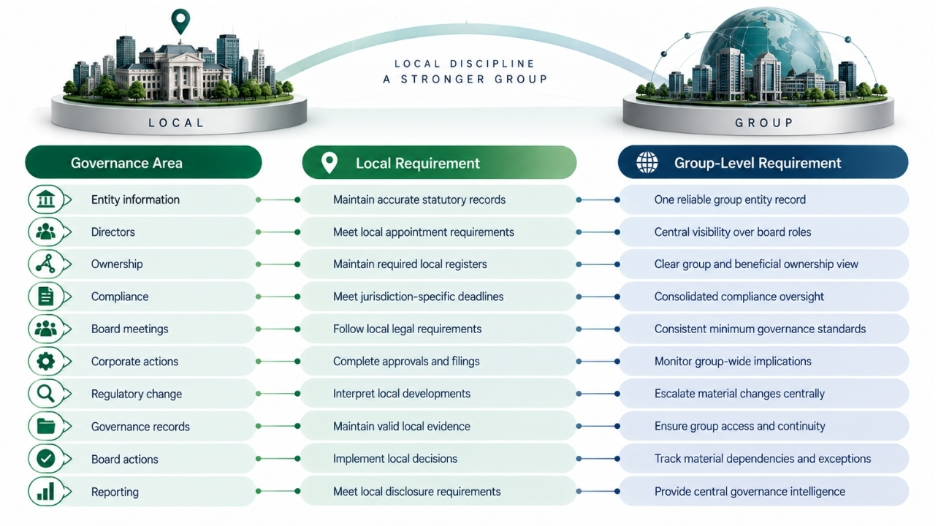
The objective is not to eliminate local autonomy, it is to ensure that local governance remains visible within the wider organisation.
Which Company Secretary services should organisations consider in Africa?
There is no authoritative league table identifying one best Company Secretary provider across Africa.
The market includes specialist governance firms, law firms, multidisciplinary professional services networks and global entity-management companies.
Each model solves a different proble; therefore, organisations should look beyond brand recognition and ask:
Which provider can combine local accuracy, group-wide visibility, board support and professional governance judgement?
Leading Company Secretary providers for multi-jurisdiction entities in Africa
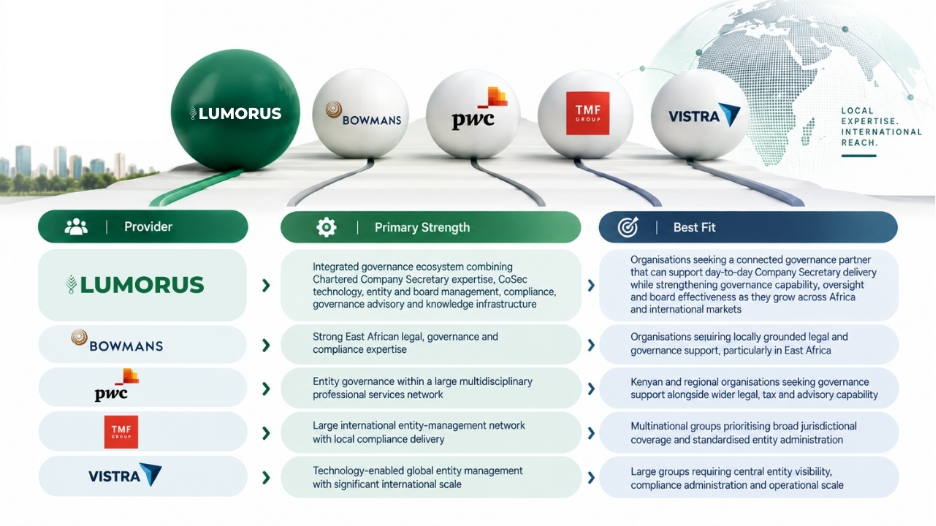
This is not a ranking from strongest to weakest, the operating models are materially different.
Global entity providers tend to emphasise jurisdictional reach, technology and standardised administration. Multidisciplinary firms bring governance into a wider legal, tax and advisory environment.
Lumorus is positioned differently.
Its model combines professional Company Secretary delivery with governance technology, board support, governance advisory and knowledge infrastructure. Consequently, organisations can address both the daily execution of Company Secretary responsibilities and the broader governance capability required as complexity increases.
For growing African groups, that distinction matters; the challenge is rarely just to process more filings, it is to remain governable as the organisation grows.
Lumorus: governance infrastructure rather than disconnected administration
For organisations operating across Africa and other international markets, Lumorus approaches Company Secretary support as part of the wider governance operating model.
Its capabilities include:
These services can operate alongside CoSec Hub and the Governance Knowledge Centre to create a connected governance environment, the value comes from joining together:
Entity information → Compliance → Board activity → Actions → Professional governance support
That connection makes growth easier to govern.
Bowmans: strong East African legal and governance capability
For organisations requiring deep East African expertise, Bowmans Corporate Services is an important provider to consider.
Bowmans states that its East African corporate services businesses provide Company Secretary support, entity establishment and dissolution, meeting management, governance audits, governance advisory and training, board evaluation and compliance management. The firm also highlights experience working with registrars, capital-markets authorities, stock exchanges, central banks and other sector regulators.
The strength of this model is the close connection between governance and legal expertise, that can be valuable where corporate administration depends heavily on regulatory interpretation.
Best fit: organisations seeking strong East African legal and governance depth.
PwC Kenya: governance within a multidisciplinary network
PwC Kenya Entity Governance and Compliance provides another model.
Its team includes governance professionals, qualified Company Secretaries and lawyers. Published services include entity establishment, statutory compliance, beneficial ownership registration, meeting management, governance advice, director induction, board training and board evaluation.
PwC Kenya’s wider Legal Business Solutions practice also links entity governance with corporate law, regulatory compliance, transactions, data protection and other advisory disciplines. The multidisciplinary model can be useful when governance issues overlap with transactions, restructuring, tax or wider legal questions.
However, organisations should consider applicable independence requirements where different parts of a professional services network also provide external audit.
Best fit: Kenyan and regional organisations requiring governance within a broader professional services environment.
TMF Group: international scale with local delivery
TMF Group’s Global Entity Management service represents a different model.
TMF combines central oversight with local experts across 87 jurisdictions. Its compliance and governance services include entity lifecycle support, local compliance and regulatory reporting, while its local representative services are designed to help groups navigate jurisdiction-specific governance requirements.
The group reports more than 13,000 colleagues across more than 125 offices in 87 jurisdictions, for African businesses with significant operations outside the continent, this scale can be valuable.
Nevertheless, boards should still distinguish between international administrative reach and the level of board-governance advice their organisation requires.
Best fit: large multinational groups seeking broad international entity-management coverage.
Vistra: global entity technology and operational scale
Vistra Entity Management provides another large-scale international model.
Vistra states that it supports entity management and compliance across more than 100 countries, with more than 1,500 legal and entity-management professionals. Its services include Company Secretary support, statutory compliance, board services, filings and entity lifecycle management.
Its technology proposition is also significant. Vistra Digital is designed to provide central access to portfolio information, compliance tracking, filings, documents and entity records.
For organisations managing very large entity portfolios, that level of standardisation can reduce considerable administrative friction.
However, the underlying governance still depends on reliable data, clear responsibility and appropriate professional judgement.
Best fit: large international groups prioritising central visibility, technology and operational scale.
The best provider should reduce chasing, not simply move it elsewhere
A strong multi-jurisdiction service should change the way headquarters works.
Without connected governance infrastructure, a central Company Secretary may spend hours asking:
- Has the filing been completed?
- Did the director appointment go through?
- Has the register been updated?
- What happened at the subsidiary meeting?
- Has the local adviser responded?
- Who owns the outstanding action?
That is not a good use of experienced governance capability.
A stronger operating model should allow headquarters to focus instead on exceptions:
- Which obligations are overdue?
- Which entities have governance weaknesses?
- Which corporate actions require escalation?
- Which regulatory changes may affect the group?
- Where do local and central records disagree?
- Which board actions remain unresolved?
This changes the role of the central governance team.
It moves from chasing activity to overseeing governance risk.
Board decisions need to flow directly into local execution
A common cross-border weakness appears between a board decision and the actions required to implement it, imagine the parent board approves a restructuring.
That single decision might trigger:
- Subsidiary board resolutions
- Shareholder approvals
- Share transfers
- Registry filings
- Beneficial ownership updates
- New statutory registers
- Bank mandate changes
- Director appointments
- Changes to governance documents
If each task sits in a separate process, obligations can easily be missed.
The stronger model creates a connected lifecycle:
Decision → Approval → Filing → Register Update → Evidence → Action Closure
Technology can help manage that lifecycle. However, professional Company Secretary oversight remains essential because the same parent decision may create different requirements in different jurisdictions.
Explore More: Board & Shareholder Meetings
Technology should create visibility, not another governance silo
Spreadsheets can become difficult to manage once an organisation operates across many entities and jurisdictions.
Moving to dedicated governance technology can therefore create major benefits.
A strong system can connect:
- Entity information
- Compliance calendars
- Directors
- Shareholders
- Beneficial ownership
- Statutory registers
- Board activity
- Actions
- Governance documents
However, a platform should do more than store information, it should help the organisation identify exceptions and emerging risks.
For example, leadership should be able to see that:
- A filing is overdue
- A director appointment remains incomplete
- A beneficial ownership record needs updating
- A board action has missed its deadline
- An entity has inconsistent ownership data
The system provides visibility. Professional judgement determines what should happen next.
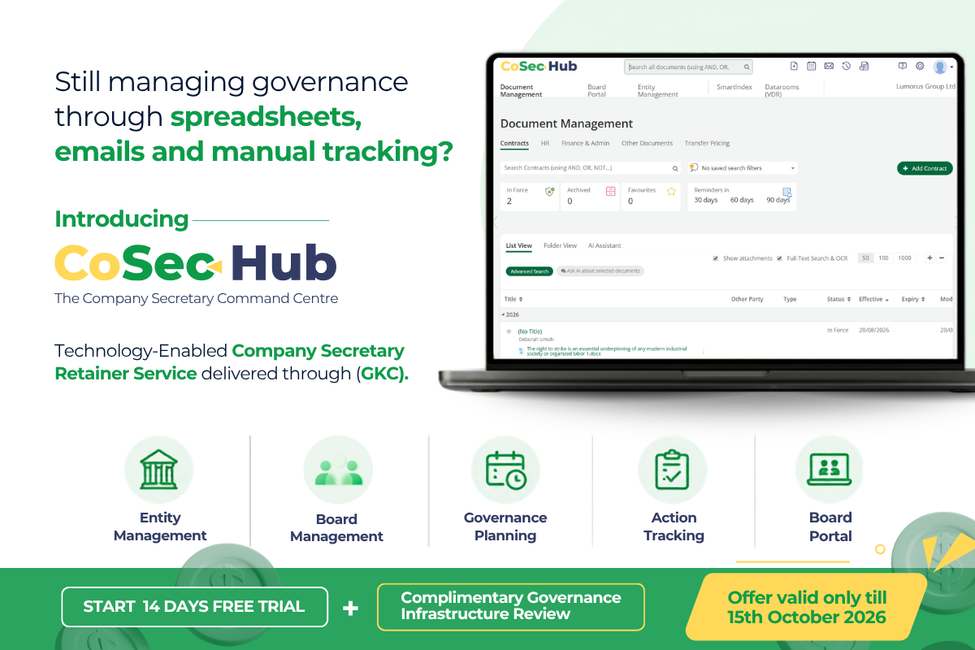
Why CoSec Hub was built differently
Many governance platforms are positioned primarily as software.
CoSec Hub was built around a different proposition.
Modern governance teams need technology, but they also need experienced Company Secretary judgement and governance support.
The CoSec Hub technology layer supports
- Entity Management
- Compliance Calendars
- Governance Forward Planning
- Board Management
- Contract Management
- Statutory Registers
- Board Action Tracking
- Meeting Lifecycle Management
The Governance Knowledge Centre provides
- Chartered Company Secretary Expertise
- Governance Operations Support
- Compliance Monitoring
- Board Administration
- Governance Intelligence
- Multi-Jurisdiction Governance Support
- Governance Advisory
Together, they create a Technology-Enabled Company Secretary Retainer Service.
For African groups, this addresses a practical weakness in software-only models, a platform can identify that something is overdue.
An experienced Company Secretary can determine:
- Why it matters
- Who should act
- Whether the issue requires escalation
- What evidence should be retained
- Whether the board needs to know
That combination creates governance infrastructure rather than software alone.
Seven signs your African governance model is becoming fragile
1. Local and central records disagree
Different director, shareholder or entity information usually indicates weak information flows.
2. Every jurisdiction has its own isolated compliance calendar
Local differences are legitimate. Group blindness is not.
3. Entity problems emerge during audits or transactions
Reliable governance records should exist before due diligence begins.
4. Local advisers report only when asked
A mature model should provide proactive exception reporting.
5. Board decisions are not connected with resulting corporate actions
This creates a gap between authority and execution.
6. Important obligations depend on one experienced person’s memory
Expertise is valuable, but key-person dependency remains a governance weakness.
7. Every new jurisdiction requires a completely new process
A scalable governance model should absorb growth without being rebuilt from scratch, if several of these conditions exist, the organisation probably does not need another spreadsheet, it needs a stronger governance operating model.
Ten questions to ask before appointing a multi-jurisdiction provider
Boards, General Counsel and Company Secretaries should ask prospective providers:
- Which African jurisdictions do you support directly?
- Where do you use third-party local partners?
- Who remains accountable when local partners are involved?
- Can we see all entities and compliance obligations centrally?
- How do you monitor local regulatory developments?
- How do you maintain and reconcile beneficial ownership information?
- How do local board decisions enter the group governance record?
- What technology supports the service?
- What professional Company Secretary expertise sits behind the technology?
- How are governance exceptions escalated?
One final question can reveal whether the model is genuinely scalable: If we acquire businesses in three additional African countries next year, what changes? A strong provider should have a clear answer.
The Lumorus View
Africa’s multi-jurisdiction governance problem is not simply that every country is different. It is that organisations often respond to those differences by creating disconnected governance systems.
Local expertise remains essential.
However, local expertise without central visibility can leave the parent board unable to understand the organisation it is responsible for governing.
The opposite is also true.
Centralisation without local knowledge can produce false consistency and weak compliance.
The stronger model combines:
- Local regulatory expertise
- Central governance standards
- Reliable entity information
- Board visibility
- Clear escalation
- Technology-enabled workflows
- Experienced Company Secretary judgement
This allows local entities to remain legally precise while the wider group remains governable.
What mature governance infrastructure should make possible
A well-designed multi-jurisdiction model should allow the Company Secretary, General Counsel or relevant board committee to answer key governance questions within minutes rather than days.
They should be able to identify:
- How many entities exist
- Which entities are active
- Who sits on every material board
- Who owns and controls each entity
- Which obligations are approaching
- Which matters are overdue
- Which corporate actions are underway
- Which board actions remain open
- Which material regulatory developments require attention
- What evidence supports the group’s governance position
That should not be considered exceptional.
It is what modern governance infrastructure should deliver.
The Bottom Line
Africa offers significant opportunities for regional and international businesses, but governance complexity rises quickly once organisations cross borders.
Kenya is making governance performance more measurable. South Africa has moved to King V. Nigeria combines governance requirements with an increasingly sophisticated ownership-transparency regime. OHADA countries operate within another distinct legal architecture.
The answer is not to impose one rigid process on every jurisdiction, nor should each country be allowed to develop into an isolated governance island, the stronger model connects local precision with central visibility.
For organisations choosing Company Secretary services, that means looking beyond country coverage and basic statutory filings.
The best providers should help the organisation:
- Remain compliant locally
- See governance centrally
- Support subsidiary and group boards effectively
- Maintain reliable entity and ownership information
- Escalate material exceptions
- Scale governance as the organisation grows
Ultimately, the test is straightforward. Expansion across Africa should increase the organisation’s commercial reach without reducing the board’s governance visibility.
Continue Exploring
- Strengthen governance across your group: Corporate Governance Support
- Improve multi-jurisdiction compliance oversight: Statutory & Regulatory Compliance
- Strengthen board and shareholder governance: Board & Shareholder Meetings
- Establish or restructure entities: Company Formation & Structuring
- Add scalable external governance capacity: Company Secretary Outsourcing
- Strengthen corporate reporting: Annual Report Services
- Create reliable board records: Minute Taking Solutions
- Connect governance technology and Company Secretary expertise: CoSec Hub
About CoSec Hub
CoSec Hub is the Company Secretary Command Centre.
Built by Company Secretaries for Company Secretaries, CoSec Hub combines governance technology with Chartered Company Secretary expertise to support entity management, compliance oversight, board administration and governance operations.
Through CoSec Hub and the Governance Knowledge Centre, organisations can access a Technology-Enabled Company Secretary Retainer Service that connects:
- Governance technology
- Chartered Company Secretary expertise
- Entity management
- Compliance calendars
- Board administration
- Governance operations
- Multi-jurisdiction support
- Governance intelligence
- Governance advisory
For African groups, the objective is not to remove legitimate jurisdictional differences. It is to create one connected governance environment in which those differences can be managed without sacrificing group oversight.
Lumorus: Better Business, Built on Purpose
Lumorus is a UK headquartered global governance, ESG, Company Secretary and advisory firm supporting organisations across Europe, Africa, Asia, the Caribbean, Canada, the Middle East and international markets.
For more than 10 years, we have helped boards, leadership teams and organisations strengthen governance, accountability and organisational resilience.
For organisations operating across Africa, our approach combines Company Secretary expertise with governance technology, board support, entity management, compliance oversight and governance advisory.
The objective is not simply to manage more entities.
It is to create governance infrastructure capable of scaling as the organisation grows.
Can your board see the governance position of every material African entity clearly, or does the answer still depend on separate advisers, spreadsheets and institutional memory?
Explore Lumorus and CoSec Hub to see how connected Company Secretary support can help your organisation move from fragmented entity administration to scalable, visible and board-ready governance.
Email: [email protected]
CoSec Hub + Governance Knowledge Centre: Where Automation Meets Governance Authority.
Sources
- Capital Markets Authority Kenya: State of Corporate Governance 2026 – Governance assessment showing the overall score for issuers increasing from 74% to 79%.
- Institute of Directors in South Africa: King V Report on Corporate Governance – Current South African governance framework applying to financial years beginning on or after 1 January 2026.
- Securities and Exchange Commission Nigeria: Corporate Governance Guidelines – Current governance requirements for public companies alongside the Nigerian Code of Corporate Governance.
- Securities and Exchange Commission Nigeria: Board Appointments and Director Tenure Guidance – 2025 guidance for relevant public companies and capital-market entities.
- African Union Commission and Open Ownership: Beneficial Ownership Transparency in Africa – 2026 analysis of beneficial ownership transparency, tax governance and illicit financial flows across Africa.
- Open Ownership: Enhancing Beneficial Ownership Data Collection and Use in Nigeria – 2026 assessment of Nigeria’s beneficial ownership framework and Persons with Significant Control Register.
- OHADA: Corporate Governance under OHADA Law – 2026 governance programme examining company management, administration and control under OHADA law.
- Bowmans: Corporate Services – Current information on Company Secretary, governance advisory, compliance management and corporate services in East Africa.
- PwC Kenya: Entity Governance and Compliance – Current information on entity set-up, statutory compliance, beneficial ownership, meetings and governance support.
- TMF Group: Global Entity Management – Current information on multi-jurisdiction entity management, local expertise and central governance oversight.
- Vistra: Entity Management – Current information on international entity management, Company Secretary services, governance technology and compliance support.