The Company Secretary role has expanded faster than the infrastructure supporting it
The modern Company Secretary is no longer responsible only for board papers, minutes and statutory filings. The role increasingly touches entity management, board effectiveness, regulatory compliance, beneficial ownership, governance reporting, director appointments, corporate transactions, shareholder matters and regulatory change.
In multinational organisations, these responsibilities can extend across dozens of entities, several jurisdictions and multiple boards. Yet, while the mandate has expanded, the operating model beneath it has often remained fragmented.
The Diligent Global State of Legal Entity Compliance 2026 surveyed more than 300 Company Secretaries, General Counsel and legal operations leaders across 38 jurisdictions. According to the research, 74% said their responsibilities had expanded over the previous two years, while 63% reported that workload had grown faster than their teams.
The same research also found continued dependence on spreadsheets, Word documents and SharePoint for entity information, while only a minority of respondents had near real-time visibility of their compliance obligations.
That combination matters because governance risk often grows quietly. One new entity creates additional filings. Another jurisdiction adds another regulatory calendar. More board activity generates further decisions and actions, while acquisitions, restructurings and new directors create additional records that must remain accurate.
At first, experienced professionals can absorb the complexity. Over time, however, professional effort begins to compensate for weak systems.
That is precisely where governance infrastructure becomes essential.
Governance infrastructure is not simply software. It is the connected combination of people, processes, information, technology, controls and accountability that allows governance to operate reliably as an organisation becomes more complex.
Read More: Corporate Governance Support
What Company Secretaries are being asked to manage has changed
The profession itself is becoming more strategic.
The Chartered Governance Institute UK & Ireland Governance Market Survey 2026 drew on responses from 971 governance professionals and found that 65% believed the influence of the governance function was increasing.
That result reflects a broader shift.
Company Secretaries are increasingly expected to contribute to:
- Board decision making
- Governance risk
- Regulatory compliance
- Succession planning
- Organisational change
- Shareholder matters
- Governance reporting
- Board effectiveness
- Entity and subsidiary governance
- Corporate transactions
The role therefore sits close to the point where board information, management accountability and legal obligations meet.
However, when the infrastructure beneath those responsibilities is weak, the Company Secretary becomes the organisation’s human integration system.
They know which spreadsheet is current, which director still has an action, which adviser needs chasing, which version of the board paper is final and which compliance deadline is approaching.
That knowledge is valuable. However, it should not become the organisation’s primary control environment.
A governance model that depends too heavily on individual memory may appear resilient while experienced people remain in place. Once somebody leaves, becomes unavailable or the organisation grows rapidly, the weakness becomes visible.
Governance infrastructure is broader than technology
Technology is an important part of modern governance, but governance infrastructure is more than a software platform.
A strong operating model brings together five connected elements.
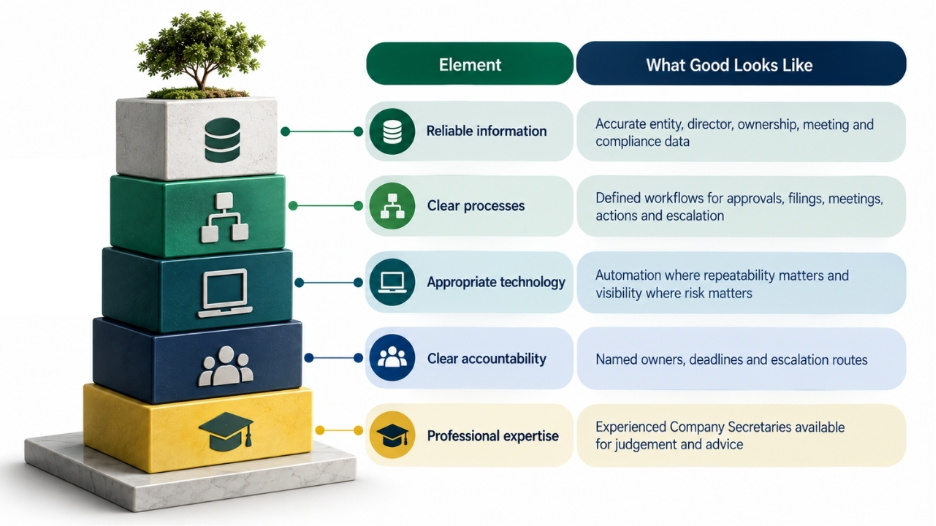
Each element supports the others.
Technology without accountability simply organises tasks. Processes without reliable information create false confidence, while professional expertise without infrastructure can leave the organisation overly dependent on individuals.
The strongest model therefore combines systems and judgement.
Technology should manage what is repeatable.
Experienced Company Secretaries should focus on what requires interpretation, challenge and professional advice.
Explore: CoSec Hub
Why manual governance becomes harder to control as organisations grow
Spreadsheets remain useful in many governance functions.
The problem is not the spreadsheet itself.
The problem appears when the number of entities, directors, obligations and transactions becomes too large for manual reconciliation to remain reliable.
Consider a director appointment.
One decision may trigger:
- Board approval
- Director consent documentation
- Regulatory filing
- Statutory register updates
- Beneficial ownership review
- Conflict declarations
- Changes to signing authorities
- Board portal access
- Group entity-record updates
- Director induction requirements
If each activity is maintained in a separate spreadsheet, inbox or system, the Company Secretary must keep every record aligned manually.
That creates both workload and risk.
The Diligent 2026 benchmark found that governance professionals continue to spend significant amounts of time tracking filings, deadlines and record updates.
That time has a hidden cost.
A senior Company Secretary reconciling records cannot simultaneously advise the Chair, review governance risk, support directors or prepare the organisation for regulatory change.
The deeper problem with fragmented governance is therefore not simply inefficiency.
It is that administration begins to consume time that should be spent on judgement.
Near misses are often infrastructure warnings
A missed deadline is obvious.
A near miss can be more revealing because it shows how close the governance system came to failure.
The Diligent Global State of Legal Entity Compliance 2026 found that 51% of respondents had experienced a compliance near miss during the previous year.
That does not necessarily mean governance teams were performing poorly.
In many cases, the opposite may be true.
Experienced professionals may have intervened at the last moment because they knew:
- Which filing was at risk
- Which adviser had not responded
- Which approval remained outstanding
- Which record had not been updated
- Which obligation needed escalation
Professional expertise prevented failure.
However, where this happens repeatedly, the organisation should ask whether its systems are doing enough.
A governance model that works because one person remembers what the infrastructure does not has created key-person dependency.
Strong governance should make professional expertise more valuable, not make the organisation dependent upon it for routine control.
Read More: Statutory & Regulatory Compliance
Good infrastructure makes obligations visible before they become urgent
Constant urgency is often a symptom of weak governance planning.
A filing becomes critical because it is due tomorrow. Board papers become urgent because the meeting is approaching, while shareholder approvals are chased because a transaction is close to completion.
Strong governance infrastructure changes that pattern by improving forward visibility.
Company Secretaries should be able to see, in one connected planning environment:
- Statutory deadlines
- Regulatory submissions
- Board and committee meetings
- Annual reporting milestones
- Director reviews
- Shareholder meetings
- Board evaluations
- Policy reviews
- Governance training
- Corporate transactions
- Recurring approvals
This allows the function to plan before pressure builds.
Instead of asking what is due tomorrow, the governance team can ask what requires preparation next quarter.
That is a very different operating model.
It moves the function from reactive administration towards proactive governance.
Boards depend on governance infrastructure more than they realise
Governance infrastructure is not simply about making the Company Secretary function more efficient.
Boards rely on it too.
The Financial Reporting Council’s Corporate Governance Code Guidance emphasises the importance of timely, high-quality information for directors. It also highlights the role of the Company Secretary in supporting the Chair, maintaining effective information flows and helping the board and its committees operate efficiently.
In practice, effective boards depend on a number of connected governance processes:
- Reliable board papers
- Clear agendas
- Accurate minutes
- Committee coordination
- Governance calendars
- Action tracking
- Director information
- Conflict management
- Escalation processes
- Access to professional advice
A board portal can distribute documents.
It cannot by itself ensure that the right matters have reached the board, that information is decision useful or that actions are implemented after a meeting.
Those outcomes depend on the wider governance system.
Explore More: Board & Shareholder Meetings
Information is one of the most important governance controls
Boards exercise authority largely through information.
If directors receive incomplete information, receive it too late or cannot see material risks, board effectiveness deteriorates even where meeting administration is excellent.
The G20/OECD Principles of Corporate Governance emphasise that directors need accurate, relevant and timely information. The OECD also highlights the importance of parent boards receiving sufficient information about subsidiaries to oversee group-wide risks and objectives.
That places the Company Secretary at the centre of an important information chain.
A mature governance model should make clear:
- What information directors need
- Who owns that information
- When it should reach the board
- Which decision it supports
- What needs escalation
- How challenge is recorded
- What happens after the decision
When those elements work together, governance becomes easier to evidence and easier to improve.
The result is not simply better information.
It is stronger accountability.
Board action tracking is a governance control, not an administrative convenience
A board decision is rarely the end of the governance process.
Often, it creates a new set of responsibilities.
For example, a board may approve:
- A restructuring
- A financing arrangement
- A remediation programme
- A new subsidiary
- A policy change
- An executive appointment
Each decision can create several actions, and those actions need clear owners, deadlines, evidence and escalation.
Yet many organisations control the meeting process more carefully than the implementation process.
Board papers are prepared.
Minutes are approved.
Actions then migrate into email, spreadsheets or personal task lists.
That creates a governance gap between decision and delivery.
Connected governance infrastructure keeps those two stages together so that the board and Company Secretary can see which actions remain outstanding and why.
Read More: Minute Taking Solutions
Entity management and board management should work together
Another common weakness is the separation between entity management and board management.
These activities are often treated as distinct administrative functions, even though they regularly affect each other.
Consider a share transfer.
The process may involve:
- Board approval
- Shareholder approval
- Transfer documentation
- Statutory filings
- Updated ownership records
- Beneficial ownership review
- Statutory register changes
- Group structure updates
The same is true of director appointments, capital changes, restructurings, entity formations and dissolutions.
Where the board system and entity system are disconnected, the Company Secretary must manually bridge the gap.
A stronger model connects the meeting lifecycle with the entity lifecycle so that governance decisions trigger the related entity and compliance processes.
That reduces duplication and creates a more reliable audit trail.
Explore More: Company Formation & Structuring
Multi-jurisdiction growth makes connected infrastructure essential
Governance complexity rises sharply once an organisation operates across several jurisdictions.
Each country may introduce different requirements around:
- Directors
- Shareholders
- Beneficial ownership
- Statutory registers
- Annual filings
- Board meetings
- Local representation
- Corporate approvals
- Record retention
- Regulatory reporting
The central team must therefore manage two competing requirements.
Local entities need local accuracy, while the group needs central visibility.
Strong governance infrastructure allows both.
Local professionals can apply jurisdiction-specific knowledge, while headquarters maintains a consolidated view of entities, directors, obligations and governance risks.
Without that connection, international growth often produces a patchwork of local advisers, separate calendars and different standards.
The result may be good local compliance but poor group-wide oversight.
That is why Company Secretary Outsourcing can become strategically valuable as organisational complexity grows.
The hidden cost of weak governance infrastructure is reconciliation
Many Company Secretaries spend significant amounts of time comparing data that should already agree.
Finance may maintain one entity list.
Tax uses another.
Legal has a separate record, while local subsidiaries may hold more recent director information.
The board portal may contain yet another version.
This is not simply duplication.
Different datasets create different versions of organisational reality.
During routine operations, those inconsistencies may remain manageable. They become far more serious during:
- Acquisitions
- Financing
- Due diligence
- Regulatory reviews
- Audits
- Restructuring
- Leadership changes
A mature governance model should therefore establish:
- Which system is authoritative
- Who owns each data category
- Who can update information
- What evidence supports a change
- How local updates reach headquarters
- How discrepancies are resolved
- When records should be reviewed
This creates more than a central database.
It creates information accountability.
What connected governance should look like
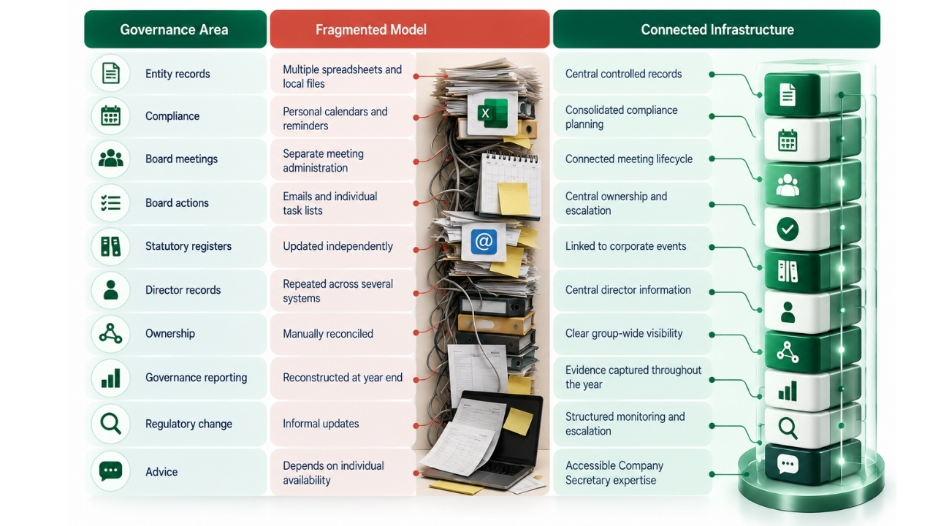
The objective is not to automate every governance activity.
It is to remove unnecessary fragmentation.
Governance infrastructure reduces key-person dependency
Every Company Secretary function has experienced people whose knowledge is exceptionally valuable.
The organisation should retain and value that expertise.
However, routine institutional knowledge should not sit only in somebody’s head.
A Company Secretary may know:
- Which filing remains outstanding
- Which register is current
- Which board action still needs attention
- Which adviser needs to respond
- Which obligation is due next month
- Which version of the board paper is final
That knowledge reflects experience.
Yet the system should capture information that can reasonably be captured.
Doing so improves resilience during:
- Holidays
- Staff turnover
- Acquisitions
- Leadership transitions
- Restructuring
- Unexpected absence
The principle is straightforward.
Expertise should strengthen governance infrastructure, not replace it.
AI will make governance infrastructure more important
Artificial intelligence will automate more governance activity.
However, AI depends on reliable information.
The Diligent 2026 benchmark found growing use of AI in governance functions alongside continuing concerns about data quality and accuracy.
That should be expected.
If entity information is fragmented, AI processes fragmented information.
If ownership records are wrong, automation can reproduce those errors at greater speed.
Where accountability is unclear, an intelligent workflow still cannot decide who should ultimately be responsible.
Before increasing the use of AI, organisations therefore need stronger foundations:
- Reliable data
- Clear record ownership
- Defined approval rights
- Human oversight
- Audit trails
- Escalation rules
Technology becomes more powerful when governance infrastructure is strong.
It becomes more dangerous when it simply accelerates weak processes.
Internal control expectations are also raising the standard
The wider governance environment is increasingly focused on evidence and control.
The UK Corporate Governance Code 2024 strengthens expectations around governance outcomes and internal controls, while Provision 29 applies for financial years beginning on or after 1 January 2026.
Not every organisation falls directly within the Code.
However, the direction is important.
Boards increasingly need:
- Reliable evidence
- Clear control ownership
- Better risk information
- Traceable actions
- Stronger assurance
These expectations become harder to meet where governance records and responsibilities remain fragmented.
The question is therefore changing.
It is no longer simply whether the Company Secretary can find a document.
It is whether the organisation can demonstrate how governance operated.
Strong infrastructure should create an audit trail through normal work
Some governance teams are understandably cautious about new systems because badly designed processes can create more administration rather than less.
Good infrastructure should do the opposite.
Evidence should be generated naturally through normal governance activity.
For example:
- A director appointment should update the entity record and trigger relevant filings.
- A board decision should create an accountable action with an owner and deadline.
- A completed filing should retain the supporting evidence.
- An entity change should update one controlled record rather than several spreadsheets.
- A missed deadline should create an exception automatically.
The audit trail then becomes part of the operating model.
That is far more effective than reconstructing evidence before an audit, transaction or regulatory review.
Exception management is where governance infrastructure becomes most valuable
Company Secretaries should not have to monitor every routine task manually.
The system should make significant exceptions visible.
These may include:
- Overdue filings
- Missing approvals
- Late board actions
- Incomplete director appointments
- Unreconciled ownership information
- Expiring authorities
- Material governance conflicts
- Regulatory developments requiring action
- Entities operating outside agreed standards
This changes how professional time is used.
Instead of checking whether every routine task happened, experienced Company Secretaries can focus on where judgement, escalation and advice are required.
That is a much stronger operating model.
Governance reporting becomes easier when infrastructure is strong
Annual reporting often exposes weak governance systems.
Towards year end, the Company Secretary may need to reconstruct evidence relating to:
- Board activity
- Director changes
- Committee work
- Governance actions
- Board evaluations
- Compliance developments
- Stakeholder matters
- Internal controls
Where systems are fragmented, this becomes a research project.
Where governance infrastructure is strong, much of the evidence already exists.
The annual report becomes an output of governance rather than an attempt to recreate the year after the event.
Professional Annual Report Services can strengthen the reporting process, but reliable governance information remains the foundation.
Good governance reporting begins long before anyone starts writing the annual report.
Technology should support judgement, not replace it
The strongest governance operating model does not automate everything.
Instead, it uses technology where repeatability creates value and professional expertise where context matters.
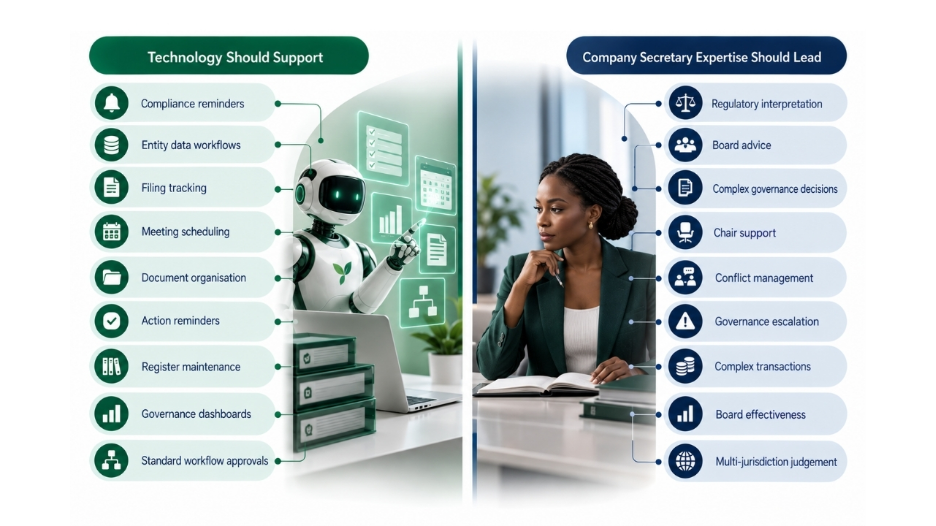
The objective is not a governance function with fewer people thinking.
It is a governance function in which experienced people spend less time on work that does not require their expertise.
Why CoSec Hub was built differently
Many governance platforms begin with software.
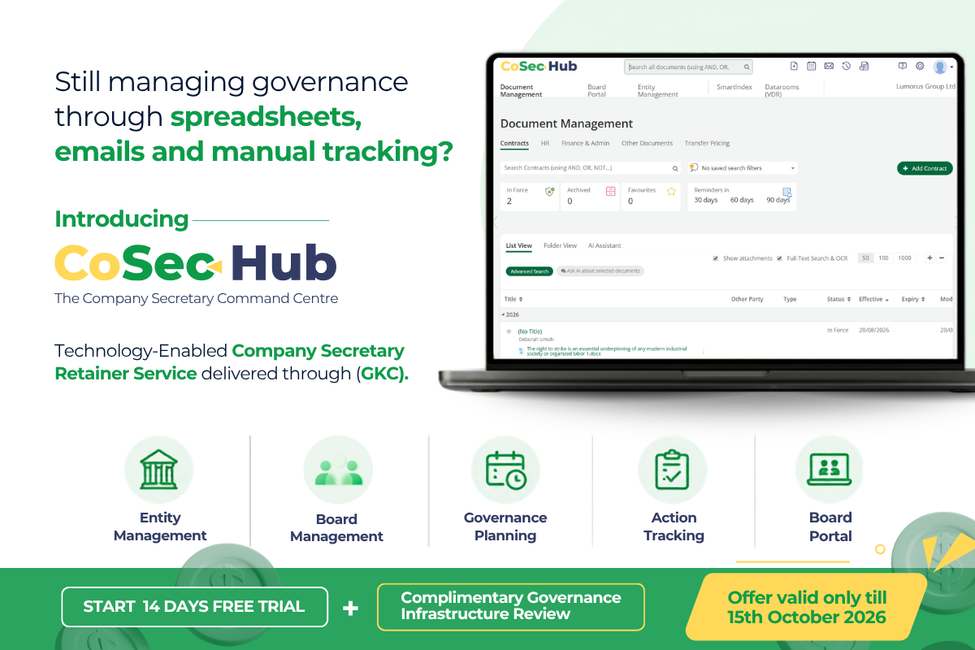
CoSec Hub begins with the governance operating model.
Modern Company Secretaries need technology, but they also need professional expertise, governance operations support and reliable access to governance knowledge.
That is why CoSec Hub combines two connected layers.
The CoSec Hub technology layer supports
- Entity Management
- Compliance Calendars
- Governance Forward Planning
- Board Management
- Contract Management
- Statutory Registers
- Board Action Tracking
- Meeting Lifecycle Management
The Governance Knowledge Centre provides
- Chartered Company Secretary Expertise
- Governance Operations Support
- Compliance Monitoring
- Board Administration
- Governance Intelligence
- Multi-Jurisdiction Governance Support
- Governance Advisory
Together, these capabilities create a Technology-Enabled Company Secretary Retainer Service.
This model addresses one of the central weaknesses in software-only governance.
A platform can tell the Company Secretary that something is overdue.
An experienced professional can determine:
- Why it matters
- Who should act
- Whether escalation is required
- What evidence should be retained
- Whether the board needs to know
That combination creates governance infrastructure rather than software alone.
Explore: CoSec Hub
Seven signs your organisation has a governance infrastructure problem
1. Compliance depends heavily on spreadsheets
Spreadsheets remain useful, but they should not be the primary control over material governance obligations in a complex organisation.
2. Different teams give different answers
Conflicting entity, director or ownership information usually points to weak data governance.
3. Important information sits in people’s heads
Institutional knowledge is valuable, but critical governance information should not depend solely on individual memory.
4. Board actions disappear into email
Important decisions need structured follow-through and clear accountability.
5. Records become reliable only before an audit or transaction
Accurate governance information should be the normal operating condition.
6. Every new entity creates proportionately more manual work
Scalable infrastructure should absorb growth without multiplying administration.
7. Senior Company Secretaries spend more time chasing than advising
This is often the clearest warning sign.
When experienced governance professionals are consumed by coordination, reconciliation and reminders, the operating model needs attention.
A governance infrastructure health check
Boards, General Counsel and Company Secretaries can assess their current model by asking:
- Can we see every legal entity in one reliable place?
- Can we identify the next 90 days of material obligations quickly?
- Does every significant obligation have a clear owner?
- Can we see which board actions remain outstanding?
- Do local and central entity records agree?
- Can we trace a significant board decision through to implementation?
- Would governance continue effectively if one experienced person became unavailable?
- Does the system create a reliable audit trail?
- Can we identify exceptions without checking every record manually?
- Is technology giving Company Secretaries more time for judgement and board support?
If several answers are no, the organisation does not simply have a technology problem.
It has a governance infrastructure gap.
The Lumorus View
Company Secretaries should not have to hold complex governance systems together through inboxes, spreadsheets and professional heroics.
That model can appear efficient because the organisation avoids investing in stronger infrastructure.
In reality, it transfers system risk into people.
A better model uses technology to manage what is repeatable while allowing experienced Company Secretaries to focus on judgement, board support and governance risk.
That means combining:
- Technology for visibility
- Processes for consistency
- Data for evidence
- Accountability for execution
- Professional expertise for judgement
The result is not less human governance.
It is stronger professional governance.
As Company Secretary responsibilities continue to expand, organisations cannot solve the capacity problem simply by asking experienced professionals to work harder.
The operating model has to improve.
What boards should expect from governance infrastructure
Boards do not need to understand every technology workflow used by the Company Secretary function.
They should expect reliable answers.
A mature governance environment should make it possible to identify:
- Which entities exist
- Who governs them
- Who owns them
- Which obligations are approaching
- Which matters are overdue
- What the board has decided
- Which actions remain outstanding
- Where governance risks are emerging
- What evidence supports the organisation’s governance position
The G20/OECD Principles of Corporate Governance explain why this matters. Directors require accurate, relevant and timely information, while parent boards need sufficient visibility over subsidiaries to oversee group-wide risk and objectives.
Governance infrastructure turns that principle into operational capability.
The Bottom Line
The Company Secretary function has outgrown the operating model that still supports it in many organisations.
Responsibilities have expanded, regulatory complexity has increased and boards expect better information. At the same time, international groups are becoming harder to oversee, while emerging technologies are creating new governance expectations.
Yet too much important governance activity still depends on spreadsheets, email, disconnected software and individual memory.
The answer is not technology for technology’s sake.
Nor is it outsourcing without visibility.
Company Secretaries need a connected governance environment that brings together entities, obligations, meetings, decisions, actions, records and professional judgement.
When that infrastructure works properly, the governance function becomes:
- More visible
- More resilient
- More scalable
- More auditable
- Less dependent on manual reconciliation
- Better equipped to support the board
Most importantly, it changes how Company Secretaries spend their time.
Less chasing and reconciliation.
More advising, anticipating and governing.
The future of the Company Secretary function will not be determined by how efficiently it administers governance. It will be determined by whether the organisation has built the infrastructure that allows governance to remain effective as complexity grows.
Continue Exploring
- Strengthen governance across your group: Corporate Governance Support
- Improve multi-jurisdiction compliance oversight: Statutory & Regulatory Compliance
- Strengthen board and shareholder governance: Board & Shareholder Meetings
- Establish or restructure entities: Company Formation & Structuring
- Add scalable external governance capacity: Company Secretary Outsourcing
- Strengthen corporate reporting: Annual Report Services
- Create reliable board records: Minute Taking Solutions
- Connect governance technology and Company Secretary expertise: CoSec Hub
About CoSec Hub
CoSec Hub is the Company Secretary Command Centre.
Built by Company Secretaries for Company Secretaries, CoSec Hub combines governance technology with Chartered Company Secretary expertise to support entity management, compliance oversight, board administration and governance operations.
Through CoSec Hub and the Governance Knowledge Centre, organisations can access a Technology-Enabled Company Secretary Retainer Service bringing together:
- Governance technology
- Chartered Company Secretary expertise
- Entity and board management
- Compliance monitoring
- Governance forward planning
- Statutory registers
- Board action tracking
- Governance operations support
- Governance intelligence
- Multi-jurisdiction support
- Governance advisory
The purpose is not simply to digitise Company Secretary administration.
It is to create an operating environment in which governance information, responsibilities, decisions and evidence remain connected as the organisation grows.
Not software alone. Not outsourcing alone. Governance infrastructure.
Lumorus: Better Business, Built on Purpose
Lumorus is a UK headquartered global governance, ESG, Company Secretary and advisory firm supporting organisations across Europe, Africa, Asia, the Caribbean, Canada, the Middle East and international markets.
For more than 10 years, we have helped boards, leadership teams and organisations strengthen governance, accountability and organisational resilience.
Our Company Secretary model recognises that modern governance teams need more than administrative support. They need reliable systems, professional expertise and connected governance operations capable of scaling with organisational complexity.
That is why Lumorus and CoSec Hub combine Company Secretary expertise with governance technology, entity management, compliance monitoring, board support and governance advisory.
Is your Company Secretary function supported by genuine governance infrastructure, or are experienced professionals still compensating for systems that have not kept pace with the organisation?
Explore CoSec Hub or contact Lumorus to discuss how a Technology-Enabled Company Secretary Retainer Service can help move your organisation from fragmented governance administration to connected, visible and board-ready governance.
Email: [email protected]
CoSec Hub + Governance Knowledge Centre: Where Automation Meets Governance Authority.
Sources
- Diligent: Global State of Legal Entity Compliance 2026 – Research involving more than 300 senior practitioners across 38 jurisdictions on expanding governance mandates, compliance risk, technology and operating models.
- Diligent: More Obligations, the Same Team – Analysis of workload growth, manual governance processes, compliance near misses, AI adoption and real-time visibility.
- The Chartered Governance Institute UK & Ireland: Governance Market Survey 2026 – Research involving 971 governance professionals on the growing influence and strategic role of governance teams.
- Financial Reporting Council: Corporate Governance Code Guidance – Current guidance on board information, governance processes and the role of the Company Secretary.
- Financial Reporting Council: UK Corporate Governance Code 2024 – Current UK governance framework, including stronger expectations around outcomes, internal controls and accountability.
- G20/OECD Principles of Corporate Governance 2023 – International principles covering board accountability, information quality and group-wide oversight.