Governance reporting is changing. The strongest reports now explain what the board did, not simply how governance is structured
For years, governance reporting followed a familiar pattern. Annual reports described committee structures, listed meetings, summarised policies and confirmed whether the company had complied with the UK Corporate Governance Code.
That information still matters. However, it is no longer enough.
The Financial Reporting Council’s Annual Review of Corporate Governance Reporting 2025 examined 100 UK-listed companies and pointed towards a more demanding approach.
In particular, the FRC wants companies to focus more clearly on outcomes, meaningful explanations and material board activity. At the same time, it wants less boilerplate language and unnecessary duplication.
Meanwhile, the UK Corporate Governance Code 2024 places greater emphasis on reporting outcomes and activities.
Provision 29 also introduces a more direct board declaration on the effectiveness of material internal controls for financial years beginning on or after 1 January 2026.
Together, these developments point to a wider change. Governance reporting is moving from describing governance processes to demonstrating governance performance.
For Company Secretaries, that changes the job, as a result, the governance section of the annual report can no longer be treated mainly as a year-end drafting exercise. Strong reporting increasingly depends on evidence created throughout the year.
Explore More: Annual Report Services
Executive Takeaway
The next generation of governance reporting will be shorter in places, but more substantive.
Investors, regulators and other stakeholders increasingly want to understand what the board considered, where directors challenged management, what changed and whether previous commitments produced results.
Several trends are driving that shift:
- Greater emphasis on governance outcomes
- More demanding internal control reporting
- Better explanations under comply or explain
- Increased scrutiny of cyber governance
- Stronger links between board effectiveness and disclosed actions
- More meaningful reporting on culture and stakeholders
- Greater transparency around directors and corporate control
- Growing pressure to reduce repetitive governance language
- Better evidence behind board claims
For Company Secretaries, the implication is significant. The annual report is becoming the final output of a year-round governance evidence system.
1. Governance outcomes are replacing descriptions of activity
One of the clearest changes is the move towards outcomes-focused reporting.
The FRC’s latest review encourages companies to explain what happened as a result of governance activity.
In other words, reports should move beyond long descriptions of policies and processes, consider a typical board strategy disclosure.
A traditional report might say:
The board considered strategy throughout the year, that tells the reader very little.
By contrast, a stronger report would explain the strategic issue considered, the challenge provided by directors and the resulting decision, the same principle applies to culture, risk, stakeholders and succession.
Therefore, the Company Secretary should increasingly ask three questions when reviewing governance disclosure:
- What happened?
- What issue came before the board?
- What did the board do?
- How did directors challenge, decide or intervene?
- What changed?
- What was the outcome?
Together, these questions create a stronger reporting chain:
Activity → Board Action → Outcome
As a result, governance reporting becomes more useful because readers can see the board exercising its responsibilities rather than simply being told that governance structures exist.
2. Better governance reporting may actually mean less reporting
A longer governance report is not necessarily a better one. The FRC has repeatedly encouraged companies to reduce boilerplate language and unnecessary duplication.
Again, its latest review points towards more focused disclosure, particularly where similar information appears across governance, stakeholder and risk sections; this creates an important tension.
Governance expectations are increasing. However, annual reports should also become clearer and more concise, the answer is not to remove material governance information.
Instead, companies should remove paragraphs that add little insight.
For example, statements such as:
- The board recognises the importance of good governance
- Our people are central to our success
- The board regularly considers risk
- Directors maintain dialogue with stakeholders
may all be true.
Yet, without evidence, they tell the reader very little.
A stronger report explains what the board actually did.
For Company Secretaries, therefore, editing becomes part of governance reporting quality.
A useful test is simple:
Could this paragraph appear unchanged in the annual report of 100 other companies?
If the answer is yes, it probably needs more detail. Alternatively, it may not need to be there at all.
Read More: Corporate Governance Support
3. Comply or explain should reveal board judgement
The UK Corporate Governance Code operates on the principle of comply or explain.
That flexibility matters because good governance does not require identical arrangements across every company.
The FRC’s 2025 review found that 25 of the 100 companies reviewed reported at least one departure from a Code provision.
Importantly, the FRC highlighted the value of meaningful explanations rather than treating every departure as evidence of poor governance.
A strong explanation should tell readers:
- Which Provision has not been followed
- Why the board chose a different approach
- What alternative governance arrangement exists
- How the relevant risk is being managed
- Why the board considers the approach appropriate
- Whether the arrangement is temporary or expected to continue
That requires more than compliance drafting.
Instead, it requires the Company Secretary to understand the board’s reasoning.
Weak reporting says that circumstances made compliance inappropriate.
By contrast, strong reporting explains what those circumstances were, what the board considered and why the alternative approach supports effective governance.
In short, comply or explain should demonstrate judgement rather than defensiveness.
4. Provision 29 will change internal control reporting
Few developments are likely to affect governance reporting more directly than Provision 29.
Under the UK Corporate Governance Code 2024, boards should monitor the company’s risk management and internal control framework and review its effectiveness at least annually.
That review covers material financial, operational, reporting and compliance controls.
From financial years beginning on or after 1 January 2026, the board should also provide three things in the annual report:
- A description of how it monitored and reviewed the framework
- A declaration on the effectiveness of material controls at the balance sheet date
- Details of material controls that did not operate effectively, together with action taken or proposed
This is a substantial reporting development.
Moreover, the FRC has clarified that reporting controls can include controls supporting narrative and ESG reporting, not only traditional financial controls.
Consequently, Company Secretaries need to think beyond the wording of the final declaration.
The harder question is:
What evidence will allow the board to make that declaration with confidence?
Explore More: Governance Review
5. Provision 29 makes governance evidence more important
The board declaration should be the conclusion of a governance process, not the beginning of one.
The FRC’s Provision 29 guidance makes clear that the board should reach its own assessment using evidence obtained through monitoring and review.
Therefore, boards need to understand:
- Which controls are material
- Why they are material
- Who owns them
- How they are monitored
- What testing has taken place
- Which weaknesses have been identified
- How those weaknesses are being addressed
- What assurance supports management’s conclusions
This has direct implications for Company Secretaries.
For example, board and committee calendars need enough time for the relevant reviews. Papers must reach directors at the right point, while actions need clear owners.
In addition, minutes should record material challenge and decisions accurately.
The reporting requirement may appear in the annual report. However, the governance work happens throughout the year.
That is why Board & Shareholder Meetings and high-quality governance records increasingly form part of the reporting infrastructure.
6. The auditor does not make the Provision 29 declaration for the board
This distinction deserves attention.
The FRC’s June 2026 guidance on auditors and Provision 29 confirms that the auditor’s consideration of the Provision 29 statement does not amount to an assurance engagement over the board’s declaration.
Therefore, the board keeps responsibility for its conclusion.
The controls relevant to the financial statement audit are not necessarily the same as the material controls identified by directors for Provision 29.
Indeed, the board’s scope is wider because it includes financial, operational, reporting and compliance controls.
This has an important governance consequence.
Directors cannot simply assume that a successful financial statement audit provides all the evidence needed for their own declaration.
Instead, boards should consider the total assurance picture, including:
- Management testing
- Risk and compliance monitoring
- Internal audit
- External audit findings
- Specialist assurance
- Control failures and near misses
- Remediation progress
In turn, the Company Secretary can help ensure that this evidence reaches the board in a clear and connected way.
7. Cyber governance is becoming visible board governance
Cyber security provides another clear example of the move towards outcome-focused reporting.
The FRC’s 2025 review found that 66% of companies highlighted board-level oversight of cyber risk.
In addition, 85% identified cyber security as a principal risk, while another 12% included it within wider operational principal risks.
Those figures show how firmly cyber risk has entered board governance.
However, simply stating that the board oversees cyber security is becoming less useful.
Stronger reporting might explain:
- Which committee leads oversight
- How often the board receives cyber information
- Whether directors receive relevant training
- How cyber incidents are escalated
- Whether scenario exercises have taken place
- How third-party exposure is considered
- What changed following board review
The annual report does not need to reveal sensitive security information.
Nevertheless, investors should be able to understand whether cyber risk receives serious board attention.
The reporting principle is therefore the same:
Do not simply identify the risk. Explain how the board governs it.
8. Board evaluation reporting should show what changed
Board evaluation is another area where generic reporting can weaken an otherwise strong governance section.
Consider this familiar disclosure:
The board completed its annual evaluation and concluded that it continues to operate effectively.
What does the reader learn?
Very little.
A stronger approach, therefore, connects evaluation findings with improvement.
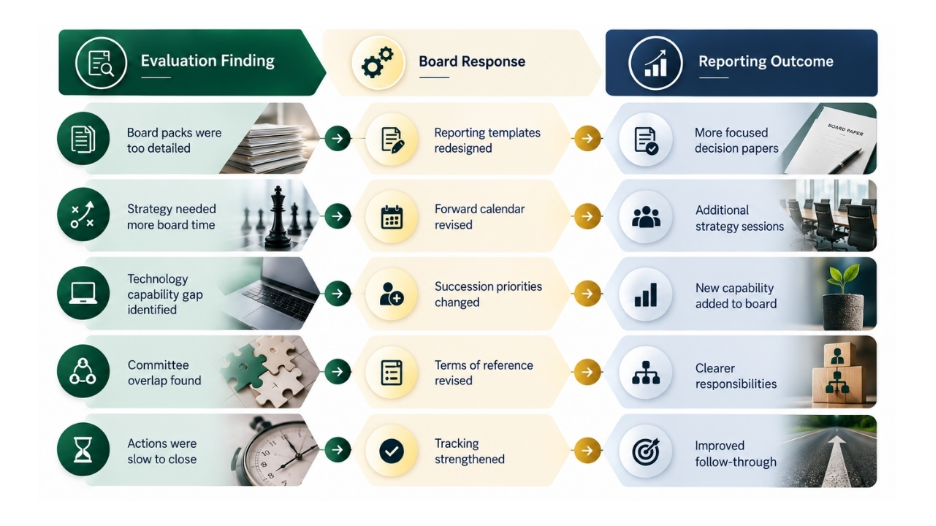
The important reporting chain is:
Finding → Action → Progress → Outcome
For example, a board may identify a need for stronger succession planning.
In that case, the report should explain what action followed, what progress was made and whether board capability improved.
As a result, board evaluation becomes evidence of continuous improvement rather than an annual governance ritual.
Explore More: Board Evaluation & Assessment
9. Board composition reporting needs to explain capability, not simply diversity
Diversity remains an important governance issue.
However, reporting is gradually becoming more sophisticated.
The FRC’s latest review found widespread disclosure of diversity approaches and progress.
Increasingly, companies are also connecting board composition with strategy and succession.
That is the right direction.
Representation data remains important. Yet a board can meet numerical targets while still lacking capabilities needed for the future.
Therefore, good composition reporting should also explain:
- Which skills the board currently has
- Which capabilities are becoming more important
- Where gaps exist
- How succession addresses those gaps
- How board composition supports strategy
- How diversity contributes to better decision making
For example, a company undertaking major digital transformation may need stronger technology capability.
Similarly, a multinational entering new markets may require deeper international or regulatory experience.
Consequently, the reporting question should move beyond who sits on the board.
It should explain why this board is equipped to govern this organisation.
Explore More: Board Skills Audit
10. Culture reporting needs evidence behind the language
Culture is one of the easiest subjects to describe and one of the hardest to prove.
Annual reports frequently contain strong statements about values, purpose and organisational culture.
However, boards need evidence.
Useful indicators might include:
- Employee engagement
- Staff turnover
- Speak-up data
- Whistleblowing cases
- Conduct incidents
- Customer complaints
- Ethics breaches
- Incentive outcomes
- Internal audit findings
- Regulatory feedback
Not every measure belongs in the annual report.
Even so, governance reporting should help readers understand how the board knows whether the culture it describes actually exists.
For example, rather than saying the board monitored culture throughout the year, the report could explain which indicators directors reviewed, what concerns emerged and what action followed.
As a result, the disclosure becomes more credible because it connects values with evidence.
11. Stakeholder reporting should explain influence, not engagement volume
Stakeholder sections can become some of the longest parts of an annual report.
Employees were surveyed. Investors attended meetings. Customers provided feedback. Suppliers were consulted.
All of that may be useful.
However, the number of engagement activities tells readers relatively little about governance.
The more interesting question is:
Did stakeholder information influence a board decision?
For example:
- Did workforce feedback change retention strategy?
- Did shareholder concerns affect remuneration?
- Did customer evidence change product design?
- Did supplier discussions expose resilience risk?
- Did community concerns change investment plans?
By focusing on influence, stakeholder reporting becomes more selective and more meaningful.
The strongest disclosure does not catalogue every conversation.
Instead, it explains where stakeholder information entered the board’s decision-making process and what happened next.
12. Corporate transparency now extends beyond the annual report
Another reporting trend is developing outside the annual report itself.
Following reforms under the Economic Crime and Corporate Transparency Act 2023, identity verification became a legal requirement for directors and people with significant control from 18 November 2025.
According to Companies House, the requirements are being phased in over a 12-month transition period.
Meanwhile, current Companies House guidance sets out the consequences of failing to comply.
Companies House is also publishing quarterly information on identity verification compliance.
As a result, corporate information is becoming easier to check.
Stakeholders can increasingly compare what an organisation says with external information about directors, control, filings and corporate status.
For Company Secretaries, therefore, data accuracy is becoming part of corporate credibility.
Read More: Statutory & Regulatory Compliance
13. The Company Secretary is becoming the architect of governance evidence
The changing reporting environment is happening alongside a wider shift in the profession.
The Chartered Governance Institute UK & Ireland’s Governance Market Survey 2026 drew on responses from 971 governance professionals.
Almost two-thirds, 65%, said the influence of the governance function was increasing.
Moreover, the research found that the traditional view of the Company Secretary as mainly responsible for board papers, minutes and compliance no longer reflects the reality of the role.
That is particularly relevant to governance reporting.
Company Secretaries increasingly connect:
- Board agendas
- Decisions
- Minutes
- Committee activity
- Governance actions
- Board evaluations
- Succession
- Risk
- Internal controls
- Stakeholder engagement
- Corporate records
- Annual reporting
Taken together, these responsibilities give the function a unique view across the governance system.
Therefore, the Company Secretary should not simply coordinate the annual governance report.
Instead, the stronger role is to ensure that governance creates reliable evidence throughout the year.
14. Build the governance report throughout the year
One of the most practical changes Company Secretaries can make is to stop treating governance reporting as a year-end project.
Instead, maintain a simple governance evidence record throughout the reporting cycle.
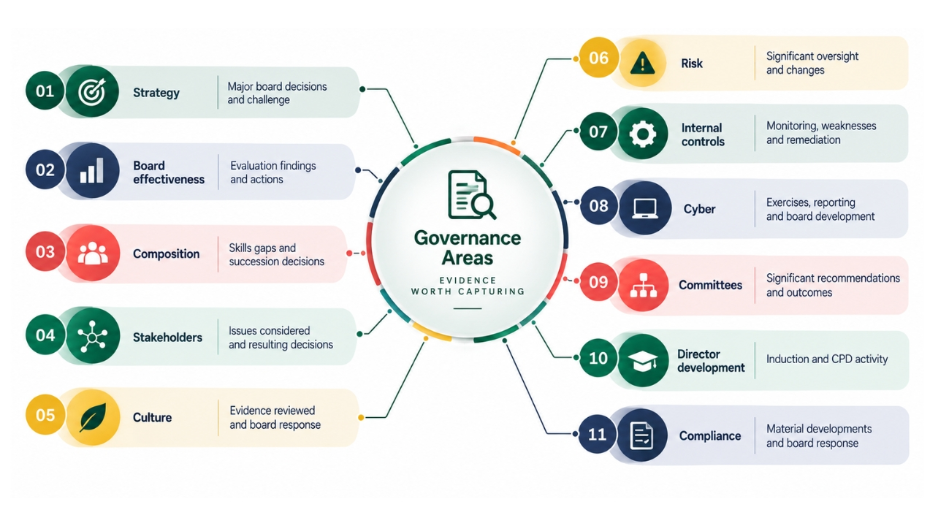
This does not need to become another major administrative burden.
In practice, much of the evidence already exists in minutes, board actions, committee reports and governance calendars.
The task is simply to capture it consistently.
By year end, therefore, the Company Secretary should not need to reconstruct 12 months of governance from memory.
Read More: Minute Taking Solutions
15. Better governance reporting starts with better board records
Annual reporting quality and minute quality are closely connected.
If board minutes simply record that a paper was noted, it becomes difficult months later to explain the board’s contribution.
Therefore, strong minutes should capture the substance of governance without becoming transcripts.
Depending on the issue, that may include:
- Material challenge
- Alternative options considered
- Conflicts
- Key judgements
- Decisions
- Agreed actions
- Responsibility
- Follow-up
This creates a reliable evidence trail.
However, the objective is not to write minutes for the annual report.
The aim is to create an accurate governance record.
As a result, better reporting becomes a natural benefit.
The same principle applies to action tracking.
If an annual report says the board identified a governance weakness, readers should eventually be able to see whether that weakness was addressed.
Ultimately, good governance reporting depends on organisational memory.
The Company Secretary helps create it.
How healthy is the governance behind your annual report?
A polished annual report does not necessarily mean the underlying governance is strong.
That distinction matters.
Before asking whether the governance section reads well, boards should consider whether the governance system supports the claims being made.
The Lumorus Board Health Check provides a practical starting point for examining board health and identifying areas that may need deeper attention.
Boards can use the assessment to consider questions such as:
- Is accountability sufficiently clear?
- Does the board receive the right information?
- Is challenge effective?
- Are committees working well?
- Are actions followed through?
- Does board composition support strategy?
- Are governance processes producing better decisions?
The Board Health Check is not a substitute for a formal Board Evaluation or Governance Review.
However, it can help expose the gap between how governance is described and how governance actually works.
Assess your board
Take the Lumorus Board Health Check
16. The next governance report should answer three questions
Despite growing disclosure requirements, the core reporting challenge can be simplified.
Every important governance section should help readers answer three questions.
What did the board see?
What information, risks, stakeholder concerns or strategic issues reached directors?
What did the board do?
Where did directors challenge, approve, reject, escalate or request further work?
What changed?
What outcome followed?
Together, these questions work across strategy, risk, culture, cyber security, succession, stakeholder engagement and internal controls.
They also improve readability because they create a natural narrative.
Readers do not need more governance vocabulary.
Instead, they need a clearer account of how governance worked.
17. Seven questions to ask before approving the governance report
Before final approval, Company Secretaries and boards should ask:
- Does the report explain what the board actually did this year?
- Can readers see outcomes rather than only activities?
- Have generic and repetitive statements been removed?
- Are Code departures explained clearly rather than defensively?
- Does the narrative match the evidence in minutes, committee reports and corporate records?
- Can previous commitments be traced to progress this year?
- Would an investor understand where governance improved and where further work remains?
If several answers are no, adding another five pages will probably not solve the problem.
Instead, better evidence and sharper writing will.
The Lumorus View
Governance reporting is moving from describing the machinery of governance to demonstrating what that machinery achieved.
That is a welcome change.
For too long, annual reports could devote considerable space to committee responsibilities, meeting attendance and governance policies while giving readers limited insight into the board’s contribution.
Now, however, the direction is different.
Provision 29 asks boards to make a more direct judgement about material controls.
Meanwhile, the wider emphasis on outcomes asks companies to explain what governance delivered.
Together, these changes create a useful discipline.
Boards should be able to answer:
- What did we challenge?
- Which decisions did we improve?
- What changed because of our oversight?
- Which weaknesses did we identify?
- What have we done about them?
- Where does further improvement remain necessary?
These are not merely reporting questions.
Ultimately, they are questions about whether the board is doing its job.
What Company Secretaries should prioritise now
The reporting environment is changing quickly.
However, five priorities can make the transition more manageable.
1. Capture outcomes throughout the year
Do not wait until annual report drafting begins to identify evidence of board contribution.
2. Prepare properly for Provision 29
Ensure the board receives enough evidence to make its material controls declaration responsibly.
3. Connect board evaluation with reporting
Track actions arising from evaluations and explain progress.
4. Remove boilerplate
Replace generic governance language with organisation-specific evidence.
5. Check the governance beneath the disclosure
Where reporting is difficult because evidence is weak, investigate the governance process rather than simply rewriting the paragraph.
Ultimately, the annual report should reflect the quality of governance rather than compensate for its weaknesses.
The Bottom Line
Governance reporting in 2026 is becoming more evidence based, more concise and more focused on outcomes.
The direction from the FRC is increasingly clear.
The UK Corporate Governance Code 2024 strengthens the emphasis on outcomes, while Provision 29 raises the standard for reporting on material internal controls.
At the same time, cyber governance, board effectiveness, culture, stakeholder engagement and corporate transparency are becoming harder to address through generic disclosure.
For Company Secretaries, this changes the reporting model.
The annual governance report should no longer be assembled mainly from last year’s wording, committee terms of reference and year-end interviews.
Instead, it should emerge from evidence captured throughout the year.
That requires better minutes, clearer action tracking, reliable governance information and stronger links between what the board discusses and what the organisation later does.
As a result, the annual report should also become better.
Not necessarily longer.
Nor does it need to be more complicated.
Simply more useful.
The strongest governance reports are not produced by organisations that have the most to say about governance. They are produced by organisations whose governance gives them something meaningful to report.
Continue Exploring
- Strengthen governance throughout the reporting cycle: Corporate Governance Support
- Prepare stronger governance and annual report disclosures: Annual Report Services
- Strengthen statutory and regulatory compliance: Statutory & Regulatory Compliance
- Improve the governance record behind reporting: Minute Taking Solutions
- Assess board performance: Board Evaluation & Assessment
- Examine wider governance effectiveness: Governance Review
- Assess current board health: Lumorus Board Health Check
How Lumorus supports better governance reporting
Lumorus supports Company Secretaries, boards and leadership teams in strengthening the governance systems behind corporate reporting.
Our work can connect:
- Board and committee governance
- Annual report preparation
- Governance evidence
- Board evaluation
- Governance reviews
- Compliance
- Minutes and board records
- Director development
- Board skills and succession
- Governance technology
This matters because governance reporting cannot be separated from governance practice.
Where the underlying governance is strong, reporting becomes clearer.
By contrast, where evidence is weak, another layer of polished language rarely solves the problem.
For organisations that want to understand their starting point, the Lumorus Board Health Check can provide an initial view of board health before a deeper Governance Review or Board Evaluation is considered.
Lumorus: Better Business, Built on Purpose
Lumorus is a UK-headquartered global governance, ESG, Company Secretary and advisory firm supporting organisations across Europe, Africa, Asia, the Caribbean, Canada, the Middle East and international markets.
For more than 10 years, we have supported boards and leadership teams seeking stronger governance, clearer accountability and greater organisational resilience.
As governance reporting becomes more evidence based, organisations need more than good annual report drafting.
Instead, they need governance systems capable of producing reliable evidence of board oversight, challenge, accountability and outcomes throughout the year.
Is your annual report trying to make governance sound effective, or does your governance evidence already prove it?
Start with the Lumorus Board Health Check or explore Lumorus Annual Report Services to strengthen the connection between governance practice and governance reporting.
Email: [email protected]
Lumorus: Better Business, Built on Purpose.
Sources
- Financial Reporting Council: Annual Review of Corporate Governance Reporting 2025 – FRC review of governance reporting across 100 UK-listed companies, including outcomes, cyber oversight, Code departures and Provision 29 preparation.
- Financial Reporting Council: UK Corporate Governance Code 2024 – Current Code requirements, including the stronger emphasis on governance outcomes and revised Provision 29.
- Financial Reporting Council: Provision 29 Guidance – Guidance on the board declaration, material controls, proportionality and implementation of Provision 29.
- Financial Reporting Council: Auditor Responsibilities for Provision 29 – June 2026 clarification of the auditor’s responsibilities in relation to the board’s Provision 29 statement.
- Companies House: Identity Verification Requirements – Details of mandatory identity verification for directors and people with significant control.
- Companies House: Current Identity Verification Guidance – Current requirements and consequences of non-compliance for directors and people with significant control.
- The Chartered Governance Institute UK & Ireland: Governance Market Survey 2026 – Research involving 971 governance professionals on the growing influence and strategic role of the governance function.