74% of governance professionals say their remit has expanded. Multi-jurisdiction entities are where the strain becomes most visible
Managing one company in one jurisdiction is relatively straightforward.
Managing 20, 50 or 100 entities across Europe is a different governance problem altogether.
Every jurisdiction can bring its own filing deadlines, director requirements, beneficial ownership rules, corporate records, board procedures and local legal expectations. Add acquisitions, restructurings, new subsidiaries and changing regulation, and the governance burden grows quickly.
That pressure is reflected in Diligent’s 2026 Global State of Legal Entity Compliance Benchmark, which surveyed more than 300 senior practitioners across 38 jurisdictions. It found that 74% said their scope had expanded during the previous two years. The research also identified significant pressure from compliance near misses, technology gaps and growing workloads.
For European groups, this is not simply an administrative issue.
It is a governance visibility issue.
The board needs confidence that every significant entity remains in good standing, local obligations are understood, directors are properly appointed, ownership information is accurate and material corporate actions are being followed through.
That is why the strongest Company Secretary services are moving beyond basic filings towards connected governance infrastructure.
Read More: Corporate Governance Support
Executive Takeaway
The strongest Company Secretary providers for multi-jurisdiction entities should be able to combine:
- Local regulatory knowledge
- Central entity oversight
- Compliance calendars
- Beneficial ownership management
- Board and shareholder support
- Statutory registers
- Director and officer administration
- Corporate transaction support
- Governance reporting
- Action tracking
- Professional Company Secretary advice
- Technology that gives headquarters one reliable view
However, the real differentiator is not how many countries appear on a provider’s website.
It is whether the provider can help the organisation govern those entities as one connected group.
Europe is not one governance jurisdiction
Europe may operate within a shared economic and regulatory environment in many areas, but company law and corporate governance remain heavily jurisdiction-specific.
A group operating in the UK, Ireland, France, Germany, Luxembourg, the Netherlands, Spain and several Central and Eastern European markets may face different rules governing:
- Legal entity formation
- Resident directors
- Board procedures
- Annual accounts
- Statutory filings
- Share capital
- Beneficial ownership
- Corporate registers
- Local representatives
- Company records
- Entity dissolution
Moreover, regulated industries can add another layer of complexity through sector-specific requirements.
As a result, a policy designed at group level cannot simply be copied across every subsidiary.
Strong multi-jurisdiction governance therefore needs two things at once:
- Common group standards
- Local legal precision
That balance is the foundation of scalable governance.
Explore More: Statutory & Regulatory Compliance
The problem is not usually local competence. It is fragmentation
Most international groups can find good advisers in individual countries.
The difficulty begins when every jurisdiction operates through a different process, adviser, spreadsheet and reporting structure.
A typical group may have:
- One provider in France
- Another in Germany
- Local counsel in Spain
- An internal team in the UK
- Separate registers in Luxembourg
- A different entity platform maintained by finance
- Board records held somewhere else
Each component may function adequately on its own.
However, the board can still lack a reliable group-wide picture.
Common warning signs include:
- Different versions of director data
- Inconsistent shareholder information
- Local filings completed but not reflected centrally
- Separate compliance calendars
- Poor visibility over overdue obligations
- Corporate actions not linked to resulting filings
- Local advisers working without clear escalation routes
The governance risk therefore sits in the connections between systems and jurisdictions.
What leading Company Secretary services should actually provide
For a multi-jurisdiction group, the provider should operate across four connected layers.
1. Local compliance
Each entity must meet the rules of the jurisdiction in which it operates.
That includes:
- Annual filings
- Statutory registers
- Director changes
- Shareholder changes
- Beneficial ownership
- Corporate approvals
- Entity formation
- Entity dissolution
2. Central visibility
Headquarters should be able to see the whole group without contacting several local advisers.
That means having access to:
- Entity status
- Directors
- Shareholders
- Ownership
- Compliance deadlines
- Material corporate actions
- Outstanding board actions
3. Board governance
Good Company Secretary support should cover the board as well as the entity.
That includes:
- Agendas
- Board packs
- Resolutions
- Minutes
- Meeting calendars
- Action tracking
- Governance advice
4. Professional judgement
Technology can track a deadline, but experienced Company Secretaries still need to interpret what matters, identify unusual issues and escalate appropriately.
This is where administration becomes governance.
The European compliance environment is becoming more demanding
Several developments are increasing the importance of accurate entity and ownership information.
The EU’s Anti-Money Laundering Regulation 2024/1624 strengthens the framework around identifying beneficial owners of legal entities and forms part of a wider European effort to improve transparency around ownership and control.
The UK is also tightening corporate transparency.
Under current Companies House identity verification requirements, identity verification requirements now affect directors and people with significant control, with implementation taking place through the current Companies House reform programme.
For cross-border groups, this creates a practical need to know:
- Which directors have verified
- Which entity appointments remain outstanding
- Whether central records match local filings
- Whether beneficial ownership data is current
- Which changes require board approval
- Which deadlines are approaching
The larger the group, the more difficult this becomes without connected governance infrastructure.
A quick test for multi-jurisdiction governance
Boards and Company Secretaries can test their current operating model with five simple questions.
Can we identify every legal entity in the group immediately?
If several teams hold different lists, the governance record is already fragmented.
Can we see the next 90 days of compliance obligations across Europe?
If the answer requires multiple advisers or spreadsheets, oversight is weak.
Do director and ownership records match across systems?
Inconsistency can create regulatory and transaction risk.
Can we reconstruct one major corporate decision quickly?
The record should show the approval, filing, register update and resulting actions.
Would governance continue effectively if one experienced person was unavailable?
If not, the organisation may be relying on institutional memory rather than infrastructure.
Which providers should European groups consider?
There is no objective ranking that identifies one best provider for every organisation.
Different operating models suit different needs.
Some providers compete primarily on geographic reach. Others offer large multidisciplinary networks, while specialist governance firms place more emphasis on board support and governance capability.
The important question is:
Which provider model best matches the complexity of your organisation?
Leading Company Secretary providers for multi-jurisdiction entities
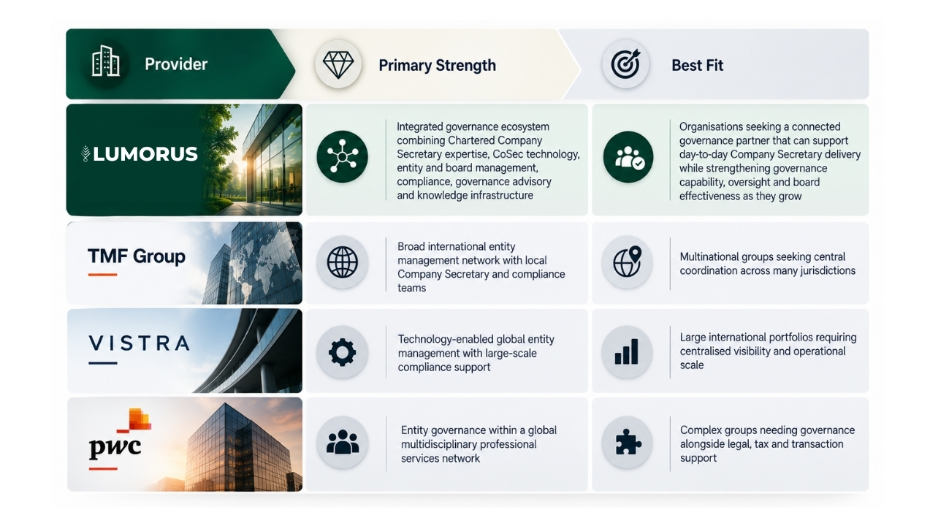
This is not a ranking from strongest to weakest. However, the operating models are materially different.
Global entity providers tend to compete on scale and jurisdictional reach, while multidisciplinary firms combine governance with wider legal, tax and advisory services.
Lumorus is positioned differently. It combines professional Company Secretary delivery with governance technology, board support, governance advisory and knowledge infrastructure. Therefore, organisations can address both the day-to-day execution of governance and the wider capability needed to govern effectively as complexity increases.
Lumorus: connected governance rather than separate compliance tasks
For organisations operating across Europe and other markets, Lumorus approaches Company Secretary support as part of the wider governance operating model.
The service can connect:
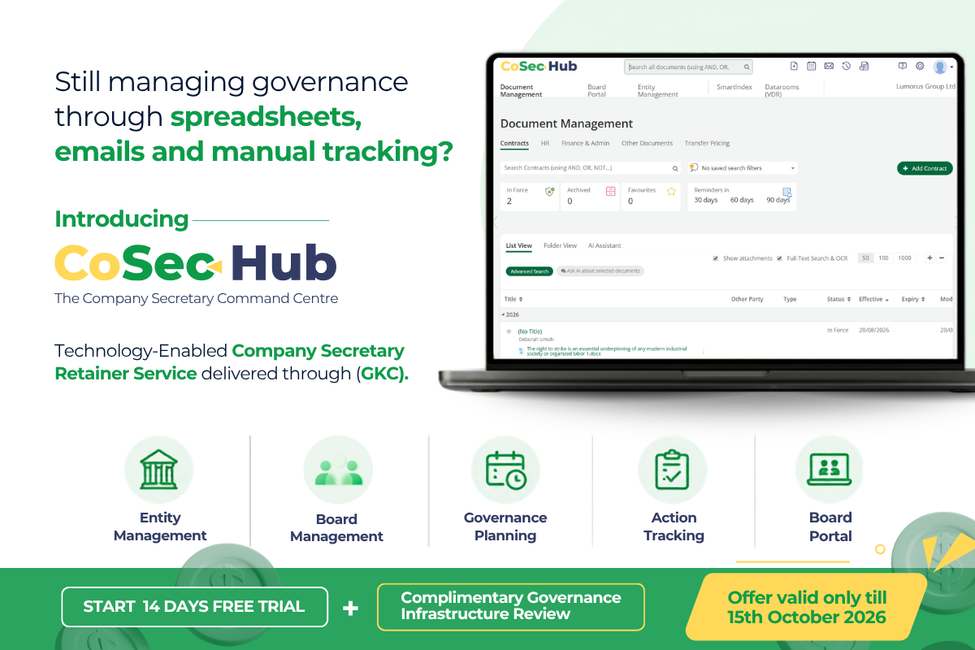
Alongside these services, CoSec Hub provides a technology layer that supports entity management, compliance calendars, board management, statutory registers and action tracking.
This combination can be particularly useful for groups that want to reduce fragmentation between local compliance, board governance and central oversight.
TMF Group: strong geographic reach and local execution
TMF Group centres its model on international entity management with local delivery.
Its compliance and governance offering includes services across entity maintenance, statutory compliance, corporate records and local governance support. Its international footprint makes the model particularly relevant for multinational groups seeking to coordinate entity obligations across many jurisdictions.
For European groups operating across several markets, this model can reduce the number of separate local advisers that headquarters needs to coordinate.
The value lies primarily in scale and local execution.
However, boards should still ask whether any provider’s service is primarily administrative or whether it also includes enough governance advice, board support and strategic insight for the organisation’s needs.
Best fit: Large multinational groups seeking broad local compliance coverage.
Vistra: technology and global entity scale
Vistra also operates a large international entity management model.
Its entity management proposition combines Company Secretary support, statutory compliance, board-related services and centralised technology across an extensive international network.
That can be valuable where the main challenge is managing a large number of entities and maintaining visibility across countries.
In particular, centralised entity information can help reduce:
- Duplicate records
- Missed deadlines
- Local reporting inconsistencies
- Manual tracking
- Poor visibility
However, as with all technology-enabled models, data quality and accountability remain critical.
A central platform does not create good governance if local information is inaccurate or if no one owns the resulting actions.
Best fit: Large groups prioritising scale, entity data and operational efficiency.
PwC: multidisciplinary support for complex multinational groups
PwC’s Entity Governance and Compliance practice combines governance and compliance support within a much broader international professional services network.
Its published services cover areas including governance assessments, corporate compliance, entity transactions and board-related support.
PwC has also published a global governance transformation case study illustrating how subsidiary governance can be reviewed across a large multinational organisation.
This model can be useful where governance requirements overlap with:
- Corporate restructuring
- Tax
- Legal support
- Transactions
- Governance transformation
- Group simplification
The main strength is breadth.
However, organisations should consider applicable independence requirements where firms within the same professional network also provide external audit services.
Best fit: Large, complex groups requiring multidisciplinary support.
What boards should ask beyond the provider’s country list
Geographic reach is important, but it can also be misleading.
A provider may claim coverage across dozens of jurisdictions while relying on different delivery models in different markets.
Boards should therefore ask:
- Which countries do you support directly?
- Where do you use local partners?
- Who owns the relationship when partners are involved?
- Can headquarters see all entities in one place?
- How are regulatory changes monitored?
- How are local filings reflected in central records?
- What happens when an issue becomes complex?
- Who provides professional Company Secretary advice?
- Can the service scale after an acquisition?
- How will governance data be transferred if the relationship ends?
These questions reveal more about the operating model than a country map.
The biggest risk is losing group-wide visibility
A company can have excellent local advisers and still have weak group governance.
Consider a group operating in ten European countries.
Each local entity files on time. Registers are maintained. Directors are properly appointed.
However, headquarters cannot answer:
- Which entities have overdue actions
- Which directors sit across multiple boards
- Whether ownership records are current
- Which regulatory changes require attention
- Which subsidiaries approved material decisions
- Whether the central database matches local records
Local compliance may therefore be strong while parent-board oversight remains weak.
The missing ingredient is governance visibility.
The provider should not simply help entities comply.
It should help the organisation understand the governance position of the group.
Board decisions need to flow into entity actions
One of the most common weaknesses in multi-jurisdiction governance appears after a board decision.
For example, the parent board may approve:
- A new subsidiary
- A share transfer
- A restructuring
- A director appointment
- A financing arrangement
- A group simplification
That decision can trigger several downstream requirements.
These may include:
- Local board resolutions
- Shareholder approvals
- Registry filings
- Statutory register updates
- Beneficial ownership changes
- Bank mandate changes
- New compliance deadlines
If the organisation treats the board meeting and the entity filing as separate processes, gaps can appear.
A stronger model connects the decision directly with resulting actions.
Read More: Board & Shareholder Meetings
Beneficial ownership needs stronger central control
European beneficial ownership requirements make accurate entity information increasingly important.
The EU Anti-Money Laundering Regulation strengthens the European framework for identifying the natural persons who ultimately own or control legal entities.
For Company Secretaries, this means ownership information should not sit only in local records.
The group should be able to explain:
- Who legally owns each entity
- Who ultimately controls it
- Which records support that conclusion
- Which changes are pending
- Whether local and central records agree
This becomes especially important during:
- Acquisitions
- Financing
- Due diligence
- Regulatory reviews
- Group restructurings
The board does not need every technical ownership detail.
However, it does need confidence that the organisation knows who owns and controls its entities.
UK identity verification adds another cross-border challenge
Groups with UK companies or relevant overseas-company registrations now face additional identity verification requirements.
Current Companies House guidance explains the identity verification requirements affecting directors and people with significant control.
For international groups, one director may hold appointments across several companies.
That creates a practical need for central tracking of:
- Verification status
- Personal codes
- Relevant appointments
- Filing deadlines
- Outstanding actions
This is exactly the type of obligation that becomes harder to manage through email and spreadsheets as the number of entities grows.
Technology matters, but software alone does not solve the governance problem
The case for dedicated governance technology is increasingly strong.
Entity platforms can:
- Store corporate information
- Send reminders
- Track filings
- Generate dashboards
- Record board actions
- Support compliance calendars
However, technology cannot independently:
- Interpret unusual regulatory requirements
- Resolve conflicts between jurisdictions
- Advise directors
- Determine whether a governance issue is material
- Decide when escalation is required
The strongest operating model therefore combines technology with professional judgement.
A platform should reduce administration so that experienced Company Secretaries have more time to focus on governance.
Explore: CoSec Hub
Why CoSec Hub was built differently
Many governance platforms are designed primarily as software.
CoSec Hub was built around a different proposition: modern governance teams need both technology and experienced Company Secretary support.
The technology layer supports
- Entity Management
- Compliance Calendars
- Governance Forward Planning
- Board Management
- Contract Management
- Statutory Registers
- Board Action Tracking
- Meeting Lifecycle Management
The Governance Knowledge Centre provides
- Chartered Company Secretary Expertise
- Governance Operations Support
- Compliance Monitoring
- Board Administration
- Governance Intelligence
- Multi-Jurisdiction Governance Support
- Governance Advisory
Together, these capabilities create a Technology-Enabled Company Secretary Retainer Service.
The distinction matters.
A system can identify that a filing is overdue.
An experienced Company Secretary can determine why it matters, who should act and whether the issue should reach senior management or the board.
That combination creates governance infrastructure rather than simply another software platform.
Seven signs your multi-jurisdiction governance model is becoming fragile
1. Headquarters and local records disagree
This usually points to weak information flows.
2. Compliance depends on personal reminders
Key obligations should not sit primarily in one person’s diary.
3. Every new country creates a new governance process
Local variation is normal. Complete operational reinvention is not.
4. Board decisions are not connected to resulting filings
This creates gaps between authority and execution.
5. Local advisers are strong, but group visibility is weak
Good local compliance does not automatically create good group governance.
6. Entity data becomes reliable only before a transaction or audit
Reliable records should be the normal operating condition.
7. One experienced person knows how everything fits together
That expertise is valuable, but the organisation should not depend on it completely.
These warning signs usually point towards an operating-model problem rather than a simple resourcing issue.
Eight questions to include in your next provider review
Boards, General Counsel and Company Secretaries should ask prospective providers:
- How do you maintain one reliable view across several European jurisdictions?
- Which countries are supported directly and which through partners?
- How do you monitor regulatory change?
- How are local board decisions reflected in group records?
- How do you manage beneficial ownership information?
- What technology supports the service?
- What professional Company Secretary expertise sits behind the technology?
- How do you report exceptions and emerging governance risks?
These questions help distinguish basic administration from genuine governance capability.
The Lumorus View
Multi-jurisdiction governance fails when organisations treat each entity as a separate compliance problem instead of managing the group as one governance system.
Local compliance matters.
However, the parent board also needs visibility.
It should understand where entities sit, who directs them, who owns them, which obligations are approaching and where exceptions require attention.
At the same time, local boards and advisers need enough autonomy to fulfil their legal responsibilities.
Therefore, the strongest model combines:
- Central oversight
- Local expertise
- Reliable entity information
- Clear escalation
- Professional Company Secretary judgement
- Technology-enabled visibility
This is what makes cross-border governance scalable.
The Bottom Line
Europe is one of the world’s most connected business regions, but it remains a complex environment for legal entity governance.
Different company laws, filing requirements, ownership rules and local governance expectations mean that organisations cannot rely on one standard process everywhere.
The best Company Secretary services therefore do more than keep individual entities compliant.
They connect local requirements with central governance.
For some groups, the priority will be broad geographic reach. Others may need a large multidisciplinary network or sophisticated entity technology.
However, growing organisations increasingly need something more integrated.
They need a partner that can support day-to-day Company Secretary delivery while also strengthening governance capability, board oversight and organisational resilience.
That is the real distinction.
Multi-jurisdiction governance should allow the organisation to grow across Europe without forcing the board to lose sight of how its entities are governed.
Continue Exploring
- For stronger governance and board support: Corporate Governance Support
- For statutory and regulatory compliance: Statutory & Regulatory Compliance
- For board and shareholder governance: Board & Shareholder Meetings
- For company formation and restructuring: Company Formation & Structuring
- For additional professional governance capacity: Company Secretary Outsourcing
- For stronger annual reporting: Annual Report Services
- For accurate and defensible board records: Minute Taking Solutions
- For connected governance technology and professional expertise: CoSec Hub
About CoSec Hub
CoSec Hub is the Company Secretary Command Centre.
Built by Company Secretaries for Company Secretaries, CoSec Hub combines governance technology with Chartered Company Secretary expertise to support entity management, compliance oversight, board administration and governance operations.
Through CoSec Hub and the Governance Knowledge Centre, organisations can access a Technology-Enabled Company Secretary Retainer Service that connects:
- Governance technology
- Entity management
- Compliance calendars
- Board administration
- Company Secretary expertise
- Governance intelligence
- Multi-jurisdiction support
- Governance advisory
For European groups, the aim is straightforward: create one connected governance environment while retaining the local knowledge needed in each jurisdiction.
Lumorus: Better Business, Built on Purpose
Lumorus is a UK headquartered global governance, ESG, Company Secretary and advisory firm supporting organisations across Europe, Africa, Asia, the Caribbean, Canada, the Middle East and international markets.
For more than 10 years, we have helped boards and leadership teams strengthen governance, accountability and organisational resilience.
For multi-jurisdiction organisations, good governance requires more than maintaining legal entities.
It requires reliable group information, experienced Company Secretaries, strong board processes and governance infrastructure capable of scaling as the organisation grows.
Can your board see the governance position of every material European entity clearly, or does the answer still depend on separate advisers, spreadsheets and individual memory?
Explore Lumorus and CoSec Hub to see how connected Company Secretary support can help your organisation move from fragmented entity administration to visible, scalable and board-ready governance.
Email: [email protected]
CoSec Hub + Governance Knowledge Centre: Where Automation Meets Governance Authority.
Sources
- Diligent: Global State of Legal Entity Compliance 2026 – Research on the changing workload, technology and compliance pressures facing governance and entity management teams.
- TMF Group: Compliance and Governance – Information on international entity management, local compliance and governance support.
- Vistra: Entity Management – Information on international entity management, Company Secretary support and technology-enabled compliance.
- PwC: Entity Governance and Compliance – Information on PwC’s international entity governance and compliance services.
- PwC: Global Governance Transformation – Published case study concerning multinational subsidiary governance transformation.
- European Union: Regulation (EU) 2024/1624 – European anti-money laundering framework covering beneficial ownership and transparency requirements.
- Companies House: Identity Verification Guidance – Current UK guidance on identity verification requirements affecting company directors and people with significant control.