74% of Company Secretaries say their remit has expanded. The operating model beneath them has not always kept pace
The role of the Company Secretary is becoming broader, more visible and more demanding.
According to Diligent’s 2026 Global State of Legal Entity Compliance Benchmark, 74% of Company Secretaries, General Counsel and legal operations leaders surveyed said their scope had expanded during the previous two years. At the same time, 63% said workload had grown faster than their teams, that gap matters.
Modern Company Secretary sits at the intersection of board governance, legal entity management, regulatory compliance, risk, corporate records and organisational accountability. As these responsibilities grow, governance teams cannot rely indefinitely on spreadsheets, email reminders and the knowledge of a few experienced people.
The challenge is no longer simply whether the work gets done, it is whether the organisation has an operating model capable of delivering that work consistently, visibly and at scale, this is where governance operations becomes important.
Governance operations brings structure to the way governance work is planned, assigned, completed, monitored and evidenced. It connects professional Company Secretary judgement with clear processes, reliable information and technology that supports the work.
Boards and governance leaders, this raises a simple question: Is your governance team operating a governance system, or is it still holding the system together manually?
Read More: Corporate Governance Support
Executive Takeaway
Leading governance operations services should help Company Secretaries gain greater control without creating unnecessary bureaucracy.
In practice, that means bringing together:
- Entity management
- Compliance calendars
- Governance forward planning
- Board and committee support
- Statutory registers
- Board action tracking
- Meeting lifecycle management
- Governance reporting
- Regulatory monitoring
- Multi-jurisdiction coordination
- Corporate actions
- Governance records and evidence
- Professional Company Secretary advice
However, technology alone is not enough.
Strong governance operations also require clear ownership, professional judgement, reliable information and defined routes for escalation, the objective should be straightforward:
Routine governance work becomes more consistent, while Company Secretaries gain more time for judgement, challenge and board advice.
Governance operations is becoming a discipline in its own right
Governance operations is a relatively new label for a long-standing problem.
One emerging definition comes from Kuberno, which describes governance operations, or GovOps, as the use of structured workflows, shared infrastructure and repeatable processes to improve consistency and transparency across governance work. The terminology may continue to evolve. The underlying challenge is already clear.
Other corporate functions have developed more structured operating models. Legal operations has changed how legal work is organised and delivered. Finance and HR also use shared systems, workflow design and data to improve execution, governance teams face a similar transition.
Traditionally, many governance functions have worked well because experienced people understood the organisation in detail. They knew which approvals were due, where records were stored, which advisers needed to be contacted and how individual boards preferred to operate.
That approach can work when organisational complexity is limited, however, it becomes harder to sustain as the number of entities, jurisdictions, directors, meetings and regulatory obligations grows, governance operations therefore asks a different question:
How do we make good governance repeatable without making it mechanical? That is the real operating model challenge.
Why the Company Secretary role is driving this change
The Company Secretary has never been simply a meeting administrator.
Chartered Governance Institute UK & Ireland describes a role that sits close to board information flows, director development, board procedures, shareholder relations, reporting and internal control.
Responsibilities can include scheduling meetings, preparing agendas, supporting board papers, recording decisions and monitoring actions.
Similarly, the International Finance Corporation describes the Company Secretary as a governance professional whose responsibilities extend across board advice, statutory compliance, records, meetings and implementation of board decisions.
As a result, governance teams increasingly work across several connected areas:
- Board governance: supporting the Chair, directors and committees
- Entity governance: maintaining reliable information about legal entities
- Compliance: ensuring statutory obligations are completed
- Decision evidence: recording and preserving important corporate decisions
- Governance reporting: giving boards visibility over obligations and exceptions
- Regulatory intelligence: identifying relevant changes before they become urgent
- Shareholder governance: supporting meetings, approvals and ownership matters
The problem is not a lack of Company Secretary expertise, instead, the volume and range of work can outgrow the operating model around that expertise.
Explore More: Board & Shareholder Meetings
What leading governance operations services should provide
A strong governance operations service should connect the main elements of governance work.
It should not treat each obligation as a separate administrative task.
Governance Operations Capability Map
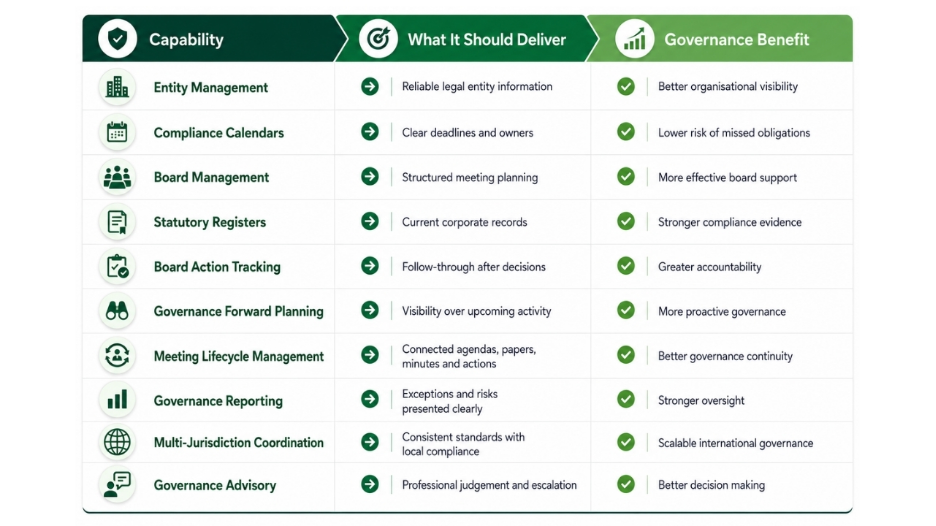
The real value lies in the connection between these activities, consider a director appointment. It should not be treated as one isolated filing, the appointment may affect the board record, statutory register, beneficial ownership analysis, Companies House or another local registry, committee composition and director induction.
Good governance operations connects those obligations so that one corporate event triggers the right actions across the organisation.
1. Entity management should create one reliable governance record
Entity information often becomes fragmented gradually.
Finance maintains one list. Tax may hold another. Local advisers keep separate records. Meanwhile, the governance team may depend on a central spreadsheet that is updated when information reaches headquarters.
Over time, those records can diverge.
A February 2026 analysis by Wolters Kluwer argues that accurate and accessible corporate records are fundamental to governance, compliance and strategic decision making. It also highlights the case for centralised entity management as organisations become more complex.
A governance operations model should therefore maintain clear information across areas such as:
- Entity name and registration
- Jurisdiction
- Directors
- Shareholders
- Beneficial ownership
- Share capital
- Registered office
- Statutory registers
- Filing status
- Corporate actions
- Constitutional documents
However, centralising information is only part of the answer, a database has little governance value if nobody can rely on its contents.
Good governance operations therefore combines technology with clear data ownership, review and accountability.
Read More: Company Formation & Structuring
2. Compliance calendars should manage accountability, not just dates
Traditional compliance calendars focus on deadlines, modern governance operations should go further.
For every material obligation, the organisation should know:
- What is required
- Which entity is affected
- Who owns the action
- When it is due
- Whether approval is required
- What evidence proves completion
- What happens if the deadline is missed
This turns a calendar into a governance control, it also improves reporting.
Rather than giving boards or governance leaders a long list of completed filings, the Company Secretary can focus attention on exceptions, including:
- Overdue obligations
- Upcoming high-risk deadlines
- Missing information
- Local adviser delays
- Actions requiring board approval
- Regulatory changes requiring implementation
Consequently, leadership sees where attention is needed rather than being told that most activities are green, that is a far more useful form of governance reporting.
Explore More: Statutory & Regulatory Compliance
3. Board operations should cover the full meeting lifecycle
Governance operations begins before a board meeting and continues after it.
The IFC’s guidance places the Company Secretary at the centre of meeting administration, board advice, director induction and information flows.
Effective board operations should therefore connect the full meeting lifecycle.
Before the meeting
- Forward calendar
- Agenda planning
- Paper requests
- Director availability
- Conflict identification
- Approval requirements
During the meeting
- Attendance
- Quorum
- Decisions
- Challenge
- Conflicts
- Actions
After the meeting
- Minutes
- Resolutions
- Action tracking
- Regulatory filings
- Statutory updates
- Follow-up reporting
This continuity matters because governance failures often occur in the space between a decision and its implementation.
A board can make the right decision and still experience poor governance if nobody ensures that the decision is carried through.
Read More: Board & Shareholder Meetings
4. Board action tracking should make accountability visible
Actions are one of the simplest tests of governance discipline.
Boards regularly request information, approve follow-up work and assign responsibilities. Yet action tracking can become inconsistent when different committees, subsidiaries or meetings use different processes, leading governance operations should provide one clear approach.
For each material action, the organisation should record:
- The decision or request
- The responsible owner
- The target date
- Current status
- Dependencies
- Evidence of completion
- Escalation where overdue
This gives the Company Secretary a reliable view without requiring repeated email chasing.
More importantly, it ensures that board decisions do not disappear once the minutes have been approved. Governance is not complete when the decision is recorded. It is complete when the decision is implemented, closed or consciously revised.
5. Governance reporting should focus on exceptions
Company Secretaries often have access to enormous amounts of information, boards do not need to see all of it, instead, good governance reporting should identify the issues requiring attention, judgement or action.
A monthly or quarterly governance operations dashboard might therefore focus on:
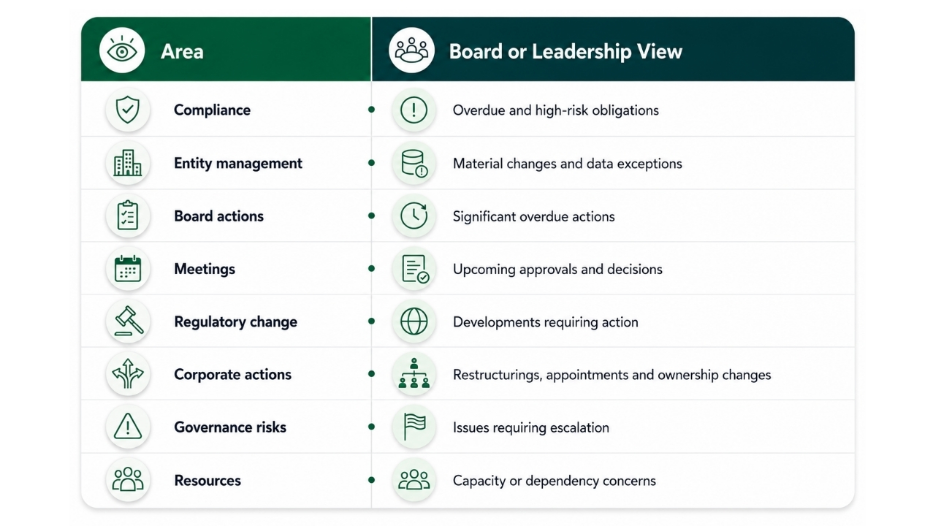
More information does not automatically create better oversight, in fact, excessive reporting can obscure the issues that matter.
The Company Secretary adds value by helping leadership distinguish signal from noise.
6. Multi-jurisdiction governance needs central visibility and local expertise
International growth creates one of the strongest cases for governance operations.
Local advisers remain essential because each jurisdiction has its own company law, regulatory expectations and filing requirements, however, local expertise without central coordination can produce fragmented governance.
PwC’s global Entity Governance and Compliance practice combines local governance support with central reporting, compliance calendars and technology-enabled entity management, it also gives the example of supporting an organisation with more than 200 entities across more than 40 jurisdictions through a centrally coordinated model.
Its bp governance transformation case study also describes an entity-by-entity assessment across more than 80 countries before the introduction of a coordinated governance model covering director support, board meetings, transactions and compliance, the lesson applies well beyond the largest multinational groups.
International governance should combine:
- Group standards
- Local regulatory expertise
- Central entity information
- Consistent reporting
- Defined escalation
- Clear local accountability
The purpose of central coordination is not to remove responsibility from local boards, it is to give the group enough visibility to govern across jurisdictions.
7. Governance operations should reduce key-person dependency
One of the most important benefits of a stronger operating model is continuity, many governance teams depend heavily on experienced individuals who understand how everything works.
They know where records sit. They know which local advisers need chasing. They understand the history behind unusual corporate structures and know which directors need additional context, that knowledge is valuable, however, it becomes a governance risk when the organisation cannot function effectively without particular individuals.
A stronger operating model should capture enough knowledge, process and evidence to remain resilient when people:
- Take leave
- Change roles
- Leave the organisation
- Experience unusually high workloads
- Need to respond to a crisis
This does not mean removing people from governance, on the contrary, it means ensuring that experienced professionals are supported by the organisation rather than becoming its only control.
The emerging GovOps debate makes a similar point. Kuberno argues that personal expertise and goodwill alone become increasingly difficult to scale as governance functions grow.
Technology should support governance, not define it
Technology can improve governance operations significantly.
It can strengthen:
- Workflow
- Data access
- Compliance monitoring
- Board action tracking
- Record keeping
- Reporting
- Entity visibility
Technology cannot decide whether a board should approve a matter, nor can software determine whether a conflict requires escalation, whether a governance process is proportionate or how directors should respond to an unusual governance problem, professional judgement remains essential.
The sequence should therefore be:
- Define the governance operating model.
- Clarify responsibility and decision rights.
- Standardise core processes.
- Identify the information required.
- Introduce technology to support those processes.
- Monitor whether the operating model improves governance outcomes.
Starting with software can simply digitise weak processes, the aim is not more automation, it is better control.
Governance operations services: understanding the different market models
There is no authoritative ranking of leading governance operations providers, nor would a simple ranking be particularly useful.
The market includes different models, from governance software and specialist Company Secretary firms to large professional services networks and internal teams, the better question is which operating model fits the organisation’s needs.
Lumorus and CoSec Hub: technology-enabled governance operations with Company Secretary expertise
Lumorus combines Company Secretary services, governance advisory and technology-enabled governance operations.
Its wider Company Secretary capabilities include:
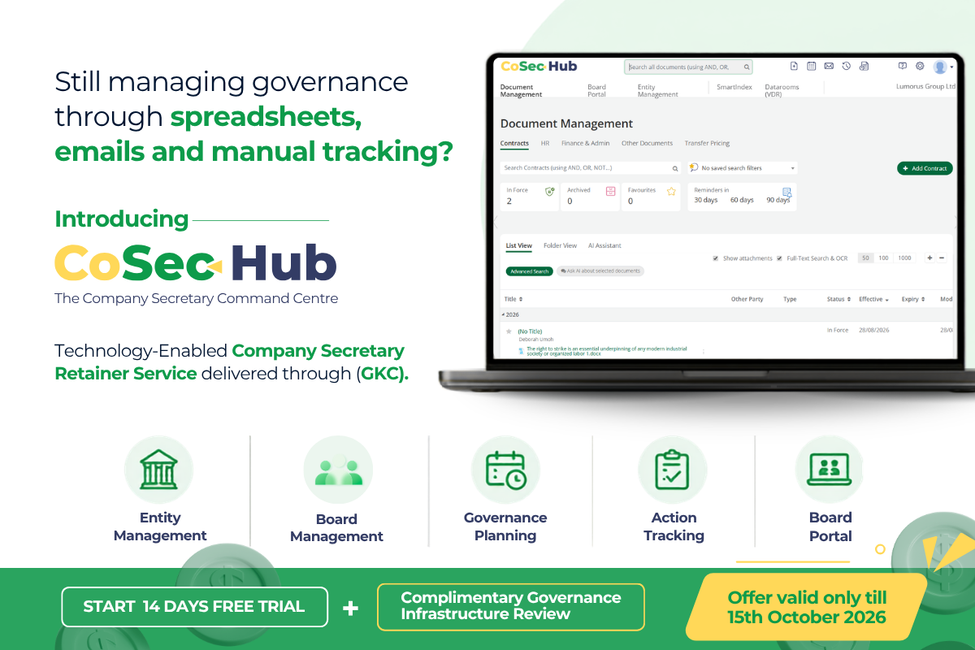
Through CoSec Hub and the Governance Knowledge Centre, the model combines technology with professional governance support, this is particularly relevant for organisations that need both operational capacity and access to Company Secretary expertise.
Best suited to: organisations seeking connected governance operations rather than software or outsourcing alone.
PwC: enterprise-scale governance and entity compliance operations
PwC combines governance, compliance, transactions and technology-enabled entity management across its international network, its model includes statutory records, filings, governance assessments, board support, central compliance calendars and dashboard reporting.
Because the service sits within a large multidisciplinary network, clients may also be able to connect governance operations with legal, tax and transaction support where appropriate.
Best suited to: large multinational organisations requiring extensive international coordination.
Wolters Kluwer: technology-led entity and governance information management
Wolters Kluwer places strong emphasis on the information infrastructure supporting legal entity governance.
Its 2026 analysis highlights centralised entity records, secure access and reliable corporate information as important foundations for governance and compliance. This model may be particularly useful where an organisation’s main weakness is fragmented entity information rather than a shortage of governance professionals.
Best suited to: legal and governance teams prioritising entity data infrastructure and technology.
Specialist governance providers: deeper local or board support
The market also includes specialist providers that combine Company Secretary delivery with governance advice. For example, Bowmans provides governance, compliance audits, meeting management and Company Secretary services in East Africa.
Meanwhile, PwC Kenya combines meeting management, action tracking, conflicts registers and governance reviews.
Specialist providers can be particularly useful where organisations need strong local knowledge or direct access to senior governance professionals.
What the different models offer
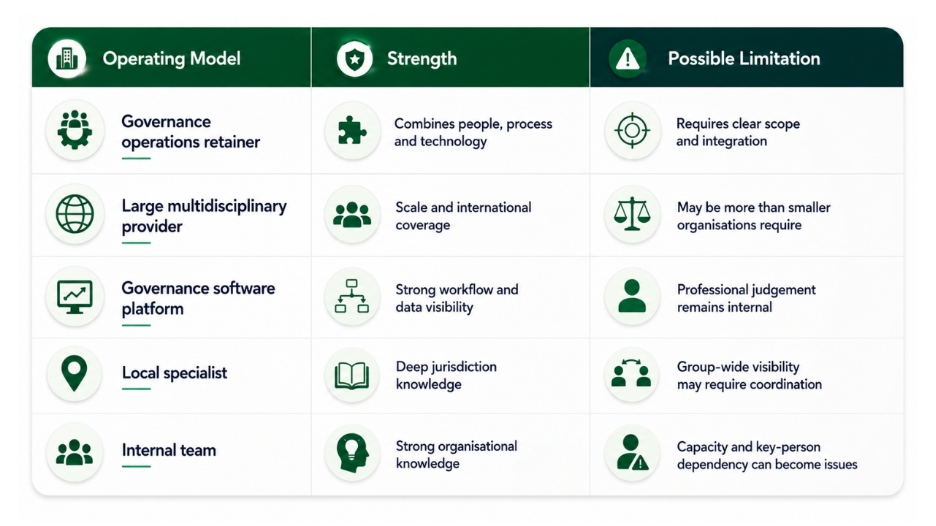
The right model depends on the organisation’s size, complexity, jurisdictions and internal capability, for many organisations, the answer will be a hybrid.
Why CoSec Hub was built differently
Many governance platforms position themselves primarily as software.
CoSec Hub was built around a different idea, modern governance teams need technology, but they also need access to professional Company Secretary judgement.
The technology layer supports
- Entity Management
- Compliance Calendars
- Governance Forward Planning
- Board Management
- Contract Management
- Statutory Registers
- Board Action Tracking
- Meeting Lifecycle Management
The Governance Knowledge Centre provides
- Company Secretary Expertise
- Governance Operations Support
- Compliance Monitoring
- Board Administration
- Governance Intelligence
- Multi-Jurisdiction Governance Support
- Governance Advisory
Together, they form a Technology-Enabled Company Secretary Retainer Service, the distinction is important.
Software can identify an overdue board action. Professional judgement may determine whether it requires escalation. Technology can show a compliance deadline. A Company Secretary understands the corporate context behind it.
A system can maintain an entity record. Governance expertise becomes essential when ownership, restructuring or director responsibilities become complex, together, these capabilities turn technology into governance infrastructure rather than simply another platform.
The Lumorus View
Governance operations should remove administrative friction without removing professional judgement.
The Company Secretary profession does not need to become more mechanical, it needs stronger infrastructure around work that should already be repeatable.
Routine obligations should be visible, consistent and easier to execute. At the same time, experienced Company Secretaries should be able to spend more time on matters where judgement creates genuine value, that includes board effectiveness, regulatory interpretation, conflicts, governance design and decision support.
This is the balance that high-performing governance operations should achieve.
Seven signs your governance operating model needs attention
Boards, General Counsel and Company Secretaries should examine the operating model closely if:
- Governance deadlines depend heavily on personal calendars or spreadsheets.
- It takes too long to confirm basic entity information.
- Board actions are tracked differently across committees or subsidiaries.
- Leadership receives little governance reporting unless something goes wrong.
- Local advisers work effectively, but central visibility remains weak.
- The team becomes significantly busier before audits, transactions or major board cycles.
- Governance continuity would be difficult if one experienced person became unavailable.
None of these signs necessarily points to weak governance professionals, more often, they indicate that capable people are working within an operating model that has not kept pace with organisational complexity.
Eight questions to ask a governance operations provider
Before choosing an external partner, test how the service will work in practice.
- What governance activities will you manage from start to finish?
- How will responsibilities between our team and yours be defined?
- What technology supports delivery?
- How do you maintain data quality?
- How will exceptions and overdue obligations be escalated?
- Can you support multiple jurisdictions consistently?
- What Company Secretary expertise sits behind the operational team?
- How will you demonstrate that the service has improved governance?
The final question is especially important. A governance operations engagement should produce measurable improvement, that could mean fewer overdue actions, more reliable entity information, stronger reporting, faster access to evidence or less dependence on manual work.
The Bottom Line
The Company Secretary role is expanding, yet many governance operating models remain designed for a simpler organisation. Diligent’s 2026 benchmark captures that tension clearly. According to the research, 74% of respondents reported an expanded remit, while 63% said workload had grown faster than team capacity.
The answer is not simply more people, nor is it simply more software. Organisations need governance operations that connect people, processes, information and technology; that means reliable entity records, visible compliance obligations, structured board processes, clear action ownership and governance reporting that directs leadership attention to the issues that matter.
Most importantly, better governance operations should allow experienced Company Secretaries to spend less time holding fragmented processes together and more time doing what boards increasingly need from them: advising, challenging, anticipating and strengthening governance.
The future of the Company Secretary function is not less human judgement. It is better infrastructure around it.
Continue Exploring Our Services
- For stronger board governance: Corporate Governance Support
- For compliance operations and deadline management: Statutory & Regulatory Compliance
- For board and shareholder governance: Board & Shareholder Meetings
- For entity creation and restructuring: Company Formation & Structuring
- For additional external governance capacity: Company Secretary Outsourcing
- For annual governance reporting: Annual Report Services
- For stronger board records: Minute Taking Solutions
- For connected governance operations: CoSec Hub
Is your Company Secretary function built to scale?
Governance responsibilities are expanding. Yet many Company Secretary functions are still supported by operating models built around spreadsheets, manual follow-up, separate systems and individual knowledge, as complexity grows, those weaknesses become harder to absorb.
That is why CoSec Hub is offering qualified Chartered Company Secretaries a practical way to experience the platform while also examining the operating model behind their current function.
Get a 14-Day FREE Trial + Complimentary Company Secretary Functional Audit
Experience CoSec Hub for 14 days and see how the Company Secretary Command Centre and Governance Knowledge Centre can support your governance operations.
In addition, qualified Chartered Company Secretaries can receive a complimentary Company Secretary Functional Audit.
The audit provides a structured review of the Company Secretary function, including:
- Operating model
- Roles and responsibilities
- Capacity
- Governance processes
- Technology and systems
- Compliance oversight
- Information flows
- Key dependencies
- Escalation arrangements
- Continuity and resilience
The purpose is not simply to identify more work, instead, the review considers where the function is working effectively, where unnecessary pressure or dependency exists and where stronger infrastructure could improve control, visibility and board support.
For Company Secretaries managing growing workloads, multiple entities or increasingly complex board and compliance requirements, the review can help answer a more important question:
Is the function itself equipped for the governance responsibilities now being placed upon it? Exclusive offer for qualified Chartered Company Secretaries.
Explore CoSec Hub and experience how connected governance operations can support a stronger Company Secretary function.
About CoSec Hub
CoSec Hub is the Company Secretary Command Centre, built by Company Secretaries for Company Secretaries, CoSec Hub combines governance technology with professional governance expertise to support compliance oversight, entity management, board administration and day-to-day governance operations.
Delivered alongside the Governance Knowledge Centre, the model provides Technology-Enabled Company Secretary Retainer Services for modern Company Secretary, legal, governance and compliance teams; the objective is not simply automation, it is to make governance operations more visible, repeatable and resilient while keeping experienced professionals at the centre of judgement and accountability.
Lumorus: Better Business, Built on Purpose
Lumorus is a global governance, ESG, Company Secretary and advisory firm headquartered in the UK and supporting organisations across Europe, Africa, Asia, the Caribbean, Canada, the Middle East and international markets.
For more than 10 years, we have helped boards, leadership teams and organisations strengthen governance, accountability and organisational resilience. As governance responsibilities grow, organisations need more than isolated software or additional administrative support.
They need an operating model that connects governance expertise, compliance, board activity, entity records and organisational accountability.
Is your governance team spending its time governing, or holding fragmented governance processes together?
Contact Lumorus to explore how our Company Secretary services and CoSec Hub can help your organisation move towards connected, technology-enabled governance operations.
Current CoSec Hub offer: Qualified Chartered Company Secretaries can receive a 14-day free trial plus a complimentary Company Secretary Functional Audit.
Email: [email protected]
CoSec Hub + Governance Knowledge Centre: Where Automation Meets Governance Authority.
Sources
- Chartered Governance Institute UK & Ireland – Guidance on the Company Secretary’s board, information, reporting and governance responsibilities.
- International Finance Corporation – The Corporate Secretary: The Governance Professional.
- IFC – Guidance on the Company Secretary’s role as adviser, governance leader and link between board and management.
- Kuberno – 2026 discussion of governance operations and the emerging GovOps operating model.
- Wolters Kluwer – 2026 analysis of entity management, governance information and compliance.
- PwC – Global Entity Governance and Compliance services, including governance, compliance calendars and entity management.
- PwC – Global subsidiary governance transformation case study.
- PwC Kenya – Entity governance, meeting management, action tracking and governance review services.
- Bowmans – Company Secretary, governance advisory and compliance operations support in East Africa.