The Company Secretary Should Not Be the Organisation’s Operating System
One of the most overlooked governance risks is the organisation that appears well controlled because an experienced Company Secretary is constantly compensating for the weaknesses beneath it.
A board meeting runs smoothly. The papers arrive, minutes are prepared, regulatory deadlines are met and outstanding actions receive attention. From the boardroom, governance appears to be functioning as intended.
Behind those outcomes, however, the Company Secretary may be resolving overlapping responsibilities, reconciling inconsistent information, chasing decisions between departments and managing processes that depend heavily on personal intervention.
Most of these problems never become visible because an experienced professional identifies them early and finds a way forward.
That is both the strength and the danger of the role.
The Chartered Governance Institute UK & Ireland’s 2026 Governance Market Survey found that 74% of respondents had experienced increased workloads during the previous year, while 42% believed their governance functions were inadequately resourced. At the same time, 65% reported that the influence of the governance function was increasing.
The findings reveal a profession becoming more important to organisational decision making while facing growing pressure on its capacity.
A separate 2026 Diligent study on legal entity compliance found that 51% of surveyed governance professionals had experienced a near-miss compliance event, while 47% identified technology gaps and legacy systems as their biggest challenge.
These findings point towards a problem that deserves more attention than it receives.
Organisations are increasingly relying on Company Secretaries to absorb complexity that better governance infrastructure should help prevent.
The issue is not simply whether the function has enough people or whether professionals can work more efficiently.
It is whether the organisation has designed its governance arrangements properly.
A strong Company Secretary can help an organisation navigate complexity. However, that should not become a reason to leave unnecessary complexity unresolved.
Read More: Corporate Governance Support
Executive Takeaway
The Company Secretary function has become central to board effectiveness, regulatory compliance, governance information and organisational accountability.
Yet many organisations still depend on fragmented systems, informal relationships and individual memory to keep governance processes functioning.
When responsibilities overlap, escalation routes become unclear or decisions struggle to move between departments, experienced Company Secretaries frequently restore order.
That capability is valuable. However, permanent dependence on it can conceal weaknesses in organisational design.
The consequences extend beyond workload. They include:
- Key-person dependency: Critical governance knowledge and processes become concentrated in individuals.
- Weak accountability: Executives rely on the Company Secretary to resolve obligations they should own.
- Fragmented information: Governance records, compliance requirements and board actions remain disconnected.
- Operational fragility: Routine processes depend on repeated personal intervention.
- Reduced strategic capacity: Experienced professionals spend less time advising boards and more time repairing administrative weaknesses.
- Limited scalability: Governance arrangements become harder to sustain as organisations grow across entities and jurisdictions.
- False assurance: Boards may mistake successful outcomes for evidence that the underlying governance system is effective.
The stronger response is to invest in connected governance infrastructure, clearer decision rights and experienced professional capacity.
This is the thinking behind CoSec Hub and the Lumorus Governance Knowledge Centre.
The goal is not to make the Company Secretary less important. It is to ensure that professional judgement is supported by an institution capable of governing well.
1. The Hidden Cost of Being Too Good at Resolving Governance Problems
Experienced Company Secretaries possess an unusual ability to recognise problems before they become formal governance failures.
They understand the organisation’s history, relationships, decision processes and regulatory obligations. Consequently, they can often resolve difficulties that would take other departments considerably longer to understand.
When an approval becomes delayed, they identify the appropriate authority. If a board paper lacks essential information, they contact management. Where an action has no clear owner, they establish who needs to respond.
These interventions are part of effective professional practice.
The problem arises when the same weaknesses recur without being addressed.
Consider a board that repeatedly receives papers late because management teams lack agreed submission standards.
The Company Secretary works with executives, secures the missing information and ensures that directors receive the material before the meeting.
The immediate problem is resolved.
However, unless management changes the underlying process, the same intervention may be required at the next meeting.
Over time, the organisation begins to treat the Company Secretary’s ability to rescue the process as part of the process itself.
This creates a governance paradox.
The more effectively an individual compensates for weak systems, the less visible those systems’ weaknesses may become.
Professional excellence can therefore conceal institutional fragility.
Boards should not judge the effectiveness of governance arrangements solely by whether the required outcomes were eventually delivered. They should also understand how those outcomes were achieved and whether the process is reliable without exceptional personal intervention.
A filing completed at the last minute may satisfy an immediate obligation. Nevertheless, repeated last-minute intervention suggests that the organisation’s forward planning or accountability arrangements require attention.
The same principle applies to board decisions, entity records, compliance monitoring and action tracking.
Successful recovery is not the same as effective control.
2. Why This Is an Organisational Design Problem, Not Just a Workload Problem
When governance professionals report excessive workloads, organisations frequently respond by examining staffing levels or administrative efficiency.
Both deserve consideration.
However, increasing headcount will not necessarily resolve unclear responsibilities, fragmented information or poorly designed workflows.
A Company Secretary may spend substantial time chasing actions because executives have not been assigned clear ownership. Compliance obligations may require repeated manual checks because information is distributed across departments.
Similarly, board meeting preparation can become unnecessarily difficult when there are no consistent standards for submissions, approvals or escalation.
These are weaknesses in the operating model.
Adding another professional may provide temporary relief, but the underlying causes remain.
The better question is why so much personal intervention is necessary in the first place.
A mature governance function should distinguish between complexity that genuinely requires expertise and complexity created by weak internal arrangements.
Some matters will always require professional judgement. Conflicts of interest, sensitive board relationships, regulatory interpretation and difficult decisions cannot be reduced to routine workflows.
Other activities should be more predictable.
Compliance calendars, entity records, meeting schedules and action registers should not depend entirely on someone’s memory or ability to chase colleagues.
The 2026 Governance Market Survey also found that 66% of respondents considered supporting board information quality and decision making an increasingly important part of their role.
That finding reinforces the importance of protecting professional capacity.
If experienced Company Secretaries spend most of their time correcting avoidable process weaknesses, organisations risk underusing the very judgement they increasingly need.
The objective should be to remove unnecessary governance friction, not simply increase the function’s ability to absorb it.
Read More: Company Secretary Outsourcing
3. When the Company Secretary Becomes the Default Owner of Everybody Else’s Responsibilities
The Company Secretary sits at the intersection of several important governance relationships.
Directors rely on the function for effective board processes. Executives depend on it for governance coordination, while legal, finance, compliance and operational teams frequently require its involvement.
That position creates valuable organisational visibility.
It can also create confusion about responsibility.
An executive fails to complete a board action, so the Company Secretary follows up. A department misses a compliance deadline, prompting governance to intervene. Another function cannot determine who should approve a transaction, and the Company Secretary is asked to resolve the uncertainty.
Each intervention may be appropriate.
However, a pattern can develop in which the function becomes responsible for ensuring that everyone else fulfils their responsibilities.
This is not the same as accountability.
A mature governance model distinguishes between management ownership, governance coordination and board oversight.
For example, the Company Secretary may record a board decision, identify the responsible executive and monitor progress. Nevertheless, accountability for implementing the decision should remain with the person or function assigned to deliver it.
When these boundaries become blurred, the Company Secretary can accumulate responsibility without the authority necessary to control outcomes.
That is a structural governance weakness.
It also creates a potential distortion in board reporting.
If an action remains incomplete, directors should understand which executive is accountable and why progress has stalled. The issue should not be reduced to whether the Company Secretary has sent sufficient reminders.
A governance function should make accountability visible, not become a substitute for it.
This is particularly important in organisations where decision rights have evolved informally as the business has grown.
Delegated authorities, committee responsibilities and management reporting lines should remain aligned with the organisation’s actual operating arrangements.
Where they do not, professional intervention may conceal a deeper problem in the allocation of power.
Explore More: Board & Shareholder Meetings
4. Fragmented Information Creates an Invisible Governance Burden
Many governance problems begin with information that exists but does not connect.
Finance maintains one entity list, while legal holds another. Local advisers update director information separately, and compliance obligations are monitored through individual spreadsheets.
Board actions may be recorded in meeting minutes but tracked through email. Contractual commitments can remain disconnected from the processes responsible for monitoring them.
Each arrangement may function reasonably well in isolation.
The weakness emerges between them.
When information differs, somebody must establish which version is correct. Where an obligation has no clear owner, somebody must identify the responsible function.
Frequently, that person is the Company Secretary.
The work may appear administrative, but the consequences can be significant.
Inconsistent entity records can affect regulatory filings, audits, transactions and due diligence. Poor action tracking can weaken the implementation of board decisions, while fragmented compliance information increases the risk that important obligations will be overlooked.
Diligent’s 2026 Global State of Legal Entity Compliance research found that only 19% of surveyed practitioners reported near real-time visibility of their obligations.
That finding illustrates the difficulty of maintaining effective oversight when information is delayed or dispersed.
A stronger governance environment should establish authoritative records, clear information ownership, controlled access and reliable processes for updating information.
Technology can help connect these elements, but the organisation must first determine who is accountable for their accuracy.
The purpose of connected governance infrastructure is not simply to store information. It is to make organisational accountability more reliable.
Read More: Statutory & Regulatory Compliance
5. Board Effectiveness Suffers When the Company Secretary Is Constantly Repairing Processes
The quality of board decisions depends heavily on what happens before and after meetings.
Directors need timely information, clear proposals, relevant evidence and an understanding of the risks and trade-offs involved.
Following a decision, management must implement agreed actions and provide appropriate assurance that they have been completed.
The Company Secretary plays an important role in connecting these activities.
However, the function’s effectiveness can be weakened when routine process failures consume excessive attention.
A late board paper may require repeated intervention. An unclear proposal may need substantial clarification, while overdue actions can generate weeks of follow-up.
As a result, experienced professionals have less time to identify emerging governance risks, advise the Chair or improve the quality of board processes.
The Financial Reporting Council’s Corporate Governance Code Guidance recognises the importance of clear responsibilities, effective information flows and the Company Secretary’s contribution to board effectiveness.
These principles are particularly relevant to organisations whose governance arrangements depend heavily on individual effort.
A reliable board process should allow the Company Secretary to concentrate on whether directors are receiving the information necessary for sound judgement.
Similarly, an effective action-tracking system should provide visibility over ownership, deadlines, progress and evidence of completion.
The professional can then focus on interpreting what the information reveals.
An overdue action may indicate an ordinary operational delay. Alternatively, it could expose weak management accountability or an unresolved control failure.
The distinction requires judgement.
Better infrastructure should free Company Secretaries to identify governance problems, rather than spend most of their time compensating for them.
Read More: Minute Taking Solutions
6. Institutional Memory Should Belong to the Organisation
Experienced Company Secretaries often hold an extraordinary amount of institutional knowledge.
They understand why particular governance arrangements were adopted, how board relationships have developed and which unresolved matters require attention.
Such knowledge is valuable because governance decisions rarely occur without context.
However, the organisation becomes vulnerable when that knowledge exists primarily in one person’s memory.
Consider what happens when a long-serving Company Secretary leaves unexpectedly.
Can the organisation identify outstanding board actions, upcoming compliance obligations and current entity information?
Will colleagues understand the history behind significant decisions?
Are important governance commitments documented, and can authorised professionals locate the relevant evidence?
If these questions cannot be answered reliably, the organisation has allowed institutional knowledge to become personal rather than institutional.
The consequences may not be immediate.
Nevertheless, key-person dependency can become particularly serious during acquisitions, restructuring, leadership transitions, regulatory reviews and periods of rapid growth.
A resilient function should therefore combine documented processes, reliable records, continuity arrangements and access to experienced professional support.
This does not diminish the importance of individual expertise.
Instead, it allows expertise to contribute to lasting institutional capability.
The strongest Company Secretary is not the person without whom governance cannot function. It is the professional who helps build governance that remains effective beyond any one individual.
Read More: Company Secretary Outsourcing
7. Why Technology Alone Cannot Resolve Poor Organisational Design
Technology can significantly improve governance operations.
It can support compliance monitoring, entity management, meeting coordination, action tracking and access to important records.
However, digitisation should not be confused with effective governance.
An automated reminder sent to the wrong person does not resolve unclear accountability. A centralised dashboard containing inaccurate information does not create reliable oversight.
Likewise, software cannot independently determine whether a board decision was appropriately challenged or whether management has provided a credible explanation for a material delay.
Those questions require professional judgement.
The first step towards stronger governance infrastructure is therefore to understand the operating model.
Organisations need to establish which processes should be standardised, which responsibilities require clearer ownership and which decisions need professional intervention.
Technology can then support the agreed arrangements.
Without that discipline, organisations risk transferring fragmented manual processes into digital systems without addressing the weaknesses beneath them.
A stronger approach combines technology, professional expertise and clear accountability.
Routine governance activities should become more reliable and visible, while experienced Company Secretaries retain responsibility for interpreting complex issues and supporting effective decisions.
The goal is not to automate judgement. It is to create the conditions in which judgement can be exercised more effectively.
8. What Good Governance Infrastructure Should Remove From the Company Secretary’s Day
A well-designed governance operating model should reduce unnecessary administrative friction.
It should not remove professional judgement or weaken accountability.
The distinction can be understood through the following practical examples.
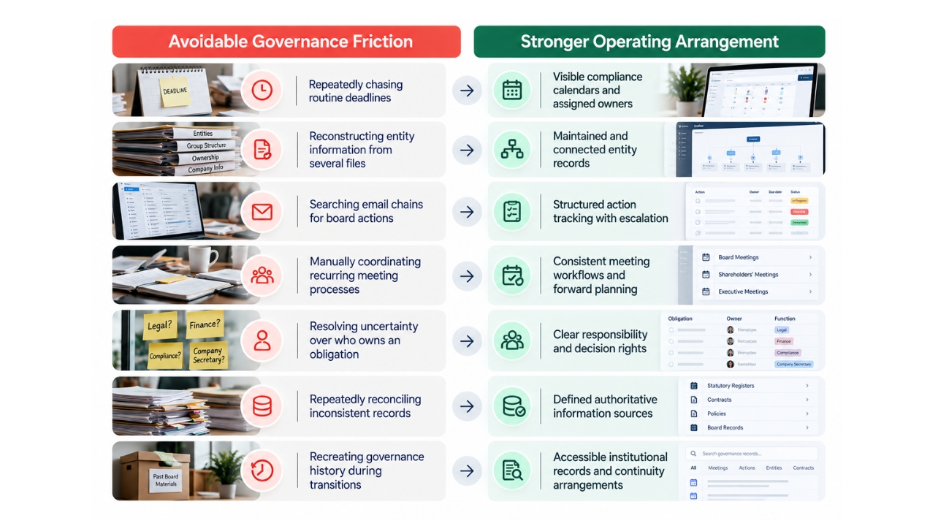
These improvements should have a broader purpose than administrative efficiency.
They should strengthen the organisation’s ability to understand its obligations, monitor decisions and identify emerging risks.
More importantly, they should create capacity for professional advice.
A Company Secretary who spends less time locating information can spend more time evaluating its significance.
Similarly, a function with reliable compliance visibility can concentrate on anticipating regulatory changes rather than constantly responding to approaching deadlines.
Good governance infrastructure does not make professional expertise less valuable. It allows that expertise to be used where it matters most.
9. CoSec Hub: Giving Company Secretaries the Infrastructure Their Judgement Deserves
Many governance solutions begin with a technology problem.
CoSec Hub begins with the operating challenges faced by Company Secretaries.
Modern governance functions need reliable technology, but they also require professional expertise, operational capacity and access to appropriate support.
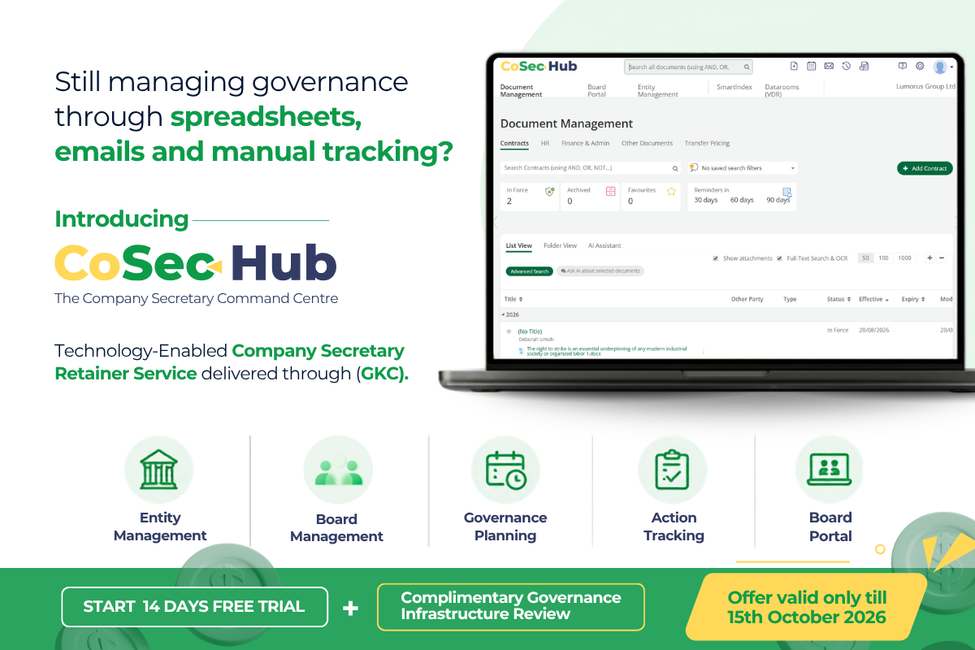
CoSec Hub is positioned as The Company Secretary Command Centre, providing a connected environment for important governance activities.
Its technology layer supports:
- Entity Management
- Compliance Calendars
- Governance Forward Planning
- Board Management
- Contract Management
- Statutory Registers
- Board Action Tracking
- Meeting Lifecycle Management
These capabilities are designed to help organisations move away from fragmented information and excessive dependence on manual coordination.
However, technology is only one part of the model.
Alongside CoSec Hub, the Lumorus Governance Knowledge Centre provides access to experienced Company Secretary expertise and governance support.
This includes professional capability in governance operations, compliance monitoring, board administration, governance intelligence, multi-jurisdiction support and advisory work.
Together, they form a Technology-Enabled Company Secretary Retainer Service.
The model reflects an important distinction.
Technology can improve visibility, consistency and workflow management. Experienced professionals provide the judgement necessary to interpret information, advise leadership and respond to complex governance situations.
CoSec Hub + Governance Knowledge Centre: Where Automation Meets Governance Authority.
The objective is not to replace Company Secretaries.
It is to provide an operating environment that reduces avoidable complexity and strengthens their capacity to deliver effective governance.
Explore: CoSec Hub, The Company Secretary Command Centre
10. The Commercial Case for a Better Company Secretary Operating Model
Poor organisational design creates costs that do not always appear clearly in financial reporting.
Repeated administrative intervention consumes professional time. Fragmented information increases duplication, while unclear accountability can delay decisions and weaken implementation.
Key-person dependency also creates continuity risk.
These weaknesses become more significant as organisations grow.
A business managing a small number of entities may be able to rely on relatively simple arrangements. However, additional subsidiaries, jurisdictions, investors and regulatory obligations can quickly increase the demands placed on governance professionals.
Without stronger infrastructure, the organisation may respond by adding more manual work rather than redesigning the process.
That approach becomes increasingly difficult to sustain.
A better operating model can improve efficiency, but its commercial value extends further.
Reliable governance information supports transactions, due diligence, regulatory compliance and board oversight.
Clear accountability can improve implementation, while continuity arrangements reduce dependence on particular individuals.
Most importantly, stronger infrastructure protects the time of experienced professionals.
That time should be directed towards board effectiveness, governance risk, regulatory interpretation and organisational accountability.
The business case is not simply cheaper administration. It is stronger governance capability, greater resilience and better use of professional expertise.
The Hidden-Risk Map: Where Poor Organisational Design Creates Dependency
The relationship between organisational weaknesses and Company Secretary dependency can be summarised across five areas.
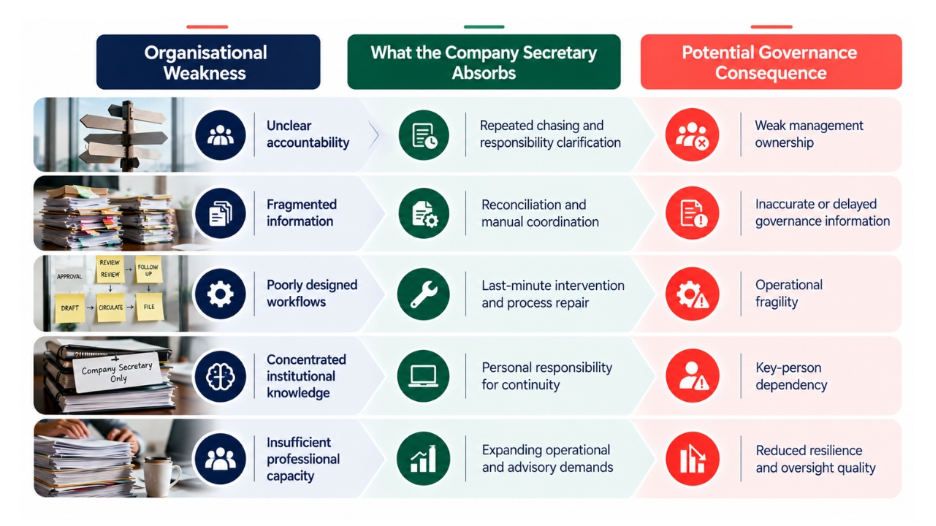
The common thread is organisational design.
Most of these risks become more serious when governance processes depend on informal coordination rather than reliable institutional arrangements.
The Company Secretary may be capable of managing the consequences.
However, the organisation should not mistake that capability for evidence that the underlying operating model is sound.
Seven Warning Signs Your Company Secretary Has Become the Operating System
1. Everything Depends on One Experienced Professional
Important records, deadlines and governance knowledge cannot be accessed reliably without one person’s involvement.
2. Board Actions Require Constant Personal Follow-Up
Management accountability depends on repeated intervention rather than clear ownership and escalation.
3. Different Departments Hold Different Versions of Governance Information
Entity, director, ownership and compliance records require regular manual reconciliation.
4. Governance Processes Become Urgent at the Last Minute
Routine obligations are completed successfully, but only through repeated recovery efforts.
5. Responsibilities Are Clarified Only When Problems Arise
Decision rights and operational ownership remain uncertain until the Company Secretary intervenes.
6. Senior Company Secretary Time Is Dominated by Administration
Experienced professionals spend more time chasing, reconciling and coordinating than advising on governance quality.
7. Leadership Assumes the System Is Effective Because Nothing Has Gone Wrong
Successful outcomes are being mistaken for evidence of resilient governance arrangements.
Several of these warning signs together suggest that the organisation has moved beyond a workload problem.
It has a governance operating-model problem.
A Practical Company Secretary Operating Model Health Check
Boards, General Counsel, CEOs and Company Secretaries can assess their current arrangements by asking ten questions.
- Can we identify all material governance and compliance obligations due during the next 90 days?
- Do board actions have clearly assigned owners, deadlines and escalation arrangements?
- Can authorised colleagues access accurate entity and governance information without relying on one individual?
- Are management responsibilities clearly distinguished from the Company Secretary’s coordination role?
- Do governance processes continue reliably when key professionals are unavailable?
- Are recurring governance activities supported by documented workflows?
- Can we identify which information source is authoritative when records differ?
- Does the function have sufficient professional capacity to support growing organisational complexity?
- Are governance professionals spending more time advising leadership than repairing routine process weaknesses?
- Would our governance arrangements remain effective if our most experienced Company Secretary left tomorrow?
The answers reveal whether an organisation has developed resilient governance capability or remains dependent on exceptional personal effort.
They also provide a starting point for determining where clearer accountability, better infrastructure or additional professional support may be required.
The Lumorus View
The Company Secretary function should not become the permanent shock absorber for organisational weaknesses that leadership has failed to address.
Experienced Company Secretaries bring judgement, discretion, institutional knowledge and professional competence that few other roles can replicate.
Their ability to navigate complexity is one of the profession’s greatest strengths.
However, organisations should not confuse that strength with evidence that their governance arrangements are properly designed.
When a Company Secretary continually reconnects fragmented processes, the immediate result may be successful governance delivery.
Over time, the same pattern can create dependency.
Responsibilities remain unclear because somebody resolves them. Information stays fragmented because somebody knows where to find it, while processes remain manual because somebody reliably completes them.
Eventually, the organisation becomes dependent on the professional’s ability to absorb complexity.
That is not a sustainable model.
The stronger approach combines clear accountability, connected information, structured processes and experienced professional support.
Technology should manage repeatable activities more reliably, while professional expertise should focus on judgement, challenge, board effectiveness and emerging governance risks.
Boards should also ensure that operational responsibilities remain with those accountable for delivering them.
This is the thinking behind CoSec Hub and the Lumorus Governance Knowledge Centre.
Not software alone.
Not professional outsourcing alone.
Connected governance infrastructure, supported by experienced Company Secretary professionals.
The objective is not to make the individual less important.
It is to make the institution less dependent on individual rescue.
The Bottom Line
The most capable Company Secretaries often prevent organisational complexity from becoming a visible governance problem.
That capability deserves recognition.
However, it should not become an excuse for poor organisational design.
When governance processes depend on repeated personal intervention, the organisation may appear effective while remaining operationally fragile.
Overlapping responsibilities continue, information stays fragmented and escalation routes remain unclear.
Important decisions depend on informal coordination, while experienced professionals spend increasing amounts of time holding the system together.
The solution is not simply asking them to work harder or become more efficient.
It is to design a better operating environment.
Clear accountability, connected governance infrastructure, reliable information and professional support can reduce avoidable friction while strengthening continuity and board effectiveness.
Your Company Secretary should not be the operating system.
The organisation should have an operating system that enables its Company Secretary to exercise professional judgement effectively.
That is the distinction between relying on an exceptional individual and building an institution capable of governing well.
Why CoSec Hub Was Built Around This Problem
Modern Company Secretaries need more than disconnected software applications and expanding administrative responsibilities.
They need governance infrastructure that connects information, supports accountability and provides reliable visibility across important obligations.
Equally, they need access to experienced professional capacity when complexity exceeds the resources available internally.
CoSec Hub combines these requirements through a technology-enabled Company Secretary support model backed by the Lumorus Governance Knowledge Centre.
The approach is designed to help organisations:
- Improve visibility over governance obligations and actions.
- Reduce dependence on fragmented manual processes.
- Strengthen the consistency of governance information.
- Support continuity across entities and jurisdictions.
- Access experienced Company Secretary expertise.
- Create more capacity for judgement, advice and board effectiveness.
The purpose is straightforward.
Give experienced Company Secretaries the infrastructure and professional support their judgement deserves.
Discover a stronger way to run your Company Secretary function.
Continue Exploring
- Understand the hidden risks that Company Secretaries manage every day: The Company Secretary Is Often the Control Nobody Realises They Depend On
- Strengthen board governance processes and organisational accountability: Corporate Governance Support
- Improve visibility over statutory and regulatory obligations: Statutory & Regulatory Compliance
- Support effective board meetings and decision processes: Board & Shareholder Meetings
- Protect governance records and institutional memory: Minute Taking Solutions
- Access experienced Company Secretary capacity: Company Secretary Outsourcing
- Explore technology-enabled Company Secretary support: CoSec Hub, The Company Secretary Command Centre
Sources
1. Chartered Governance Institute UK & Ireland: Governance Market Survey 2026
Published in July 2026, the survey examined the responsibilities, influence, workload and resources of governance professionals.
The research found that 74% of respondents had experienced increased workloads, 42% considered their functions inadequately resourced and 65% reported growing influence.
Source: Governance Professionals Now Central to Board Decision-Making
2. Diligent: Global State of Legal Entity Compliance 2026
The study examined the operational pressures facing Company Secretaries, General Counsel and governance professionals.
Its findings included near-miss compliance events, technology limitations, increasing responsibilities and difficulties maintaining visibility across governance obligations.
Source: Diligent Global State of Legal Entity Compliance Research
3. Financial Reporting Council: Corporate Governance Code Guidance
The FRC’s guidance addresses board effectiveness, governance responsibilities, information quality, the division of responsibilities and the Company Secretary’s role in supporting effective governance.
Source: FRC Corporate Governance Code Guidance
4. Lumorus: The Company Secretary Is Often the Control Nobody Realises They Depend On
Published on 18 September 2026, this related Lumorus article examines the hidden operational, compliance and governance risks that experienced Company Secretaries frequently manage before they become visible to boards.
Source: Company Secretary Risks: What Boards Often Fail to See