The Company Secretary role has changed. In many organisations, the job design has not.
Something important is happening inside the governance profession.
The Company Secretary is moving closer to the centre of corporate decision making.
Once associated primarily with board administration, minutes, statutory records and compliance, the role increasingly reaches into board information, succession, organisational change, shareholder relations, risk, artificial intelligence, sustainability and strategic decision support.
The evidence is unusually clear.
The Chartered Governance Institute UK & Ireland Governance Market Survey 2026, based on responses from 971 governance professionals, found that 65% believe the influence of the governance function is increasing. Two-thirds said supporting the quality of board information and decision making is becoming more important, while 59% identified board and executive succession planning as a growing responsibility. Half said AI literacy for boards is becoming more important.
Yet the same research exposes a problem.
Almost three-quarters of respondents reported increased workloads. 42% said their governance function was not adequately resourced, while 70% of those whose responsibilities had expanded said there had been no meaningful improvement in recognition.
That tension should concern boards.
The Company Secretary is acquiring greater influence, wider responsibility and higher expectations without always receiving equivalent authority, resources, infrastructure or organisational standing.
This is not merely a professional-development issue.
It is a governance-design issue.
An organisation cannot expect its Company Secretary to become a strategic adviser, board counsellor, governance architect, information gatekeeper, regulatory interpreter and institutional conscience while designing the role as though its primary purpose remains meeting administration.
Eventually, something breaks.
The individual burns out.
Strategic work is displaced by administration.
Governance advice arrives too late.
Important concerns struggle to reach the board.
Or the organisation becomes overly dependent on one exceptional person quietly compensating for an inadequate operating model.
The profession has evolved.
The next question is whether organisations are prepared to redesign the role around what they now expect it to deliver.
Read More: Corporate Governance Support
Executive Takeaway
The modern Company Secretary increasingly operates across five distinct roles:
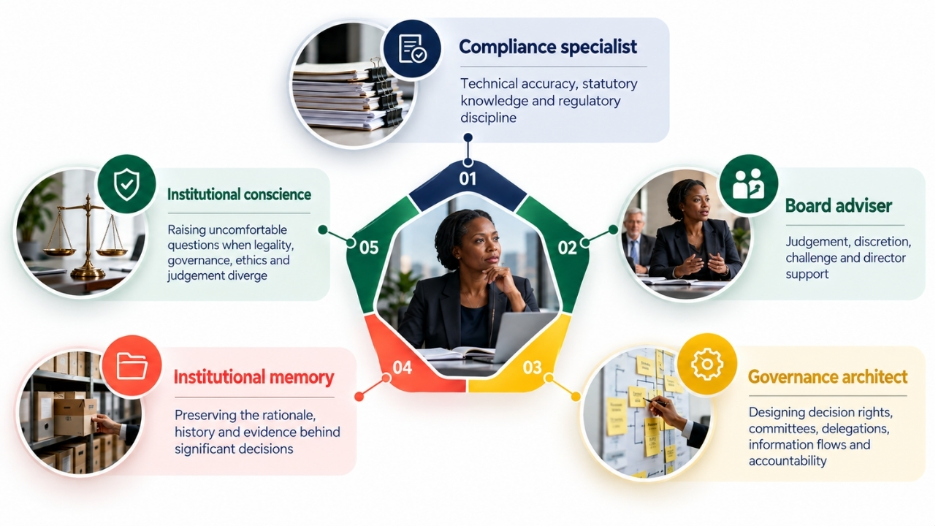
The problem is that many organisations have expanded the responsibilities without redesigning:
- Reporting lines
- Authority
- Team capacity
- Remuneration
- Access to the Chair
- Technology
- Information rights
- Career structures
- Escalation mechanisms
- Professional development
The result is a role with more responsibility but not always more institutional power.
That gap matters because responsibility without authority creates fragile governance.
The traditional description of the Company Secretary no longer matches the work
For decades, outsiders could be forgiven for associating Company Secretary work mainly with procedural governance.
Board packs needed preparing.
Meetings required organising.
Minutes had to be drafted.
Registers needed maintaining.
Corporate filings had to be completed.
Those functions remain important because governance collapses quickly when basic corporate administration becomes unreliable.
However, they now describe only part of the role.
The CGI Competency Framework describes the modern governance professional as having evolved from technical expert towards strategic enabler. It combines specialist governance knowledge with values, emotional intelligence, commercial understanding and the ability to apply judgement within the particular circumstances of the organisation.
The Institute’s detailed practice framework goes further. It says the impact, influence and leadership of Company Secretaries naturally increase as their expertise develops, with some experienced governance roles becoming similar in practical influence to board-level positions.
That is a profound change.
The Company Secretary is no longer simply supporting governance processes.
Increasingly, the role helps shape them.
1. The Company Secretary is becoming a board adviser
The advisory dimension of the role is perhaps the most visible change.
Modern boards face questions that rarely have neat procedural answers.
Should an issue be escalated?
Has management given directors enough information?
Does a conflict require a director to leave the room?
Should the board reconsider an earlier strategic decision?
Is a proposed committee structure appropriate?
Has regulatory compliance become disconnected from the underlying risk?
Does a difficult stakeholder issue require board attention?
These questions cannot be resolved through a filing calendar.
They require professional judgement.
The Financial Reporting Council’s Corporate Governance Code Guidance, updated in June 2026, formally reflects this wider responsibility. It says the Company Secretary is responsible for advising the board on governance matters, supporting the Chair and helping the board and committees function efficiently. The guidance also gives the Company Secretary responsibility for facilitating good information flows, supporting induction and development, and periodically reviewing governance processes with the Chair.
That is not an administrative description.
It describes a governance adviser sitting close to the centre of board effectiveness.
Read More: Board & Shareholder Meetings
2. Board information has made the role more powerful
Information is power inside institutions.
Boards cannot challenge what they do not know.
Directors cannot make sound decisions when information arrives late, hides uncertainty, overwhelms them with detail or presents management recommendations as foregone conclusions.
The Company Secretary often sits directly within this information architecture.
According to CGI’s 2026 research, 66% of governance professionals believe supporting board information quality and decision making is becoming more important.
That statistic deserves more attention than it receives.
Improving board information does not simply mean correcting formatting.
It can involve challenging whether:
- The purpose of the paper is clear
- The decision required from directors is explicit
- Significant risks are visible
- Alternatives have been presented fairly
- Assumptions are supported
- Relevant stakeholders have been considered
- Directors have enough time to review the material
- Management has distinguished information from advocacy
A Company Secretary capable of influencing these questions can influence the quality of board decisions before the meeting even begins.
That is institutional power.
The role therefore needs to be designed with corresponding independence and standing.
3. The Company Secretary is becoming a governance architect
Governance architecture determines who can decide what.
It determines which matters reach the board, which committees have authority, where management discretion begins and where it ends.
As organisations become more complex, those structures require continual adjustment.
The Company Secretary may increasingly help design or review:
- Matters reserved for the board
- Committee terms of reference
- Delegated authorities
- Subsidiary governance
- Decision pathways
- Board calendars
- Governance policies
- Conflict processes
- Escalation arrangements
- Information flows
This is architecture rather than administration.
It concerns the allocation and constraint of institutional power.
A poorly designed delegation framework can allow decisions to be made at the wrong level.
Weak committee boundaries can create duplicated oversight or, worse, gaps between committees where nobody accepts responsibility.
An ineffective board calendar may crowd strategic discussion out with recurring compliance matters.
Poor information architecture can allow management to control the board agenda through what it chooses to surface.
These are structural governance issues.
The Company Secretary is often uniquely positioned to see them because the function observes the organisation across meetings, committees, entities, regulatory responsibilities and leadership relationships.
Explore More: Governance Review
4. The role is becoming the organisation’s institutional memory
Boards change.
Chief executives leave.
Strategies evolve.
Businesses are acquired and sold.
Committees are restructured.
Yet important governance decisions often have consequences many years after the people who made them have gone.
The Company Secretary frequently preserves the institutional thread.
Why was a particular authority delegated?
What concern led to the creation of a committee?
Why did directors reject a transaction?
Which conditions were attached to an approval?
What commitment was made to a regulator or shareholder?
Which actions followed an earlier board review?
Minutes form part of this memory, but the responsibility extends further.
Good institutional memory connects:
Context → Decision → Rationale → Action → Evidence → Outcome
Without that thread, organisations repeatedly relearn their own history.
A sophisticated governance function therefore does more than maintain records.
It protects the organisation from institutional amnesia.
Read More: Minute Taking Solutions
5. The institutional conscience is becoming more important
The phrase institutional conscience can sound grand.
In practice, it describes something simple.
There are moments when the technically permissible decision is not necessarily the best-governed decision.
A transaction may comply with legal requirements while creating an obvious conflict.
A remuneration outcome might satisfy the policy while appearing indefensible alongside workforce experience.
Management may possess formal authority to proceed while the issue deserves board scrutiny.
A disclosure may technically satisfy a minimum requirement while obscuring the substance.
Someone needs the confidence to ask:
Should we do this simply because we can?
Recent regulatory thinking supports this broader conception of the role.
In September 2026, the Chairman of Securities Commission Malaysia described Company Secretaries as, in many organisations, part of the institutional memory, conscience and compass. He also argued that the profession increasingly needs to provide a critical and constructive internal voice when boards make difficult decisions.
That is not a universal legal definition of the role.
It is, however, a revealing description of where expectations are moving.
The Company Secretary is increasingly expected to protect the quality of governance rather than merely certify that governance procedure occurred.
6. Greater responsibility without authority is dangerous
Here lies the central design problem.
Organisations can give somebody responsibility without giving them power.
A Company Secretary may be expected to improve board papers but lack authority to reject papers that arrive late.
They may be responsible for governance standards yet have no direct route to the Chair.
The function can be asked to track board actions while management repeatedly ignores them.
A governance professional may identify a serious concern but sit several layers below the executives whose decisions need challenging.
That is structurally weak.
The FRC’s current guidance addresses this directly for companies within its governance framework. It says the Company Secretary should report to the Chair on all board governance matters and should build relationships of trust with the Chair, senior independent director and non-executive directors while retaining executive confidence.
That reporting relationship matters.
It protects the role from being reduced to an extension of executive management.
A Company Secretary who supports the board must have a route to the board.
7. The reporting line is not an organisational technicality
Where the Company Secretary reports tells people something about how the organisation understands governance.
There is nothing inherently wrong with dual reporting relationships.
A Company Secretary may have executive responsibilities requiring operational reporting to the Chief Executive, General Counsel or another senior executive.
However, board governance responsibilities are different.
The FRC’s guidance makes clear that reporting to the Chair on board governance matters can coexist with other executive reporting relationships.
This distinction protects both roles.
Operational accountability can sit within management.
Governance accountability can remain sufficiently connected to the board.
Problems arise when the distinction disappears.
If the person responsible for advising directors on governance depends entirely on an executive whose decisions may need challenging, the organisation creates a potential conflict in the design of the role.
The issue is not individual integrity.
It is institutional architecture.
Governance should not require personal courage to compensate for a poorly designed reporting line.
8. Access to the Chair should be designed, not improvised
Experienced Company Secretaries frequently develop strong relationships with Chairs.
That relationship matters because much of good governance occurs between formal board meetings.
The Chair may need to know that:
- Board papers are deteriorating
- A director is concerned about information quality
- A committee boundary is creating confusion
- An important action remains unresolved
- Management is resisting escalation
- A shareholder concern deserves more attention
- A board evaluation issue requires follow-through
These conversations rarely appear on a formal organisational chart.
Yet they can determine whether problems are addressed early or allowed to grow.
The FRC therefore identifies trust between the Company Secretary, Chair, senior independent director and non-executive directors as an important element of effectiveness.
Boards should not leave this relationship entirely to personality.
Access should be structurally legitimate.
9. The strategic role is expanding faster than recognition
Here the CGI research becomes particularly uncomfortable.
56% of governance professionals surveyed by Diligent described themselves as strategic advisers to the board, but only 17% believed leadership fully shared that view. More than half said leadership underestimated the complexity of entity and subsidiary governance.
That creates a recognition gap.
Governance professionals may believe they are performing strategic work while the organisation continues to see an administrative support function.
The consequences extend beyond professional frustration.
Perception shapes:
- Budget
- Headcount
- Technology investment
- Remuneration
- Seniority
- Recruitment
- Reporting lines
- Access
- Career progression
An organisation that misunderstands the role will inevitably under-design it.
This explains why professional influence can rise without the operating model changing around it.
10. Resourcing has not kept pace with expectations
The numbers are stark.
CGI found that 74% of governance professionals had experienced increased workloads, while 42% said their governance function was not adequately resourced. Among respondents whose responsibilities had expanded, 70% reported no meaningful improvement in recognition.
Diligent’s global research tells a similar story.
Its 2026 benchmark surveyed more than 300 senior practitioners across 38 jurisdictions. 74% said their scope had expanded in two years, while 63% reported that workload had grown faster than their teams or that team size had reduced.
These are not normal productivity pressures.
They reveal structural mismatch.
The governance function cannot continually absorb more:
- Regulation
- Entities
- AI oversight
- Sustainability
- Board demands
- Shareholder expectations
- Subsidiary governance
- Internal controls
- Cyber issues
without something else changing.
Eventually, either capacity increases or quality falls.
11. The role may be becoming more powerful while simultaneously becoming less sustainable
This is the paradox.
Greater influence can make a role more attractive.
It can also make it harder.
A modern Company Secretary may spend the morning advising the Chair, the afternoon responding to a regulatory development and the evening preparing a board pack.
Strategic responsibility sits on top of operational delivery rather than replacing it.
Over time, exceptional governance professionals compensate by working longer, relying on personal memory or silently absorbing complexity.
From the board’s perspective, everything still appears to function.
That can conceal the risk.
Professional competence can mask structural weakness.
A governance model that works only because exceptional individuals continually rescue it is not resilient governance.
It is dependence.
12. Boards should distinguish between professional capacity and administrative capacity
This distinction becomes essential as the role evolves.
Professional Company Secretary capacity is needed for:
- Judgement
- Board advice
- Interpretation
- Challenge
- Escalation
- Governance design
- Regulatory analysis
- Stakeholder issues
- Board effectiveness
Administrative capacity is needed for:
- Document processing
- Repetitive updates
- Deadline monitoring
- Routine record maintenance
- Meeting logistics
- Standard workflows
- Information retrieval
Both matter.
However, they should not consume the same scarce resource unnecessarily.
If highly qualified governance professionals spend disproportionate amounts of time on work that can be systematised, the organisation is misallocating professional capacity.
That is an operating-model failure.
13. Technology should make the Company Secretary more powerful, not less
This is where the technology debate is frequently misunderstood.
Automation does not have to diminish the profession.
Used properly, it can strengthen it.
Diligent’s 2026 research found that 55% of governance teams still manage entity data using spreadsheets, Word documents and SharePoint, while only 33% use a dedicated platform. More than half spend at least six hours each week tracking filings, deadlines and record updates.
Every one of those hours has an opportunity cost.
A professional cannot simultaneously reconcile registers and advise the Chair.
The stronger model automates or systematises:
- Compliance reminders
- Entity records
- Governance calendars
- Action tracking
- Standard workflows
- Record retrieval
- Repetitive document processes
That creates room for the work technology does not perform well.
Judgement.
Interpretation.
Challenge.
Context.
Technology should not replace Company Secretary expertise. It should stop wasting it.
Explore: CoSec Hub
14. Better information infrastructure strengthens independence
Independence is often discussed as an attitude.
Infrastructure matters too.
A Company Secretary cannot provide reliable advice if the underlying information is fragmented, inaccessible or controlled entirely by others.
Suppose entity records sit in several spreadsheets.
Board actions remain inside emails.
Regulatory obligations depend on local advisers sending updates.
Historical decisions are difficult to retrieve.
In that environment, the governance professional spends significant energy establishing basic facts before exercising judgement.
Better governance infrastructure creates a stronger informational base.
The Company Secretary can then advise from evidence rather than institutional memory alone.
This also reduces the risk that management controls governance indirectly through control of information.
15. Decision rights around governance need greater clarity
As the role expands, organisations should decide what the Company Secretary is actually empowered to do.
Can the role:
- Reject a materially inadequate board paper?
- Escalate an overdue material action directly to the Chair?
- Require conflicts to be formally considered?
- Recommend additional board advice?
- Challenge whether an item belongs on the consent agenda?
- Require governance concerns to be recorded?
- Initiate a review of committee terms?
- Escalate regulatory issues independently?
The appropriate answer will vary by organisation.
The problem is ambiguity.
If nobody knows where governance authority begins and ends, the Company Secretary must negotiate authority in real time.
That makes governance dependent on personality.
Well-designed institutions make important authority explicit.
16. Remuneration and seniority should reflect what the organisation actually expects
Job design sends signals.
If an organisation describes its Company Secretary as a strategic adviser but remunerates, grades and positions the role as administrative support, the formal message contradicts the rhetoric.
Recognition does not mean title inflation.
It means aligning:
- Responsibility
- Authority
- Reward
- Organisational level
- Access
- Professional requirements
The CGI survey’s finding that 70% of those experiencing increased responsibilities saw no meaningful improvement in recognition should therefore concern employers as much as practitioners.
Governance capability is difficult to retain when the job grows but the career architecture does not.
17. Career design within governance teams needs attention
Another problem appears beneath the most senior role.
How does somebody become an excellent Company Secretary?
If junior governance professionals spend most of their early careers completing administrative work without exposure to board judgement, regulation, strategy and stakeholder issues, organisations may struggle to develop the next generation of advisers.
The CGI Competency Framework provides a useful model because it links career progression with values, practice and knowledge rather than technical knowledge alone.
A strong governance function should therefore create deliberate exposure to:
- Board meetings
- Committee work
- Regulatory interpretation
- Board evaluations
- Governance reviews
- Shareholder engagement
- Strategic projects
- Subsidiary governance
- Emerging technology
Succession matters inside governance functions too.
Read More: Company Secretary Outsourcing
18. AI will increase the value of judgement
Artificial intelligence will change Company Secretary work.
It can already help with document analysis, regulatory monitoring, information retrieval, workflow automation and first drafts.
That will improve.
However, CGI’s 2026 research also found that half of governance professionals believe AI literacy for boards is becoming more important.
The profession will therefore play two roles.
It will use AI.
It will also help govern AI.
That makes human judgement more important, not less.
The Company Secretary increasingly needs to understand where automation can be trusted, where human review remains necessary and how accountability survives when software performs tasks previously carried out by people.
Technology can process information.
Someone still needs to understand institutional consequence.
19. Regulatory thinking is beginning to catch up with the changing role
A recent development in Malaysia provides an instructive example.
On 22 September 2026, the Chairman of Securities Commission Malaysia said the regulator was exploring a standardised competency framework for Company Secretaries of listed companies and working with Bursa Malaysia on requirements involving fit and properness and accountability. The announcement explicitly linked stronger competency with the evolving role of the Company Secretary as trusted adviser and constructive internal voice.
CGI Global has also advocated greater recognition of professionally qualified Company Secretaries in markets including Australia and Japan, reflecting the increasingly strategic conception of the role internationally.
The exact regulatory models will differ.
The direction is more important.
Regulators increasingly recognise that good governance depends partly on the competence and standing of the professional sitting between the board, management and governance system.
20. The Company Secretary should not become the owner of everyone else’s accountability
Greater influence contains another danger.
As the Company Secretary becomes central to more processes, organisations can begin treating the function as the owner of governance outcomes that actually belong elsewhere.
An executive misses a board action.
Governance chases it.
A policy has not been reviewed.
Governance sends reminders.
Management has not implemented a control.
Governance tracks the delay.
Eventually, the Company Secretary becomes responsible for making everybody else responsible.
That is not good accountability design.
The Company Secretary should enable governance.
Management should own delivery.
The board should oversee where appropriate.
Those distinctions matter.
The role should facilitate accountability without absorbing it.
21. Institutional conscience does not mean becoming the corporate moral police
The expanded role also needs boundaries.
A Company Secretary is not responsible for every ethical judgement inside an organisation.
Nor should the role become an unelected veto over management or the board.
The board remains accountable for governance.
Executives remain responsible for managing the business.
The Company Secretary advises, facilitates, challenges and preserves the quality of the governance process.
That distinction protects the legitimacy of the role.
The strongest Company Secretary is influential because the advice is trusted, not because the role accumulates unbounded authority.
Power must therefore be paired with clear institutional boundaries.
22. What does a properly designed Company Secretary role look like?
A mature operating model aligns expectation with structure.
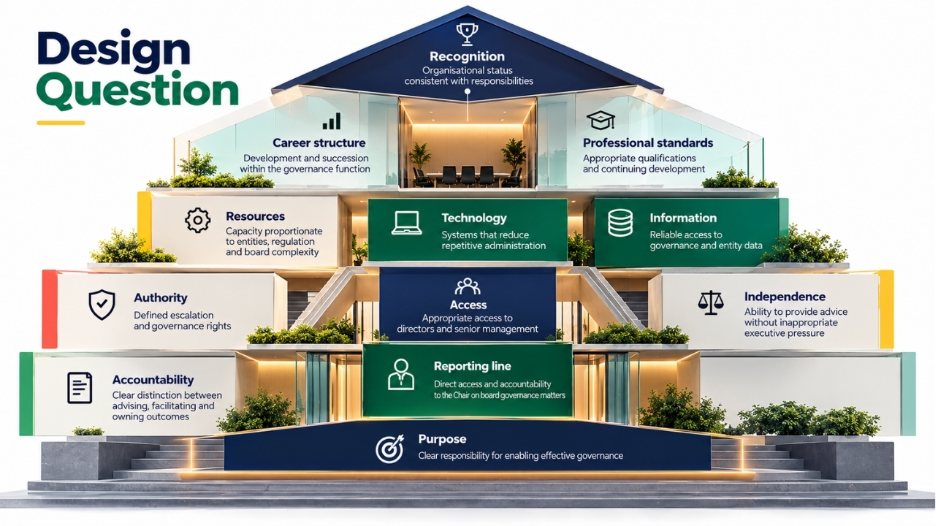
No two organisations require identical structures.
A FTSE 100 group needs something different from a rapidly growing private company.
A regulated bank differs from a family-owned business.
However, the design principle remains consistent.
The role should be built around the governance complexity it is expected to manage.
The Company Secretary Role Design Test
Boards can test whether their current model remains appropriate by asking:
- What do we genuinely expect our Company Secretary to contribute?
- Does the job description reflect that expectation?
- Does the Company Secretary have direct access to the Chair?
- Can significant governance concerns be escalated without obstruction?
- Is the function sufficiently resourced for its current mandate?
- How much senior professional time is consumed by repetitive administration?
- Does technology reduce manual work or merely digitise it?
- Can the function access reliable governance information quickly?
- Does the remuneration reflect responsibility and complexity?
- Are governance professionals being developed for future strategic roles?
- Is there succession planning for the Company Secretary function itself?
- Would the governance model continue effectively if one key person became unavailable?
Several weak answers indicate something more important than a staffing problem.
They suggest the role itself needs redesign.
The power and design gap
The profession’s current transition can be summarised simply.
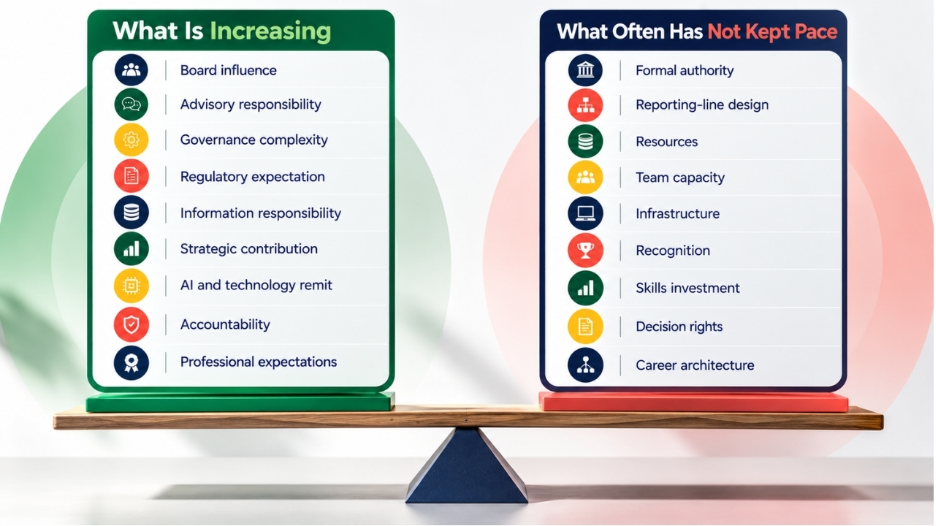
This gap is where many governance functions now sit.
Closing it should become a board concern.
Why boards should care about Company Secretary role design
It may be tempting to see this as a professional issue for governance teams.
That would underestimate the consequences.
A poorly designed Company Secretary role can affect:
- Board information
- Decision quality
- Regulatory compliance
- Escalation
- Succession
- Shareholder relations
- Committee effectiveness
- Governance reporting
- Institutional memory
- Board challenge
The Company Secretary sits unusually close to the mechanisms through which the board functions.
Weakness in that role therefore becomes weakness in board infrastructure.
The question is not whether the Company Secretary deserves greater status.
That frames the issue too personally.
The real question is whether the board has designed the governance function it needs.
Test the wider governance system, not only the individual
Sometimes the Company Secretary appears to be underperforming when the underlying governance system is the real problem.
Perhaps board papers are consistently late because management processes are weak.
Maybe directors receive poor information because reporting expectations are unclear.
Actions remain overdue because nobody has established meaningful accountability.
Committee overlap may be creating duplication.
In other cases, the Company Secretary may be working effectively within a board model that itself needs attention.
That is why role design should be considered alongside board effectiveness.
The Lumorus Board Health Check provides boards, Chairs and governance leaders with a practical starting point for examining whether board composition, information, challenge, accountability and decision processes remain fit for purpose.
The diagnostic does not assess the Company Secretary in isolation.
That is precisely the point.
The effectiveness of the Company Secretary depends partly on the governance system in which the role operates.
Where deeper issues emerge, organisations can then consider a Governance Review, Board Evaluation & Assessment or Board Skills Audit.
Assess your governance foundations: Take the Lumorus Board Health Check
Why CoSec Hub is designed around this new reality
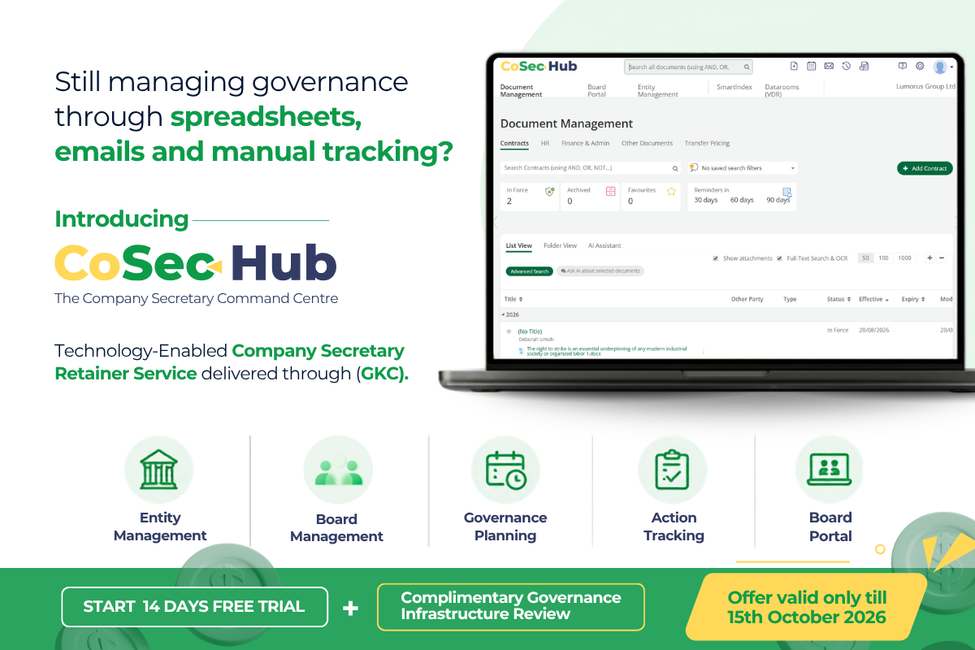
The changing role of the Company Secretary sits at the heart of CoSec Hub.
The operating principle is simple:
Automate the infrastructure, information flow and repetitive administration so experienced Company Secretaries can spend more time exercising judgement.
The technology layer can support areas including:
- Entity management
- Compliance calendars
- Governance forward planning
- Board management
- Statutory registers
- Board action tracking
- Meeting lifecycle management
- Governance records
Those capabilities create structure and visibility.
However, technology is only part of the model.
Through the Governance Knowledge Centre, organisations can also access:
- Chartered Company Secretary expertise
- Governance operations support
- Compliance monitoring
- Board administration
- Governance intelligence
- Multi-jurisdiction support
- Governance advisory
Together, these capabilities create a Technology-Enabled Company Secretary Retainer Service.
The objective is not to automate the profession away.
It is the opposite.
Automation should free governance professionals from work that does not require their highest level of professional judgement.
Technology handles structure.
Professionals interpret exceptions.
Boards receive stronger advice.
Explore: CoSec Hub
The Lumorus View
The Company Secretary is becoming more powerful because governance itself has become more consequential.
Boards now operate through greater regulatory complexity, technological disruption, sustainability demands, shareholder pressure, geopolitical uncertainty and more intensive scrutiny.
Somebody has to connect those pressures with the way the board actually works.
That is increasingly the Company Secretary.
Yet many organisations have expanded the job without redesigning the institution around it.
They want strategic advice but provide administrative resources.
Expect challenge but create weak reporting lines.
Demand accountability without defining authority.
Rely on professional judgement while consuming professional time through spreadsheets, reconciliation and chasing.
That model will not hold indefinitely.
The answer is not to turn the Company Secretary into another executive power centre.
Nor should the role accumulate responsibility that properly belongs to directors or management.
The goal is more disciplined.
Give the role sufficient authority to fulfil its responsibilities, sufficient independence to provide credible advice, sufficient resources to operate effectively and sufficient infrastructure to stop wasting professional judgement on avoidable administration.
That is good role design.
And good role design is good governance.
The Bottom Line
The Company Secretary profession is in the middle of an important transition.
The CGI Governance Market Survey 2026 shows governance professionals becoming more influential, more involved in decision quality and more exposed to strategic issues. Yet it also shows workload, resourcing and recognition failing to keep pace.
The FRC Corporate Governance Code Guidance already positions the Company Secretary as an adviser to the board, supporter of the Chair, facilitator of information flows and contributor to the ongoing improvement of governance processes.
Meanwhile, Diligent’s 2026 research shows that the operating model beneath the profession remains heavily dependent on manual systems, with more than half of surveyed teams still managing entity information through spreadsheets, Word documents and SharePoint.
Regulators elsewhere are also beginning to focus more closely on Company Secretary competence, accountability and professional standing.
Taken together, these developments suggest that the next governance debate should not simply concern what Company Secretaries do.
It should concern how the role is designed.
Boards should examine:
- Authority
- Access
- Reporting lines
- Capacity
- Technology
- Information
- Professional standards
- Career development
- Recognition
- Accountability
The role has already changed.
Organisational design now needs to catch up.
The Company Secretary should not become more powerful because organisations need another executive empire. The role should become better designed because boards increasingly depend on it to make governance work.
Continue Exploring
- Build stronger governance infrastructure around the Company Secretary: CoSec Hub
- Strengthen governance structures and board support: Corporate Governance Support
- Add scalable professional Company Secretary capacity: Company Secretary Outsourcing
- Improve statutory and regulatory oversight: Statutory & Regulatory Compliance
- Strengthen board information and meeting governance: Board & Shareholder Meetings
- Protect the quality of the board’s institutional record: Minute Taking Solutions
- Examine whether your wider governance architecture remains fit for purpose: Governance Review
- Test the effectiveness of your board: Lumorus Board Health Check
About CoSec Hub
CoSec Hub is the Company Secretary Command Centre, built by Company Secretaries for Company Secretaries.
It combines governance technology with Chartered Company Secretary expertise to help organisations build an operating model around the modern role.
Rather than asking experienced professionals to manually connect fragmented governance systems, CoSec Hub can bring together entity information, compliance calendars, governance planning, board workflows, statutory records and action tracking.
Alongside the technology, the Governance Knowledge Centre provides access to professional Company Secretary expertise where governance requires interpretation and judgement.
The operating principle is straightforward:
Automate what can be standardised.
Structure what needs visibility.
Preserve human judgement where governance requires it.
This creates a different model for the modern Company Secretary.
Not a better administrator.
A better-supported governance professional.
Explore CoSec Hub to examine how your Company Secretary operating model could evolve alongside the role itself.
Lumorus: Better Business, Built on Purpose
Lumorus is a UK headquartered global governance, ESG, Company Secretary and advisory firm supporting organisations across Europe, Africa, Asia, the Caribbean, Canada, the Middle East and international markets.
We help boards and leadership teams examine whether governance structures remain appropriate as organisational complexity, regulation and expectations increase.
Our Company Secretary capabilities include:
For organisations seeking a more connected operating model, CoSec Hub combines governance infrastructure with professional Company Secretary capability.
A useful place to start is with a deceptively simple question:
If your Company Secretary is now expected to influence decisions, challenge governance weaknesses and advise the board, have you redesigned the role to make those expectations possible?
If not, the issue may not be the individual.
It may be the institution around them.
Take the Lumorus Board Health Check, explore CoSec Hub or visit Lumorus to strengthen the governance architecture behind the modern Company Secretary.
Lumorus: Better Business, Built on Purpose.
Sources
The Chartered Governance Institute UK & Ireland: Governance Market Survey 2026
Research based on 971 governance professionals showing increasing influence, expanding board decision-support responsibilities, rising workloads and significant resourcing and recognition gaps.
Read the CGI Governance Market Survey 2026 findings
The Chartered Governance Institute UK & Ireland: Competency Framework for Governance Professionals
Framework setting out the knowledge, practice and values required of modern Company Secretaries and describing the profession’s evolution from technical expertise towards strategic enablement.
Explore the CGI Competency Framework
Financial Reporting Council: Corporate Governance Code Guidance
Current guidance describing the Company Secretary’s role in advising the board, supporting the Chair, maintaining information flows, facilitating director development and helping improve governance processes.
Read the FRC Corporate Governance Code Guidance
Financial Reporting Council: UK Corporate Governance Code 2024
The current UK governance framework, including recognition of the Company Secretary within senior management for succession-planning purposes.
Read the UK Corporate Governance Code 2024
Diligent: Global State of Legal Entity Compliance 2026
Research based on more than 300 governance, legal and entity-management professionals showing expanding mandates, workload pressures, manual administration and a gap between strategic contribution and organisational recognition.
Read Diligent’s 2026 Global State of Legal Entity Compliance research
Securities Commission Malaysia: CGI Global Governance Summit 2026 Keynote
September 2026 regulatory commentary describing the changing role of Company Secretaries and proposals concerning competency, fit and properness and accountability.
Read the Securities Commission Malaysia keynote
CGI Global: ASX Corporate Governance Consultation Response 2026
CGI Global’s September 2026 submission supporting stronger recognition of professional qualifications and the strategic governance-adviser role of the Company Secretary.