55% of governance teams still rely on spreadsheets and shared systems. Moving everything into software is necessary, but it is not the same as fixing governance
The case for better Company Secretary technology is compelling.
Governance teams are managing more entities, more regulatory obligations, more board activity and more requests for reliable corporate information.
According to Diligent’s 2026 research, 55% of governance professionals still manage entity data through spreadsheets, Word documents and SharePoint, while only 33% use a dedicated platform.
At the same time, 74% said their remit had expanded during the previous two years, while 63% said workload had grown faster than their teams.
Clearly, technology needs to play a bigger role.
However, there is a danger in drawing the wrong conclusion from those figures.
Replacing a spreadsheet with software can improve control, visibility and efficiency. Yet it does not automatically answer the harder governance questions.
For example, a platform can show that an action is overdue, but it cannot always decide whether the delay creates a material governance risk.
Likewise, software can store a board resolution. However, it cannot determine whether the board had enough information to make the decision responsibly.
That distinction is fundamental.
Governance technology manages information and workflow. Governance itself manages authority, judgement, challenge and accountability.
The strongest organisations therefore do not choose between software and professional Company Secretary expertise.
Instead, they design an operating model where technology handles repeatable work and qualified professionals focus on matters that require judgement.
Explore: CoSec Hub
The argument for Company Secretary software is stronger than ever
The modern governance function has become too complex to run mainly through personal calendars, inboxes and spreadsheets.
According to Diligent’s Global State of Legal Entity Compliance 2026, more than 300 senior practitioners across 38 jurisdictions reported growing pressure on governance and entity compliance teams.
The same research found that 51% had experienced a near-miss compliance event. In addition, 47% identified technology gaps and legacy systems as their biggest challenge.
For many organisations, dedicated governance software can therefore solve real operational problems by helping teams:
- Maintain central entity information
- Track statutory and regulatory deadlines
- Manage director and shareholder records
- Maintain statutory registers
- Organise board and committee activity
- Monitor outstanding actions
- Store governance documents
- Improve audit trails
- Produce governance reports
- Coordinate multiple jurisdictions
These improvements are not cosmetic.
They reduce manual effort and make important governance information easier to find.
Nevertheless, software only becomes truly valuable when it supports a well-designed governance operating model.
A poorly defined process does not become good governance simply because it is automated.
The real distinction: software runs processes, governance governs decisions
The G20/OECD Principles of Corporate Governance place responsibility for strategic direction, management oversight, risk, internal controls and accountability with the board.
They also stress that directors need accurate, relevant and timely information to discharge those responsibilities effectively.
Technology can improve that information.
However, it cannot carry the board’s responsibility.
Consider a conflict of interest.
A governance platform can record a declaration, identify the relevant meeting and store supporting documents.
Yet professional judgement may still be needed to decide whether:
- The director should receive the paper
- The director should remain in the discussion
- The director should vote
- Independent advice is required
- The conflict should be escalated
- Additional disclosure is necessary
The same principle applies throughout governance.
A workflow can show what should happen next according to a set process.
By contrast, governance expertise is required when the right answer depends on context.
Technology provides structure. Governance professionals provide judgement.
Read More: Corporate Governance Support
Where software works well and where human judgement remains essential
The easiest way to see the difference is to separate repeatable governance activity from work that depends heavily on judgement.
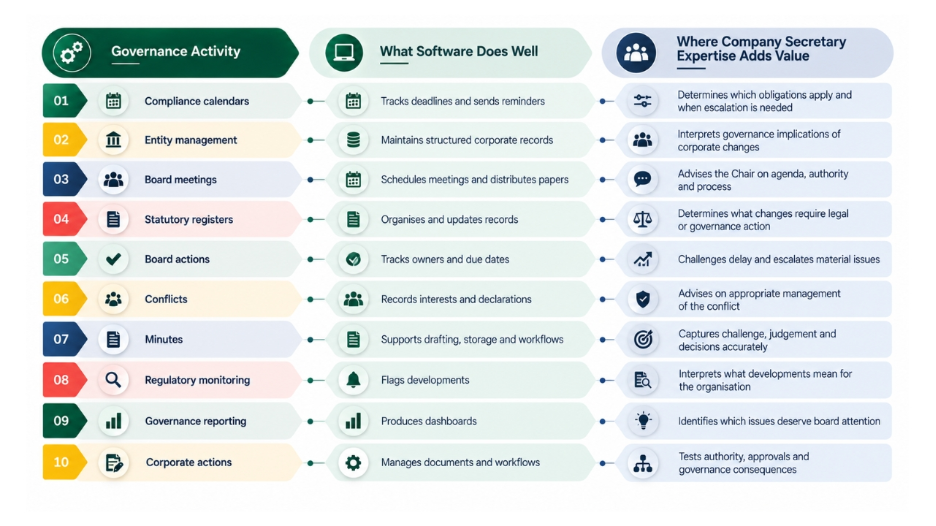
The important word is combination.
Software is strongest when the underlying process is clear.
Professional expertise, however, becomes most valuable when the circumstances are unusual, sensitive or open to interpretation.
A compliance calendar cannot decide what belongs on the calendar
Compliance calendar functionality is one of the strongest reasons to use dedicated Company Secretary software.
However, even the best calendar needs governance logic behind it.
Someone must still establish:
- Which requirements apply
- Which entity is affected
- What triggers the obligation
- Whether any exemption exists
- Who owns the action
- What approvals are required
- What evidence proves completion
- When an overdue item becomes a material issue
- Which regulatory changes create new requirements
The challenge becomes even greater across several jurisdictions because the same corporate event can create different requirements in different markets.
For example, appointing a director may require a straightforward filing in one country.
Elsewhere, the same appointment may also need extra approvals, disclosures or residency checks.
A system can automate known requirements.
However, regulatory interpretation still requires people who understand both the jurisdiction and the corporate context.
That is why Statutory & Regulatory Compliance should combine structured monitoring with experienced Company Secretary oversight.
Entity software can create a single source of truth, but only if the truth is accurate
Centralising entity information is one of the most valuable technology improvements a governance team can make.
However, the phrase single source of truth can create false confidence.
A central database is useful only when the information entering it is accurate, updated consistently and clearly owned.
If the underlying records are wrong, the platform simply creates a faster way to distribute wrong information.
Modern governance teams therefore need clear processes around:
- Who owns entity information
- Who approves changes
- How local changes reach headquarters
- When records are checked
- How conflicting information is resolved
- Which documents provide evidence
- Who verifies ownership and control information
Diligent’s 2026 research makes this increasingly important because entity data is now used well beyond the Company Secretary function.
Risk, finance, internal audit, compliance and boards increasingly rely on the same information.
Consequently, entity management is becoming part of wider governance infrastructure.
Software supports that infrastructure.
People, however, remain responsible for its integrity.
Entity management and entity governance are not the same thing
A complete entity database can tell leadership which companies exist, where they are incorporated and who their directors are.
Entity governance asks harder questions.
For example:
- Why does the entity exist?
- Does it still serve a strategic purpose?
- Who actually exercises control?
- Are decision rights clear?
- Does the local board have the right capability?
- Are directors fulfilling local responsibilities?
- Is the subsidiary receiving appropriate group oversight?
- Are dormant entities creating unnecessary risk or cost?
- Does the legal structure still support the business model?
These questions cannot be answered by data completeness alone.
The distinction becomes particularly important during acquisitions, restructurings and international expansion.
At those points, organisations can accumulate entities faster than they review the governance structure around them.
Good Company Formation & Structuring should therefore connect legal structure with governance purpose.
A company can be perfectly administered and still be poorly governed.
A board portal cannot create an effective board
Board technology has transformed meeting administration.
Directors can receive documents securely, version control is easier and agendas can be organised more efficiently.
Those are meaningful improvements.
However, a technically efficient board can still be ineffective.
Common problems include:
- Board packs that are too long
- Important risks buried in appendices
- Agendas dominated by reporting rather than decisions
- Limited time for strategy
- Weak challenge of management
- Excessive influence from one director or executive
- Poor follow-up after decisions
- Committees duplicating one another
None of these problems disappears when board papers are distributed digitally.
Instead, effective board governance requires someone to ask whether the meeting structure is actually helping directors discharge their responsibilities.
An experienced Company Secretary can work with the Chair to improve:
- Agenda design
- Board paper quality
- Decision sequencing
- Committee coordination
- Information flows
- Action accountability
- Governance forward planning
Therefore, board technology and board effectiveness should never be treated as the same thing.
Explore More: Board & Shareholder Meetings
Minutes show exactly where automation reaches its limits
Artificial intelligence has made minute drafting faster.
Used carefully, AI can assist with transcription, summaries, actions and first drafts.
As a result, governance teams handling large meeting volumes may reduce some administrative effort.
However, board minutes are not simply summaries of conversation.
They are governance records.
Good minutes need to reflect:
- Material matters considered
- Relevant challenge
- Conflicts
- Judgements
- Decisions
- Agreed actions
- Responsibility for follow-through
At the same time, minutes should remain proportionate.
Recording too much can be as problematic as recording too little.
That balance requires context.
A technology tool may identify that directors discussed a particular risk for 15 minutes.
A skilled Company Secretary, however, must decide which parts of that discussion matter to the governance record and how they should be recorded accurately.
For this reason, AI can support minute preparation.
It should not remove appropriate professional review.
Read More: Minute Taking Solutions
The modern Company Secretary role is becoming more strategic
The technology debate matters because the profession itself is changing.
Research published in July 2026 by The Chartered Governance Institute UK & Ireland found that 65% of governance professionals said the influence of the governance function was increasing.
The survey covered 971 professionals across listed companies, financial services, private businesses, charities and other organisations.
In addition, the Institute found that the traditional image of the Company Secretary as mainly responsible for minutes, board papers and compliance no longer reflects the role.
Governance professionals increasingly contribute to information quality, succession, organisational change and board decision making.
This creates an important opportunity.
If technology removes repetitive work, experienced Company Secretaries can spend more time on:
- Board advice
- Regulatory interpretation
- Governance design
- Director support
- Governance risk
- Strategic transactions
- Succession
- Board effectiveness
- International governance
- Organisational accountability
The objective should therefore be augmentation rather than replacement.
Technology should make the Company Secretary more valuable by creating more time for work that genuinely requires expertise.
The biggest technology mistake is automating weak governance
Automation makes processes faster.
Unfortunately, it also makes weak processes faster.
Consider five examples.
Unclear responsibility
A workflow can allocate tasks.
However, it cannot fix a culture where nobody accepts accountability.
Poor information
A platform can distribute board papers instantly.
Yet it cannot make those papers more useful unless management improves how it communicates.
Weak escalation
A dashboard can display a red warning.
Even so, somebody still needs to decide what happens next.
Inaccurate records
An entity platform can centralise data.
However, the organisation must still verify that the information is right.
Weak board challenge
Technology can give directors more information.
It cannot make directors use that information well.
For this reason, organisations should design governance before configuring software.
A better sequence is:
- Define responsibilities.
- Clarify decision rights.
- Map key governance processes.
- Establish escalation routes.
- Determine information requirements.
- Introduce technology.
- Test whether governance outcomes improve.
Otherwise, digital transformation can become little more than digital administration.
Cross-border governance makes professional judgement even more important
The limits of software become especially clear in multinational organisations.
A single platform may give a group visibility across Europe, Africa, Asia, the Caribbean, Canada, the Middle East and other markets.
That is valuable.
Nevertheless, local company law and regulatory obligations remain different.
Jurisdictions may have different requirements concerning:
- Directors
- Shareholders
- Beneficial ownership
- Board procedures
- Corporate filings
- Statutory registers
- Local representation
- Regulatory reporting
- Share capital
- Corporate transactions
Therefore, cross-border governance needs three capabilities working together.
Central technology
Provides one group view.
Local regulatory knowledge
Ensures country-specific requirements are understood.
Professional Company Secretary expertise
Connects local compliance with group oversight and board accountability.
The OECD also emphasises the importance of giving parent boards access to relevant information about subsidiaries so they can manage group-wide risks and objectives effectively.
That is why Company Secretary Outsourcing can become valuable when international complexity begins to exceed internal capacity.
AI makes the governance question more important, not less
Artificial intelligence will accelerate the automation of Company Secretary activity.
Recent Diligent developments show how AI is moving further into entity compliance, ownership analysis and governance workflows.
The productivity opportunity is significant.
However, AI also creates new governance questions:
- Which tools can use confidential board information?
- Who reviews AI-generated output?
- How are errors identified?
- What happens when AI produces inconsistent advice?
- Is there an adequate audit trail?
- Which decisions still require human approval?
- Who remains accountable for the final output?
The answer should not be to avoid AI.
Instead, organisations need clear boundaries between assistance and accountability.
AI can draft.
It can search.
The technology can classify information and identify patterns.
Responsibility, however, still belongs to people.
That principle should remain central as governance technology becomes more capable.
What should be automated and what should remain expertise-led?
A practical operating model separates repeatable activity from work requiring material judgement.
Strong candidates for automation
- Recurring compliance reminders
- Entity data workflows
- Routine filing processes
- Meeting scheduling
- Standard document management
- Action reminders
- Compliance dashboards
- Routine register maintenance
- Governance reporting preparation
Best kept expertise-led
- Board advice
- Complex regulatory interpretation
- Governance design
- Conflict management
- Chair support
- Major governance escalation
- Sensitive board records
- Board effectiveness
- Complex corporate actions
- Multi-jurisdiction judgement
- Director and stakeholder governance
Technology can assist both categories.
However, the second group should retain strong human oversight because the consequences of poor judgement are greater.
The strategic test: does technology give the Company Secretary more time to govern?
This is perhaps the best question to ask when evaluating governance technology.
Diligent found that 52% of governance professionals spend six or more hours each week tracking filings, deadlines and record updates.
That is time that cannot be spent advising the Chair, improving board information, analysing governance risk or preparing the organisation for regulatory change.
Therefore, technology should be judged partly by whether it changes how professional time is used.
A good system should reduce:
- Manual reconciliation
- Repetitive data entry
- Routine chasing
- Duplicate record keeping
- Deadline tracking
- Document searches
In return, the organisation should gain more professional capacity for:
- Governance advice
- Regulatory horizon scanning
- Board effectiveness
- Risk escalation
- Strategic governance
- Director support
If a technology implementation does not materially change that balance, the organisation should ask whether it has actually transformed governance operations.
Software or governance infrastructure? The difference matters
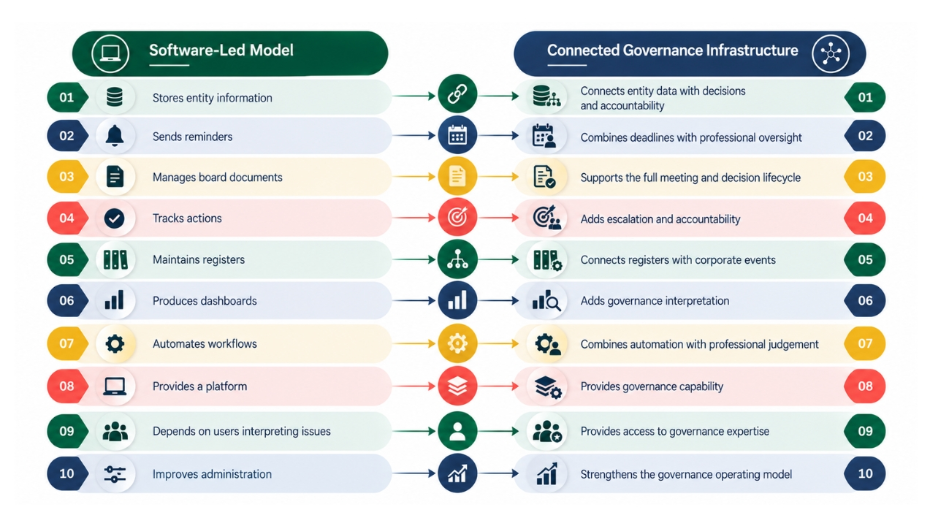
This distinction should shape how boards, General Counsel and Company Secretaries buy governance technology.
A software licence gives the organisation a tool.
Governance infrastructure gives the organisation a capability.
Why CoSec Hub was built differently
Many Company Secretary platforms are positioned mainly as software.
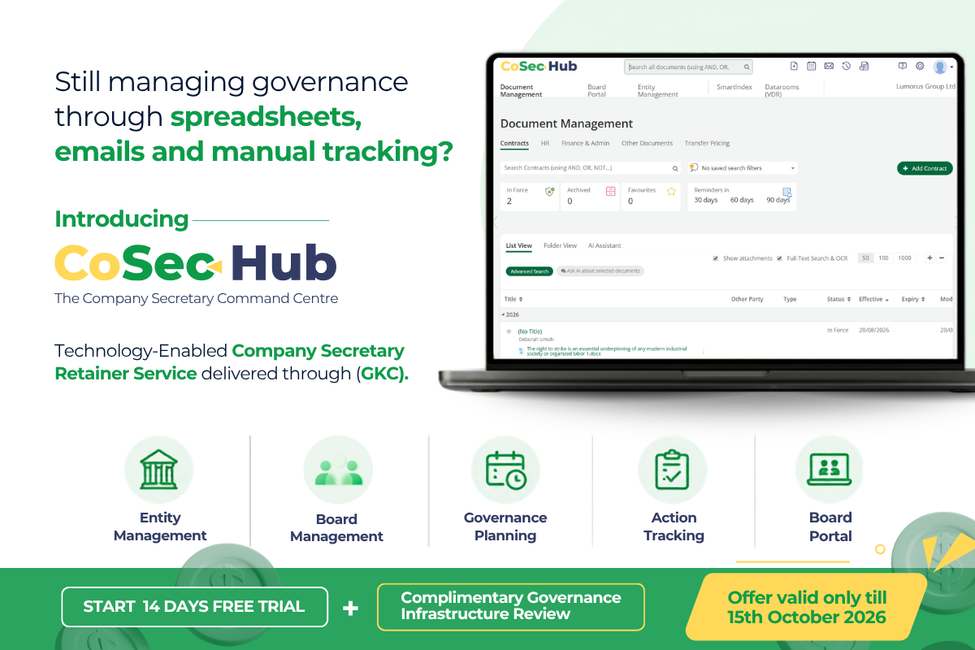
CoSec Hub was designed around a different model.
Modern governance teams need technology.
At the same time, they need professional Company Secretary expertise, governance operations support and reliable governance knowledge.
The CoSec Hub technology layer supports
- Entity Management
- Compliance Calendars
- Governance Forward Planning
- Board Management
- Contract Management
- Statutory Registers
- Board Action Tracking
- Meeting Lifecycle Management
The Governance Knowledge Centre provides
- Chartered Company Secretary Expertise
- Governance Operations Support
- Compliance Monitoring
- Board Administration
- Governance Intelligence
- Multi-Jurisdiction Governance Support
- Governance Advisory
Together, they create a Technology-Enabled Company Secretary Retainer Service.
The model addresses a practical weakness in software-only approaches.
A platform can show that something happened.
An experienced Company Secretary, however, can help determine why it matters and what should happen next.
That combination turns technology into governance infrastructure.
Explore: CoSec Hub
Seven questions to ask before buying Company Secretary software
A product demonstration can make almost any platform look convincing.
The harder questions concern the operating model behind it.
Before making a decision, ask:
1. What governance problem are we trying to solve?
Start with the problem rather than the product.
2. Who will own the information in the system?
Accurate data requires clear accountability.
3. Who interprets regulatory change?
Notifications are useful.
However, they are not the same as professional advice.
4. How are exceptions escalated?
A strong system should make material problems difficult to ignore.
5. Does the platform connect entities, boards, actions and compliance?
Several disconnected governance tools can recreate the fragmentation they were bought to solve.
6. What happens when an issue falls outside the workflow?
This reveals where professional support becomes necessary.
7. Will this strengthen governance or simply digitise administration?
This should be the deciding question.
The best technology investments improve both efficiency and governance quality.
Signs your organisation needs more than software
Technology may not be enough if:
- Governance responsibilities are unclear
- Regulatory interpretation depends heavily on one person
- Group and local entity records do not agree
- Board actions are repeatedly overdue
- Directors receive poor-quality information
- Governance issues are escalated inconsistently
- Local advisers operate without central coordination
- Corporate structures have grown without regular review
- Governance processes differ significantly across the group
- Technology tells the organisation what is wrong, but nobody owns the response
These signals point towards an operating model problem.
Adding another system may therefore add another layer unless people, responsibilities and processes are addressed at the same time.
The Lumorus View
The future of Company Secretary technology should not be measured by how many governance professionals it can replace. It should be measured by how much professional judgement it releases from avoidable administration.
The distinction matters because the Company Secretary role is becoming more influential just as technology is becoming more capable.
According to the Chartered Governance Institute’s 2026 market survey, almost two-thirds of governance professionals believe the influence of their function is increasing.
That is the opportunity.
Organisations should automate work that benefits from consistency.
Meanwhile, they should strengthen professional capability around the work that requires judgement.
Better software should not reduce governance.
It should create more time for it.
The Bottom Line
Company Secretary software is increasingly essential.
Governance functions should not be expected to manage complex international structures, hundreds of obligations and significant board activity through disconnected spreadsheets and personal knowledge.
However, replacing those tools with software solves only part of the problem.
Technology can improve records, workflows, deadlines and visibility.
It cannot independently decide whether governance structures remain fit for purpose, whether directors are receiving the information they need or whether a sensitive governance issue requires escalation.
Those questions require experience and judgement.
The future therefore belongs neither to software-only governance nor to governance teams resisting technology.
Instead, it belongs to organisations capable of combining:
- Strong governance technology
- Reliable information
- Clear processes
- Local regulatory knowledge
- Professional Company Secretary expertise
- Board accountability
Software can run the governance process. People still have to govern.
Continue Exploring
- For stronger governance and board support: Corporate Governance Support
- For statutory and regulatory compliance: Statutory & Regulatory Compliance
- For board and shareholder governance: Board & Shareholder Meetings
- For company formation and restructuring: Company Formation & Structuring
- For additional professional governance capacity: Company Secretary Outsourcing
- For stronger annual reporting: Annual Report Services
- For accurate and defensible board records: Minute Taking Solutions
- For connected governance technology and professional expertise: CoSec Hub
Is your Company Secretary technology actually strengthening the function?
Technology should do more than move governance administration from spreadsheets into another system.
It should reduce avoidable manual work, improve visibility and give experienced Company Secretaries more time for judgement, challenge and board support.
That is why CoSec Hub is offering qualified Chartered Company Secretaries a practical way to test both the technology and the operating model around their function.
Get a 14-Day FREE Trial + Complimentary Company Secretary Functional Audit
Experience CoSec Hub for 14 days and see how the Company Secretary Command Centre and Governance Knowledge Centre can support your governance environment.
In addition, qualified Chartered Company Secretaries can receive a complimentary Company Secretary Functional Audit.
The audit provides a structured review of the Company Secretary function, including:
- Operating model
- Roles and responsibilities
- Capacity
- Governance processes
- Technology and systems
- Compliance oversight
- Information flows
- Key dependencies
- Escalation arrangements
- Continuity and resilience
The purpose is not simply to identify more work.
Instead, the review considers where the function is working well, where manual activity or dependency may be creating risk and where stronger infrastructure could improve control, visibility and board support.
For teams considering greater automation or AI, it can also help answer a crucial question:
Which work should technology handle, and where does professional judgement still need to sit?
Exclusive offer for qualified Chartered Company Secretaries.
Explore CoSec Hub and see how technology-enabled Company Secretary support can strengthen your governance function.
About CoSec Hub
CoSec Hub is the Company Secretary Command Centre.
Built by Company Secretaries for Company Secretaries, CoSec Hub combines governance technology with Chartered Company Secretary expertise to support entity management, compliance oversight, board administration and governance operations.
Through CoSec Hub and the Governance Knowledge Centre, organisations can access a Technology-Enabled Company Secretary Retainer Service bringing together:
- Governance technology
- Chartered Company Secretary expertise
- Entity and board management
- Compliance monitoring
- Governance operations support
- Governance intelligence
- Multi-jurisdiction governance support
- Governance advisory
The objective is not simply to digitise Company Secretary administration.
Instead, it is to create governance infrastructure that allows organisations to grow without losing visibility, accountability or professional judgement.
Lumorus: Better Business, Built on Purpose
At Lumorus, we believe governance is not paperwork. It concerns the allocation, exercise, constraint and accountability of power inside organisations.
Lumorus is a UK-headquartered global governance, ESG, Company Secretary and advisory firm supporting organisations across Europe, Africa, Asia, the Caribbean, Canada, the Middle East and international markets.
For more than 10 years, we have helped boards and leadership teams strengthen governance, accountability and organisational resilience.
Our model combines professional Company Secretary expertise with technology-enabled governance operations because growing organisations increasingly need both.
Technology should make governance faster where speed helps, clearer where visibility matters and more consistent where repeatability reduces risk.
However, professional judgement should remain at the centre of decisions where context, accountability and consequences matter.
Is your Company Secretary technology freeing your governance team to govern, or has it simply moved the administration into another system?
Contact Lumorus or explore CoSec Hub to discuss how a Technology-Enabled Company Secretary Retainer Service can help your organisation move from fragmented governance administration to connected governance infrastructure.
Current CoSec Hub offer: Qualified Chartered Company Secretaries can receive a 14-day free trial plus a complimentary Company Secretary Functional Audit.
Email: [email protected]
CoSec Hub + Governance Knowledge Centre: Where Automation Meets Governance Authority.
Sources
- Diligent: Global State of Legal Entity Compliance 2026 – Research covering more than 300 Company Secretaries, General Counsel and legal operations leaders across 38 jurisdictions, including workload, compliance, technology and operating model pressures.
- Diligent: The Corporate Secretary’s Expanding Mandate – 2026 analysis showing the expansion of the Company Secretary role, continued dependence on manual systems and pressure on governance capacity.
- Diligent: Compliance Near-Miss Research – Findings on compliance near misses, legacy technology and the expanding strategic role of governance professionals.
- The Chartered Governance Institute UK & Ireland – Governance Market Survey 2026, based on 971 governance professionals and examining the growing influence of the governance function.
- OECD: G20/OECD Principles of Corporate Governance 2023 – International principles covering board accountability, risk oversight, access to information and governance support.