51% of governance professionals reported a compliance near miss. Better software is only part of the answer
Company Secretary technology has developed rapidly. Modern platforms can centralise entity records, automate compliance reminders, manage board documents, track actions and provide a clearer view of governance activity across complex organisations.
These capabilities are valuable, particularly because governance teams are working under greater pressure. Diligent’s 2026 Global State of Legal Entity Compliance research surveyed more than 300 senior governance practitioners across 38 jurisdictions and found that 74% had seen their responsibilities expand during the previous two years. More than half had also experienced at least one near miss compliance event, while 47% identified technology gaps and legacy systems as a major challenge.
Therefore, investing in better systems makes sense. However, there is an important distinction between improving governance administration and improving governance itself.
Software can tell a team that an obligation is approaching, but it cannot always determine how that obligation applies to a complex transaction. Likewise, a board platform can show that directors received their papers on time, yet it cannot judge whether those papers contained the information required for a sound decision.
As a result, organisations should resist the idea that governance technology can replace professional governance capability.
Technology can improve how governance is delivered. It cannot take responsibility for how power is exercised, challenged and held accountable.
Read More: Corporate Governance Support
Executive Takeaway
Company Secretary software is increasingly important, but it works best when combined with professional expertise.
A strong governance operating model should use technology to improve:
- Entity management
- Compliance calendars
- Board administration
- Statutory registers
- Governance forward planning
- Action tracking
- Record keeping
- Governance reporting
- Multi-jurisdiction visibility
At the same time, experienced Company Secretaries remain essential for:
- Board advice
- Regulatory interpretation
- Conflict management
- Governance design
- Complex corporate actions
- Director support
- Escalation of material issues
- Governance judgement
- Board effectiveness
The objective is not to choose between technology and people.
It is to ensure that routine governance becomes easier to manage, while experienced professionals have more time for the work that requires judgement.
Company Secretary software solves a real problem
Many governance teams still operate through a mixture of spreadsheets, shared folders, email reminders and individual knowledge.
That may work when an organisation has a small number of entities and relatively simple governance requirements. However, once the business grows across multiple subsidiaries, directors, boards or jurisdictions, manual processes become harder to control.
Technology can improve this environment significantly.
A strong platform can help organisations:
- Maintain one central entity record
- Monitor statutory deadlines
- Track director and shareholder information
- Store governance documents
- Manage board activity
- Record corporate actions
- Track outstanding responsibilities
- Produce governance reports
This is why governance technology is becoming more important.
According to Diligent, the expanding mandate of the Company Secretary is exposing weaknesses in traditional operating models. As governance responsibilities increase, teams need stronger systems to manage the volume of routine work.
However, systems only solve the parts of governance that can be standardised.
The more difficult questions begin where the workflow ends.
Software manages information. Governance manages responsibility
The difference becomes clearer when governance is viewed properly.
The G20/OECD Principles of Corporate Governance emphasise board responsibility for strategic direction, management oversight, internal controls, risk and accountability. They also recognise the importance of timely and relevant information for effective board decision making.
Technology can help provide that information.
However, it cannot assume the responsibility that belongs to directors, executives and governance professionals.
For example, a system can record that a director has declared an interest in a proposed transaction. Nevertheless, it cannot always determine whether that interest requires the director to leave the discussion, whether further advice is needed or whether the remaining board members can approve the transaction.
Similarly, software can confirm that a board paper was circulated before a meeting. It cannot decide whether the paper gave directors enough evidence to challenge management properly.
Therefore, organisations should distinguish between governance information and governance judgement.
Both matter, but they are not interchangeable.
Where technology helps and where expertise still matters
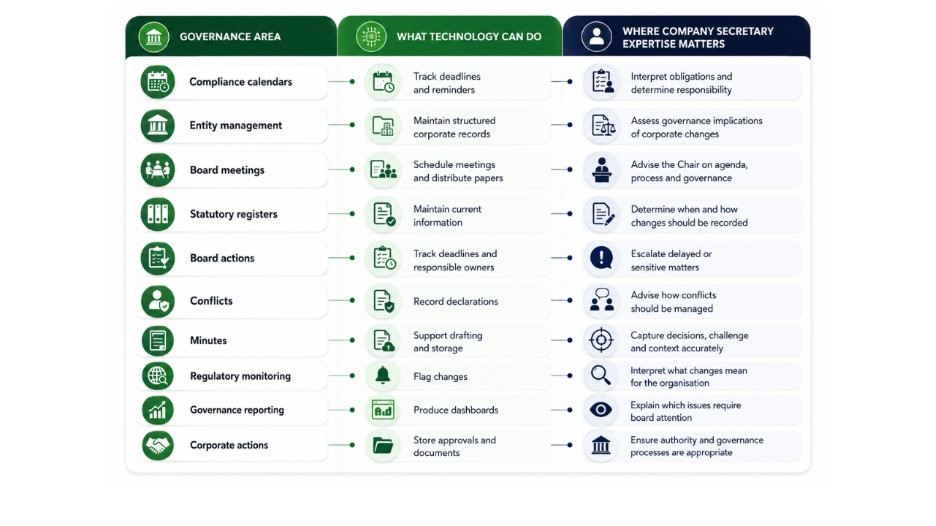
The table highlights the central issue.
Technology creates visibility and efficiency, while professional expertise provides interpretation, challenge and judgement.
The strongest governance model combines both.
A compliance calendar cannot decide what belongs on it
Compliance calendars are among the most valuable features of modern Company Secretary software because they help teams move away from personal reminders and disconnected spreadsheets.
However, the calendar is only as reliable as the rules behind it.
Someone still needs to determine:
- Which obligations apply
- Which entity is affected
- When the requirement arises
- Whether an exemption exists
- Who should own the action
- Which approvals are required
- What evidence confirms completion
- Whether the matter needs escalation
This becomes even more important when an organisation operates across several countries, because similar corporate actions can create different requirements in different jurisdictions.
Technology can automate known rules. However, unusual transactions, regulatory change and legal uncertainty still require professional interpretation.
Consequently, compliance technology works best when it is supported by experienced Company Secretaries who understand both the rules and the organisation.
Explore More: Statutory & Regulatory Compliance
A board platform cannot create an effective board
Board technology has improved meeting administration significantly.
Directors can receive papers securely, agendas can be managed more efficiently and document updates can be controlled more carefully. These improvements reduce administrative effort and help boards work with more reliable information.
Nevertheless, an efficient board process does not automatically create an effective board.
A board can receive every paper on time and still struggle because:
- The agenda focuses too heavily on reporting
- Papers are too long or unclear
- Material risks are buried
- Directors receive insufficient context
- Management dominates discussion
- Difficult issues are repeatedly deferred
- Actions are not followed through
These are governance problems rather than technology problems.
An experienced Company Secretary can help the Chair improve agenda design, challenge the quality of papers, identify matters requiring formal approval and ensure that decisions translate into accountable actions.
As a result, technology should support board effectiveness, not be confused with it.
Read More: Board & Shareholder Meetings
Minutes show why human judgement still matters
Minute taking is another area where technology and artificial intelligence can improve efficiency.
Transcription, summaries and action identification can all reduce the amount of manual work required after meetings. However, board minutes are governance records, not transcripts.
Good minutes should show:
- What the board considered
- Which material issues were discussed
- Relevant challenge
- Conflicts and how they were managed
- The decision reached
- Actions and responsibilities
At the same time, minutes should remain balanced and proportionate. They should not record every statement made during a meeting.
This requires context and judgement.
A system may identify that several directors discussed a proposal. An experienced governance professional can determine which parts of that discussion were important to the board’s final decision and how the record should reflect them accurately.
Therefore, AI can assist minute preparation, but professional review remains essential.
Automation should reduce unnecessary work. It should not remove accountable judgement.
Explore More: Minute Taking Solutions
Entity management software does not automatically create entity governance
Entity management platforms provide organisations with valuable information about their corporate structures.
For example, they can show:
- Which entities exist
- Where they are incorporated
- Who the directors are
- Who owns them
- Which filings are due
- Which corporate documents are available
- Which appointments have changed
However, governance requires organisations to ask additional questions.
For example:
- Does this entity still need to exist?
- Is its board appropriately composed?
- Who exercises real control?
- Are delegations clear?
- Does the subsidiary receive appropriate group oversight?
- Are local directors able to fulfil their duties?
- Are dormant entities creating unnecessary cost or risk?
- Does the structure still support the organisation’s strategy?
A complete database cannot answer these questions on its own.
Therefore, organisations should avoid confusing accurate entity data with effective entity governance.
The first is essential, but it only provides the foundation for the second.
Read More: Company Formation & Structuring
Cross-border governance exposes the limits of software even more clearly
Multi-jurisdiction organisations face a more difficult challenge because local regulatory requirements remain different even when governance technology is centralised.
A platform may provide one view of entities across Europe, Africa, Asia, the Caribbean, Canada, the Middle East and other markets. However, each jurisdiction can still have different rules concerning:
- Directors
- Shareholders
- Beneficial ownership
- Board meetings
- Annual filings
- Statutory registers
- Corporate transactions
- Regulatory reporting
- Governance codes
Therefore, global governance needs three elements working together.
Central governance technology
This provides group-wide visibility and consistency.
Local regulatory knowledge
This ensures jurisdiction-specific rules are understood and applied properly.
Company Secretary expertise
This connects local compliance with group oversight, board governance and professional judgement.
If one of these elements is missing, the operating model becomes weaker.
Explore More: Company Secretary Outsourcing
The biggest danger is automating a weak governance process
Automation makes processes faster. However, it does not automatically make them better.
If responsibilities are unclear, software can simply automate unclear responsibilities. Likewise, inaccurate entity information can be distributed more quickly through a sophisticated platform.
The same problem applies elsewhere.
A weak board agenda can be circulated perfectly. An action tracker can display overdue actions without anyone taking responsibility for closing them. Meanwhile, a governance dashboard can highlight a problem that the organisation still fails to escalate.
Therefore, organisations should not start governance transformation by asking:
Which platform should we buy?
The better starting point is:
How should our governance operating model work?
Only after responsibilities, decision rights, workflows and escalation routes are clear should technology be configured around them.
This avoids the common mistake of digitising an operating model that was already weak.
Five governance challenges software cannot solve on its own
1. Unclear accountability
A platform can allocate an action, but it cannot create a culture in which people genuinely accept responsibility for outcomes.
2. Weak board challenge
Technology can provide information to directors, but it cannot make them ask better questions or challenge management more effectively.
3. Complex governance judgement
Routine rules can often be automated. However, grey areas involving conflicts, director duties, authority or regulatory interpretation still require expertise.
4. Poor information flows
A board portal can distribute information efficiently, yet it cannot ensure that management has given directors the information they actually need.
5. Weak governance culture
No platform can compensate for directors or executives who view governance as an obstacle rather than part of responsible leadership.
These issues demonstrate why governance remains both a systems problem and a human one.
The Company Secretary role is becoming more strategic, not less
The growth of governance technology should increase the value of experienced Company Secretaries because automation can remove work that does not require senior judgement.
Diligent’s 2026 legal entity compliance research found that 56% of practitioners viewed themselves as strategic advisers to the board, while only 17% believed their boards saw them in the same way. The research also found that 52% believed boards underestimated the complexity of entity management.
That perception gap is important.
If Company Secretary work is viewed mainly as administration, software can appear capable of replacing much of the function.
However, when the role includes:
- Advising directors
- Supporting the Chair
- Improving board processes
- Interpreting regulation
- Designing governance systems
- Escalating governance risk
- Supporting complex transactions
- Strengthening board effectiveness
the argument changes.
Technology can reduce routine administration and free professionals to concentrate on the areas where judgement creates greater value.
That should make the profession more strategic.
What should organisations automate?
A useful distinction is between repeatable governance work and judgement-intensive governance work.
Good candidates for automation
- Recurring compliance reminders
- Entity record maintenance
- Routine workflow approvals
- Meeting scheduling
- Document organisation
- Standard filing processes
- Action reminders
- Governance dashboards
- Routine register updates
Areas that should remain expertise-led
- Board advice
- Governance design
- Regulatory interpretation
- Conflict management
- Chair support
- Material escalation
- Board effectiveness
- Complex corporate actions
- Sensitive minute review
- Multi-jurisdiction governance judgement
Technology can still support these expertise-led activities through research, data, monitoring and workflow. However, the final accountability should remain with appropriately qualified people.
The real opportunity is augmentation rather than replacement
The more useful question is not whether AI or governance software can replace the Company Secretary.
It is how technology can make the Company Secretary more effective.
Diligent reported in its 2026 research that 58% of respondents were already using AI somewhere in their function, although many uses remained focused on general productivity. (diligent.com)
Used well, technology can give governance professionals more time to focus on:
- Board advice
- Director support
- Regulatory horizon scanning
- Governance improvement
- Subsidiary oversight
- Complex corporate actions
- Board effectiveness
- Strategic governance
A highly experienced Company Secretary spending hours manually reconciling registers is not an efficient use of professional capability.
Therefore, technology should take more of the repetitive work while experienced professionals spend more time on governance.
The difference between software and governance infrastructure
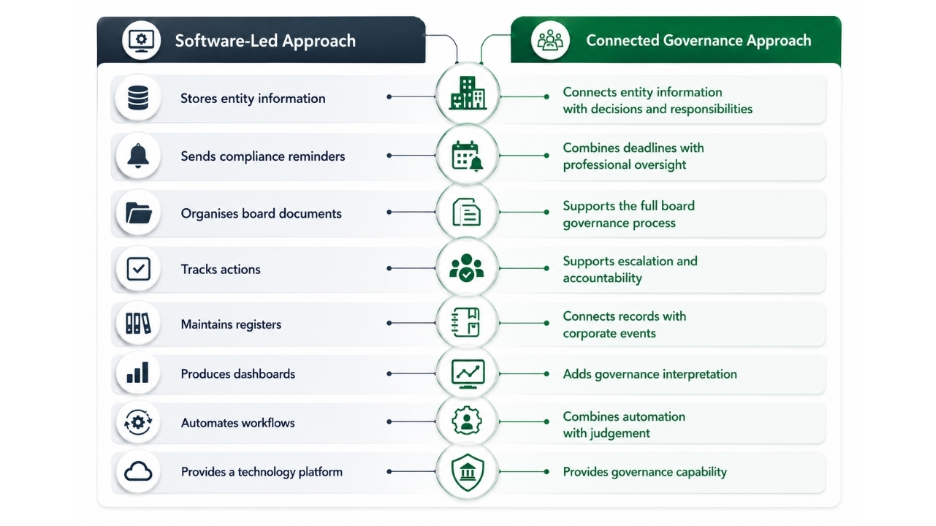
The distinction is important.
A platform is a tool.
Governance infrastructure is the combination of systems, processes, information, people and accountability that allows governance to work consistently.
Why CoSec Hub was built differently
Many Company Secretary platforms are positioned primarily as software.
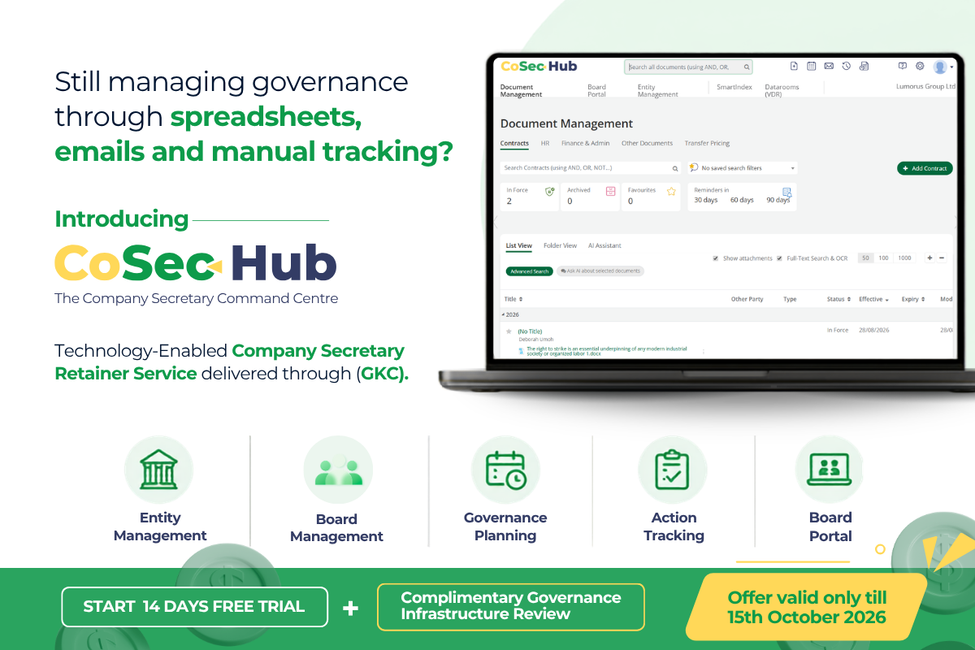
CoSec Hub was designed around a different idea: modern governance teams need technology and professional Company Secretary expertise working together.
The CoSec Hub technology layer supports
- Entity Management
- Compliance Calendars
- Governance Forward Planning
- Board Management
- Contract Management
- Statutory Registers
- Board Action Tracking
- Meeting Lifecycle Management
The Governance Knowledge Centre provides
- Chartered Company Secretary Expertise
- Governance Operations Support
- Compliance Monitoring
- Board Administration
- Governance Intelligence
- Multi-Jurisdiction Governance Support
- Governance Advisory
Together, these capabilities form a Technology-Enabled Company Secretary Retainer Service.
This model recognises that technology can identify an overdue action, while professional judgement determines whether it needs to be escalated.
Similarly, a system can identify a compliance deadline, yet a Company Secretary must understand what the obligation means for the organisation and who needs to act.
The combination creates more than automation.
It creates connected governance infrastructure.
Explore: CoSec Hub
Seven questions to ask before buying Company Secretary software
Before choosing another platform, boards, General Counsel and Company Secretaries should ask:
- What governance problem are we trying to solve?
Technology should address a defined operating problem rather than become an end in itself.
- Who owns the information inside the system?
Data quality requires clear responsibility.
- Who interprets regulatory change?
An automated alert is not the same as professional advice.
- How will exceptions be escalated?
The system should identify problems that require management or board attention.
- Does the platform connect entities, boards, compliance and actions?
Several disconnected governance systems can reproduce the fragmentation the organisation is trying to remove.
- What professional expertise supports the technology?
Organisations need to know what happens when a problem cannot be resolved through a standard workflow.
- Will the platform strengthen governance or simply digitise administration?
This is the question that should shape the final decision.
The Lumorus View
The governance technology debate asks the wrong question when it asks whether software can replace the Company Secretary. The better question is whether technology can free Company Secretaries to spend more time doing the work that software cannot.
Boards do not need highly qualified governance professionals spending disproportionate amounts of time updating spreadsheets, chasing routine information or reconciling entity records manually.
However, organisations should not confuse automating these tasks with automating governance.
The strongest operating model removes avoidable administration while protecting professional judgement where it matters most.
That is not resistance to technology.
It is a better use of it.
The Bottom Line
Company Secretary software has an important role in modern governance.
It can reduce manual work, improve entity information, strengthen compliance monitoring, create clearer audit trails and give organisations better visibility across complex structures.
However, technology reaches its limit when governance becomes a question of judgement, challenge and accountability.
A platform cannot independently determine whether directors have challenged management sufficiently, whether a conflict has been handled properly or whether a technically compliant governance structure is still appropriate for the organisation.
Those questions require experienced people.
Therefore, the future does not belong to organisations choosing between technology and Company Secretary expertise.
It belongs to organisations that combine automation with judgement, information with accountability and software with governance capability.
Continue Exploring
- Strengthen board and organisational governance: Corporate Governance Support
- Improve regulatory and statutory oversight: Statutory & Regulatory Compliance
- Strengthen board and shareholder governance: Board & Shareholder Meetings
- Build stronger entity structures: Company Formation & Structuring
- Add scalable professional governance capacity: Company Secretary Outsourcing
- Strengthen annual governance reporting: Annual Report Services
- Create reliable board records: Minute Taking Solutions
- Connect technology with Company Secretary expertise: CoSec Hub
About CoSec Hub
CoSec Hub is the Company Secretary Command Centre.
Built by Company Secretaries for Company Secretaries, CoSec Hub combines governance technology with Chartered Company Secretary expertise to support entity management, compliance oversight, board administration and governance operations.
Through CoSec Hub and the Governance Knowledge Centre, organisations can access a Technology-Enabled Company Secretary Retainer Service that brings together:
- Governance technology
- Chartered Company Secretary expertise
- Entity and board management
- Compliance monitoring
- Governance operations support
- Governance intelligence
- Multi-jurisdiction support
- Governance advisory
The objective is not simply to digitise Company Secretary administration.
It is to build stronger governance infrastructure.
Lumorus: Better Business, Built on Purpose
At Lumorus, we believe governance is not paperwork. It is the allocation, exercise, constraint and accountability of power inside organisations.
Lumorus is a UK headquartered global governance, ESG, Company Secretary and advisory firm supporting organisations across Europe, Africa, Asia, the Caribbean, Canada, the Middle East and international markets.
For more than 10 years, we have helped boards, leadership teams and organisations strengthen governance, accountability and organisational resilience.
Our approach combines professional Company Secretary expertise with technology-enabled governance operations because growing organisations need both.
Software provides scale. Technology provides visibility. Professional governance expertise provides judgement.
Explore how Lumorus and CoSec Hub can help your organisation move from fragmented administration towards connected, scalable and board-ready governance infrastructure.
Email: [email protected]
CoSec Hub + Governance Knowledge Centre: Where Automation Meets Governance Authority.
Sources
- OECD – G20/OECD Principles of Corporate Governance 2023, covering board accountability, information quality, risk oversight and internal controls.