Africa’s governance standards are rising. Is your governance infrastructure keeping pace?
Expanding across Africa can create significant commercial opportunity. However, it also creates a governance challenge that many organisations underestimate.
Every new jurisdiction brings another legal entity, regulatory framework, board, compliance calendar and set of statutory records. In addition, organisations must deal with different company laws, beneficial ownership rules, governance codes and local regulatory practices.
As a result, the challenge quickly moves beyond administration.
The evidence also points towards rising governance expectations. In April 2026, Kenya’s Capital Markets Authority reported that the overall corporate governance score for issuers of securities to the public had increased from 74% to 79% for the 2024/25 financial year. The assessment covers listed companies and corporate bond issuers against Kenya’s corporate governance framework.
Elsewhere, South Africa has moved to King V. Meanwhile, Nigerian public companies remain subject to the Nigerian Code of Corporate Governance and the SEC Corporate Governance Guidelines. In Nigeria, for example, public companies must comply with both frameworks, including requirements covering board structure, composition and governance processes.
For an organisation operating across several African markets, the challenge is therefore not simply whether each subsidiary complies locally.
The more important question is whether the organisation can maintain one coherent governance environment across several different regulatory systems.
That is where the quality of Company Secretary support becomes critical.
Read More: Corporate Governance Support
Cross-border governance is not the same as multi-country administration
Africa is not one governance market.
A company operating in Kenya, Nigeria, Ghana, South Africa and other African jurisdictions cannot assume that the same corporate procedures will satisfy every local requirement.
Depending on the jurisdiction, different rules may apply to:
- Company formation and registration
- Directors and officers
- Annual returns and statutory filings
- Beneficial ownership
- Statutory registers
- Board and shareholder meetings
- Corporate restructurings
- Capital changes
- Regulatory reporting
- Governance disclosures
- Record retention
Moreover, regulated businesses may face another layer of sector-specific requirements from capital markets, financial services, insurance, telecommunications or other regulators.
The result is a difficult governance balance.
Group leadership needs consistency and visibility. At the same time, each subsidiary needs enough local knowledge and authority to meet its legal obligations.
Good cross-border governance therefore requires both local precision and group-level control.
Explore More: Statutory & Regulatory Compliance
The real problem begins when the organisation grows
A small organisation may be able to manage one or two entities through an experienced Company Secretary, spreadsheets, shared folders and calendar reminders.
Growth, however, changes the equation.
A regional group may have dozens of directors, subsidiaries and statutory obligations. It may also rely on several law firms, accountants and local Company Secretary providers.
Without a connected operating model, information starts to fragment.
For example, common problems include:
- Different versions of director and shareholder information
- Separate compliance calendars across different countries
- Local advisers holding records that headquarters cannot easily access
- Beneficial ownership changes not being reflected consistently
- Board actions being approved but poorly tracked
- Statutory records being updated locally but not centrally
- Regulatory changes reaching the group too late
- Corporate actions creating further obligations across several jurisdictions
These are more than administrative inconveniences.
They create enterprise governance risk.
If the board cannot obtain a reliable view of the organisation’s legal entities, ownership, directors, obligations and governance status, its ability to oversee the group becomes weaker.
What should a leading African Company Secretary provider actually deliver?
The strongest cross-border providers should operate across four connected areas.
1. Local regulatory compliance
First, each entity must satisfy the requirements of the jurisdiction in which it operates.
That includes maintaining records, completing filings and ensuring that corporate actions follow the correct legal process.
2. Group governance visibility
At the same time, the parent organisation needs a reliable view of entities, directors, ownership, compliance obligations and material governance activity across the group.
Without that visibility, local compliance can exist alongside weak group oversight.
3. Board governance
Cross-border governance should support directors as well as entities.
For example, this includes board planning, meetings, resolutions, minutes, actions, conflicts and governance reporting.
4. Professional Company Secretary judgement
Finally, technology can track an obligation, but experienced professionals must still interpret what it means.
They must determine the appropriate governance response and identify when an issue requires escalation.
This combination is increasingly important because governance complexity rarely fits neatly into a single software workflow.
Read More: Board & Shareholder Meetings
What good cross-border governance should look like
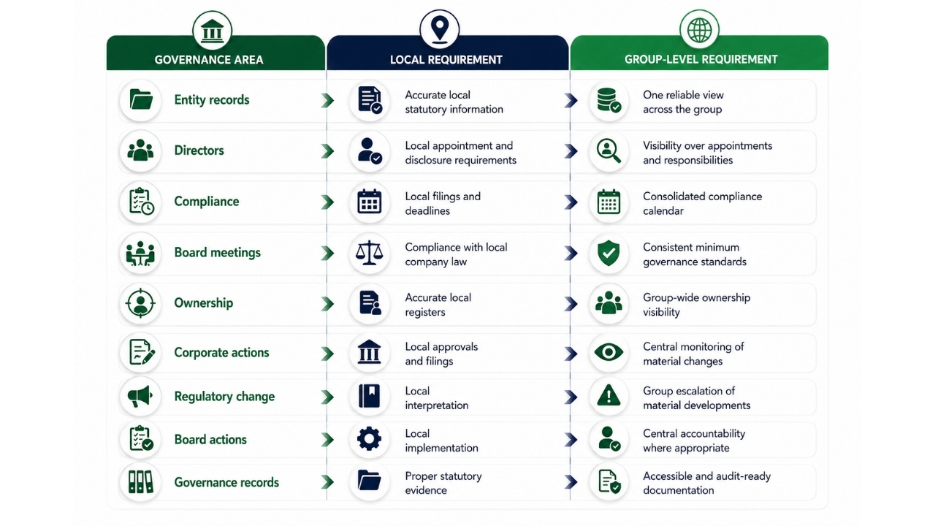
The objective is not to centralise every governance decision.
Instead, organisations should centralise enough information, standards and oversight to keep the group governable as it expands.
In practice, that means local teams can respond to local requirements while group leadership retains a clear view of material governance issues.
Which Company Secretary services should organisations consider in Africa?
There is no authoritative ranking of the best Company Secretary providers across Africa. Organisations should therefore be cautious of any list that claims otherwise.
The market includes specialist governance firms, professional services networks, law firms and large global entity management businesses.
Each model solves a different problem.
For boards, General Counsel and Company Secretaries, a more useful question is:
Which provider gives us the right combination of local expertise, governance judgement, technology and group visibility for our operating model?
Leading Company Secretary providers for cross-border governance
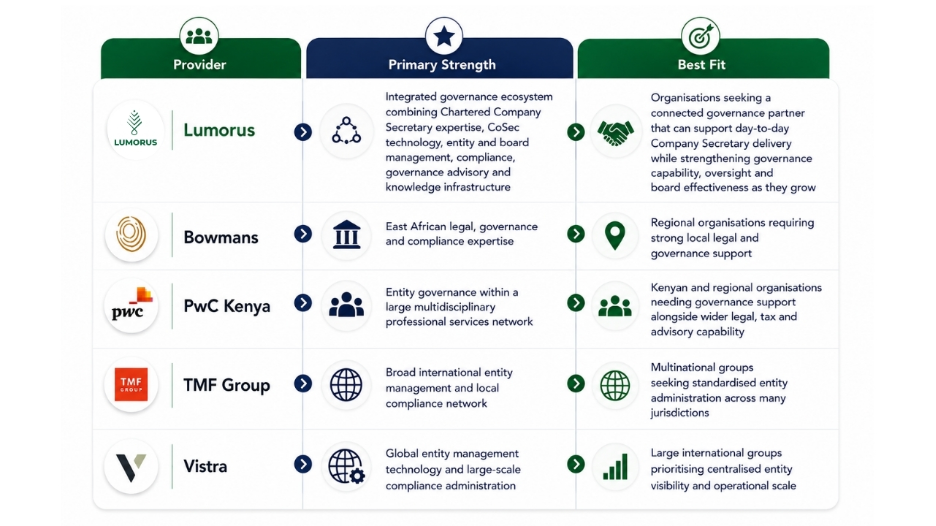
This is not a ranking from strongest to weakest. Instead, it compares different operating models.
Global entity providers tend to compete on scale and jurisdictional reach. By contrast, multidisciplinary firms combine governance with wider legal, tax and advisory services.
Lumorus is positioned differently. Its model brings together professional Company Secretary delivery, governance technology, board support, governance advice and knowledge infrastructure.
As a result, organisations can address both the day-to-day execution of governance and the wider capability needed as complexity increases.
That distinction matters for growing organisations because their governance challenge is rarely limited to statutory filings.
They need infrastructure capable of supporting the board, the governance function and the organisation itself.
Lumorus: from Company Secretary support to governance infrastructure
For organisations operating across Africa and other international markets, Lumorus provides an integrated governance model rather than treating Company Secretary work as a collection of separate administrative tasks.
Its Company Secretary capabilities include:
These services can be supported by CoSec Hub and the Governance Knowledge Centre. Together, they create an operating model that connects governance technology with experienced Company Secretary support.
The difference matters.
A filing provider can complete a filing. An entity management platform can store entity data. Meanwhile, a board platform can organise meetings and a governance adviser can advise the board.
Growing organisations, however, increasingly need these capabilities to work together.
That is the governance infrastructure problem Lumorus is designed to address.
Bowmans: strong East African legal and governance depth
For organisations requiring local legal and governance expertise in East Africa, Bowmans is another provider to consider.
Bowmans states that its corporate services businesses provide Company Secretary services alongside governance advice, compliance audits and other specialist corporate services in East Africa.
Its published offering includes:
- Company Secretary matters
- Entity establishment and dissolution
- Meeting management
- Governance audits
- Governance advice and training
- Board evaluation
- Compliance management and reporting
In addition, the firm reports experience dealing with the Registrar of Companies, Capital Markets Authority, Nairobi Securities Exchange, central banks and other sector regulators.
This model can be particularly relevant where an organisation needs Company Secretary support closely connected with legal advice.
Best fit: organisations requiring strong East African legal and regulatory depth.
PwC Kenya: multidisciplinary entity governance
PwC Kenya offers Entity Governance and Compliance services through a team of governance professionals, qualified Company Secretaries and lawyers.
Its services include entity set-up, statutory compliance, beneficial ownership registration, meeting management and governance solutions. PwC also supports board charters, director induction, training, board evaluations and governance audits.
Furthermore, PwC Kenya’s Legal Business Solutions practice sits within a wider international network and works alongside tax, advisory, consulting and assurance teams.
This structure can be useful where governance requirements overlap with wider legal, regulatory or transactional matters.
However, organisations considering a multidisciplinary professional services firm should also assess applicable independence requirements, particularly where other network services are being provided.
Best fit: organisations seeking entity governance within a wider professional services environment.
TMF Group: scale for international entity management
For multinational organisations operating well beyond Africa, TMF Group represents another provider model.
Its proposition centres on global entity management and local compliance across multiple jurisdictions.
As a result, this model can appeal to large international groups seeking to reduce the number of separate providers involved in routine entity administration.
The principal advantage is scale.
However, scale and governance depth are not necessarily the same thing.
Boards should therefore examine whether a provider will simply coordinate entity compliance or also offer the governance judgement, board support and advice the organisation requires.
For some organisations, global administration will be the priority. For others, the need will be broader: governance capability rather than entity administration alone.
Vistra: technology-enabled global entity management
Vistra provides another large-scale global entity management model.
Vistra states that it supports governance and regulatory requirements across more than 100 countries, with more than 1,500 legal and entity management professionals.
Its services include Company Secretary support, regulatory compliance, annual renewals and statutory document maintenance.
Technology is also central to its proposition. For example, organisations can gain centralised access to entity information, deadlines, filings, documents and stakeholder records.
This can be valuable for businesses with very large international entity portfolios where central visibility and standardisation are major priorities.
Best fit: multinational groups seeking global scale, entity technology and standardised compliance administration.
Why local expertise alone is not enough
Local expertise is indispensable.
However, there is an important weakness in a purely decentralised model.
Imagine an organisation with entities across six African jurisdictions. Each subsidiary has an excellent local adviser. Every adviser understands local law, and each entity is broadly compliant.
The group may still have weak governance.
Why?
Because nobody necessarily has the complete picture.
For example, headquarters may not know:
- Which filings are approaching
- Whether every entity is in good standing
- Whether director records are consistent
- Which board actions remain outstanding
- Whether ownership information has changed
- Which local regulatory developments require group attention
- Whether corporate records are complete and audit ready
Therefore, the real test is not whether every subsidiary has access to a competent local adviser.
It is whether local expertise connects into a group governance system.
Kenya shows how governance expectations are becoming more measurable
Kenya provides a useful example of the direction of travel.
The Capital Markets Authority reported in April 2026 that the overall governance score for issuers of securities to the public increased from 74% to 79% for the 2024/25 financial year.
The CMA assessment considers how issuers apply the principles and recommendations within Kenya’s corporate governance framework.
This matters because governance is increasingly being assessed through observable practice rather than assumed from the existence of policies.
For cross-border groups, subsidiary governance should therefore be able to answer practical questions:
- Is the board receiving appropriate information?
- Are decisions properly documented?
- Are conflicts managed?
- Are actions followed through?
- Are directors receiving appropriate governance support?
- Are statutory records current?
- Can compliance be evidenced?
A subsidiary may meet every filing deadline while still being poorly governed.
Compliance is necessary. Governance goes further.
Read More: Minute Taking Solutions
Nigeria demonstrates why the Company Secretary role matters
Nigeria also illustrates the importance of governance processes alongside formal compliance.
The Securities and Exchange Commission Nigeria states that public companies must comply with the Nigerian Code of Corporate Governance 2018 and its additional SEC Corporate Governance Guidelines.
Among other matters, the guidelines address board structure and composition. They also require board papers to be made available to directors at least one week before relevant meetings.
This reinforces a wider point.
Company Secretary work is not merely about keeping an entity legally alive. It also helps create the conditions in which directors can discharge their responsibilities effectively.
Therefore, the quality of board papers, governance calendars, minutes, actions and information flows matters alongside statutory filings.
Explore More: Board & Shareholder Meetings
The most dangerous cross-border risk sits between the subsidiaries
Cross-border governance failures often occur at handover points rather than within individual functions.
For example:
- A board approves a restructuring, but the entity record is not updated
- A director resigns locally, but headquarters continues to show them as active
- A shareholder change occurs, yet beneficial ownership information remains outdated
- A subsidiary approves a material decision, but group governance never receives the final resolution
- A regulatory change is identified locally, but nobody assesses its wider group impact
In each case, an individual may have completed their part of the process.
Yet the organisation still ends up with inaccurate governance information.
This is why strong governance infrastructure needs to connect decisions, obligations, people, entities and evidence.
Technology matters, but technology is not governance
Technology has an important role in solving this problem.
A strong governance platform can provide central visibility over:
- Legal entities
- Directors
- Shareholders
- Beneficial ownership
- Compliance deadlines
- Statutory registers
- Board meetings
- Board actions
- Governance documents
- Corporate transactions
However, technology cannot determine whether a complex shareholder arrangement creates a governance concern.
Nor can it advise a Chair on how to manage a difficult conflict or decide whether a regulatory development requires immediate board attention.
Those decisions require professional judgement.
The stronger model therefore combines:
Governance technology + Company Secretary expertise + governance advice + local regulatory knowledge.
That is where governance technology becomes infrastructure rather than simply another system.
Why CoSec Hub was built differently
Many governance platforms position themselves primarily as software.
CoSec Hub was built around a different philosophy.
Modern governance teams need technology. At the same time, they need access to experienced Company Secretary judgement and governance capability.
The CoSec Hub technology layer supports
- Entity Management
- Compliance Calendars
- Governance Forward Planning
- Board Management
- Contract Management
- Statutory Registers
- Board Action Tracking
- Meeting Lifecycle Management
The Governance Knowledge Centre provides
- Chartered Company Secretary Expertise
- Governance Operations Support
- Compliance Monitoring
- Board Administration
- Governance Intelligence
- Multi-Jurisdiction Governance Support
- Governance Advisory
Together, they form a Technology-Enabled Company Secretary Retainer Service.
Not simply software.
Not outsourcing alone.
Connected governance infrastructure.
This distinction is especially important for organisations expanding across Africa. Every additional jurisdiction increases both the volume of administration and the need for sound governance judgement.
Explore: CoSec Hub
See how your governance infrastructure stands up across borders
Cross-border governance becomes harder to manage as entities, jurisdictions, directors and regulatory obligations increase.
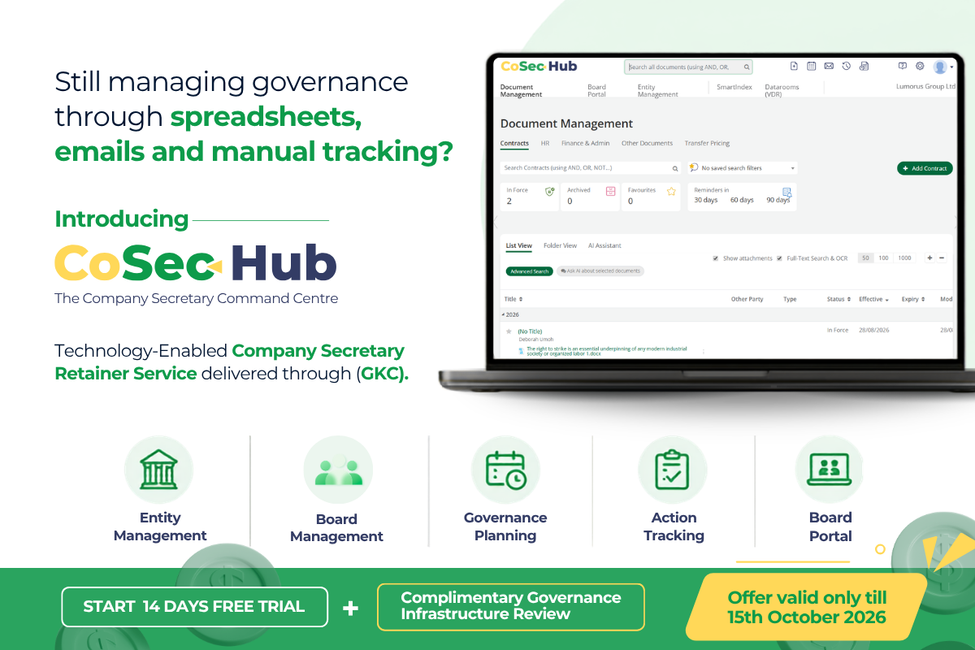
That is why CoSec Hub is offering organisations a practical way to test both the platform and the governance infrastructure behind their current operating model.
Get a 14-Day FREE Trial + Complimentary Governance Infrastructure Review
Experience CoSec Hub for 14 days and see how the Company Secretary Command Centre and Governance Knowledge Centre can support your governance environment.
In addition, eligible organisations will receive a complimentary Governance Infrastructure Review.
The review examines the systems, workflows, ownership, records and controls that support governance across the organisation. It is designed to identify where visibility is strong, where information may be fragmented and where governance processes may need greater consistency or control.
For organisations operating across several African jurisdictions, this can help answer practical questions such as:
- Can group leadership see the governance position across all entities?
- Are compliance obligations tracked consistently?
- Do local and central records agree?
- Are board decisions, actions and filings properly connected?
- Does governance depend too heavily on individual advisers or institutional memory?
- Can the model scale as the organisation enters new markets?
Offer valid until 15 October 2026.
Explore CoSec Hub and experience how connected governance infrastructure can support stronger cross-border oversight.
How to choose the right African cross-border governance partner
Boards and governance leaders should look beyond a provider’s country list.
A long list of jurisdictions may demonstrate reach. However, it says little about how the service works in practice.
Before appointing a provider, ask seven questions.
1. Who owns the relationship across all jurisdictions?
There should be clear accountability rather than a collection of disconnected local contacts.
2. Can we see our governance position centrally?
Entity, director, ownership and compliance information should be accessible without repeatedly contacting local advisers.
3. Does the provider understand boards as well as entities?
Strong governance requires board support, decision tracking and governance advice alongside statutory administration.
4. How are regulatory changes monitored and escalated?
Material developments should reach the right people before they become compliance problems.
5. Can the model scale as we grow?
Adding another subsidiary should not require the organisation to rebuild its entire governance process.
6. Where does professional judgement sit?
Organisations should know who provides Company Secretary advice when an issue cannot be resolved through a workflow.
7. Can governance be evidenced?
Records, decisions, filings and actions should leave a reliable audit trail.
Together, the answers to these questions often reveal more than a provider’s marketing material.
Five warning signs your cross-border governance model is becoming fragile
1. Headquarters and local records disagree
Conflicting director, shareholder or entity information usually signals weak information flows.
2. Compliance depends on individual memory
Experienced people are valuable. However, critical obligations should not exist primarily inside someone’s inbox or diary.
3. Every country operates differently
Local differences are inevitable. Completely different governance processes are not.
4. Local advisers are strong, but nobody owns the whole picture
This is one of the most common structural weaknesses in cross-border governance.
5. Governance information becomes reliable only before an audit
Audit-ready governance should be the normal operating condition, not a temporary project.
If several of these warning signs exist, the organisation may not need another spreadsheet.
It may need a different governance operating model.
The Bottom Line
Africa’s commercial opportunity comes with genuine governance complexity.
As organisations expand across Kenya, Nigeria, South Africa, Ghana and other African markets, the number of entities, directors, filings, board decisions and regulatory relationships increases.
The answer is neither complete centralisation nor fragmented local administration.
Instead, organisations need a connected model that combines:
- Local regulatory knowledge
- Chartered Company Secretary expertise
- Reliable entity management
- Board governance
- Compliance oversight
- Governance technology
- Professional judgement
- Central group visibility
The best Company Secretary service is therefore not necessarily the provider with the longest list of jurisdictions.
It is the provider whose operating model allows an organisation to grow across jurisdictions without losing governance control, for boards, that is the real test.
Regional expansion should increase the organisation’s reach. It should not reduce the board’s visibility.
About CoSec Hub
CoSec Hub is the Company Secretary Command Centre.
Built by Company Secretaries for Company Secretaries, CoSec Hub combines governance technology with Chartered Company Secretary expertise. It supports entity management, regulatory compliance, board administration and day-to-day governance operations.
Together with the Governance Knowledge Centre, it provides a Technology-Enabled Company Secretary Retainer Service designed for modern Company Secretary, legal, governance and compliance teams.
For organisations operating across Africa and internationally, the objective is clear: create one connected governance environment while retaining the professional and local expertise needed to navigate different jurisdictions.
Lumorus: Better Business, Built on Purpose
Lumorus is a UK-headquartered global governance, ESG, Company Secretary and advisory firm supporting organisations across Europe, Africa, Asia, the Caribbean, Canada, the Middle East and international markets.
For more than 10 years, we have helped boards, leadership teams and organisations strengthen governance, accountability and organisational resilience.
Growing organisations need more than Company Secretary administration. They need governance capability that can scale with the business, connect local entities with group oversight and give boards reliable information about the organisations they govern.
Through Lumorus and CoSec Hub, organisations can combine professional Company Secretary support with governance technology, compliance oversight, entity and board management, governance advice and knowledge infrastructure.
Can your board see how every significant entity across your African operations is governed, or does the answer still depend on separate spreadsheets, advisers and institutional memory?
Contact Lumorus to explore how our Company Secretary services and CoSec Hub can help your organisation build connected, scalable and board-ready cross-border governance.
Current CoSec Hub offer: Get a 14-day free trial plus a complimentary Governance Infrastructure Review, available until 15 October 2026.
Email: [email protected]
CoSec Hub + Governance Knowledge Centre: Where Automation Meets Governance Authority.
Sources
- Capital Markets Authority Kenya – 2026 State of Corporate Governance assessment reporting an increase in the overall governance score for issuers from 74% to 79%.
- Securities and Exchange Commission Nigeria – Corporate Governance Guidelines and requirements for Nigerian public companies.
- Bowmans – Company Secretary, governance advisory, compliance audit and corporate services across East Africa.
- PwC Kenya – Entity Governance and Compliance services covering entity establishment, compliance, beneficial ownership, meetings and board governance.
- PwC Kenya Legal Business Solutions – Legal, regulatory and ongoing Company Secretary services supported by PwC’s wider international network.
- Vistra – Global entity management and Company Secretary services across more than 100 countries.