Company secretaries often hold one of the most important roles in an organisation and one of the hardest to quantify.
When the function works well, regulatory deadlines are met. Board meetings run effectively. Directors receive the information they need. Statutory records remain accurate. Governance risks are identified before they become problems; nothing dramatic happens, that is precisely the challenge when the board asks what value the function creates.
A sales team can point to revenue. Finance can report margins. Operations can demonstrate productivity. Company secretaries, however, often create value by preventing failures, improving decisions and keeping governance infrastructure functioning quietly behind the organisation.
As a result, much of their contribution remains invisible until something goes wrong.
The answer is not to exaggerate governance ROI or invent a financial value for every activity. Instead, company secretaries need to become better at showing how their work improves decision quality, compliance confidence, organisational resilience, board effectiveness and governance efficiency.
According to Cygnetise, the modern company secretary increasingly operates at the intersection of governance, strategy and risk, helping boards improve effectiveness while navigating greater regulatory and organisational complexity.
Similarly, Azali CPS argues that company secretaries add strategic value by connecting board decision making with regulatory requirements, governance discipline, risk oversight and effective information flows; the role already creates value, the challenge is making that value visible.
Read More: Corporate Governance Support
The board does not need a list of tasks. It needs evidence of outcomes
One of the weakest ways to justify a company secretary function is to describe everything the team does.
- Meetings organised
- Minutes prepared
- Filings completed
- Registers maintained
- Resolutions drafted
Those activities are necessary. However, activity alone does not explain value.
The board is more likely to understand the contribution when the discussion moves from what the company secretary does to what the organisation gains because the work is done well.
From governance activity to board value
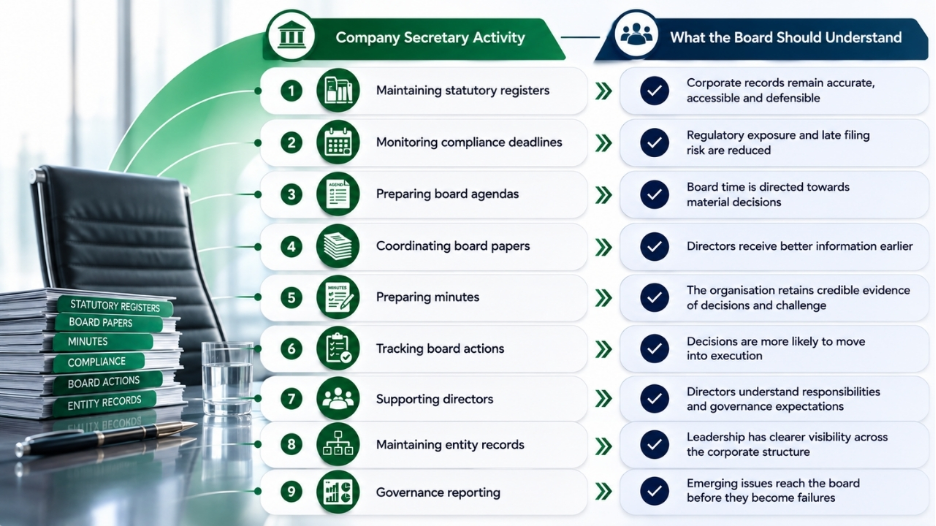
This reframing matters; the company secretary should not simply be presented as the person who keeps the governance machinery moving, the stronger proposition is that the company secretary improves the organisation’s capacity to govern itself.
Prove value through decision quality
One of the company secretary’s most important contributions happens before the board votes; good governance support improves the quality of the decision environment.
That means ensuring the board knows:
- What decision is required
- Why the matter is before the board
- Whether the board has the authority to decide it
- What information is material
- Which conflicts require management
- What risks require consideration
- What actions will follow the decision
This may sound procedural. The consequences are strategic.
A badly structured board process can result in directors spending forty minutes discussing information that requires no decision and five minutes considering a transaction that deserves serious challenge; by contrast, well-designed governance processes help boards devote attention to the matters where director judgement creates the greatest value.
Cygnetise notes that company secretaries increasingly support board effectiveness by improving processes, director onboarding and access to clear information. In turn, that allows boards to focus more effectively on their core responsibilities.
Therefore, company secretaries should not simply report the number of meetings supported. They should demonstrate improvements in how meetings function.
Useful indicators might include:
- Percentage of board papers distributed within agreed timelines
- Percentage of agenda items classified clearly as decision, discussion or information
- Reduction in late or incomplete board papers
- Director feedback on board information quality
- Percentage of actions completed by agreed deadlines
- Recurring issues reduced through improved governance processes
These measures are not perfect. However, they tell a much stronger story than the number of meetings administered.
Explore More: Board & Shareholder Meetings
Show the board the risk that did not materialise
Governance creates value partly by preventing avoidable problems.
That makes measurement difficult because the strongest outcome may be the absence of an event.
- No missed filing.
- No invalid approval.
- No outdated register discovered during due diligence.
- No board decision weakened by incomplete documentation.
- No governance scramble before an investor review.
The company secretary should therefore build a clearer picture of risk prevention and compliance reliability.
Rather than reporting only that filings were completed, show the board:
- Total statutory obligations monitored
- Percentage completed on time
- Number of potential deadline risks identified early
- Number of entity record discrepancies corrected
- Number of governance issues escalated before becoming regulatory problems
- Jurisdictions or entities requiring enhanced attention
- Compliance trends over time
This turns compliance from an invisible background activity into an observable governance control. Professional Statutory & Regulatory Compliance should therefore be understood as a risk management capability, not merely a filing service.
The message to the board is simple:
Effective company secretary support reduces uncertainty around the organisation’s legal and governance obligations.
Demonstrate the value of better information
Boards are increasingly overloaded with information. Yet information quantity is not the same as governance visibility. A company secretary often sits at the centre of the organisation’s governance information flow, connecting directors, executives, committees, advisers, regulators and shareholders.
That position creates value when information is:
- Accurate
- Timely
- Relevant
- Traceable
- Consistent
- Easy to retrieve
Azali CPS highlights this information role, noting that company secretaries support effective governance through corporate record management, board information and streamlined processes that reduce delays and improve access to governance information.
Company secretaries can make this contribution more visible by reporting improvements such as faster corporate record retrieval, fewer duplicate sources of entity information, better governance reporting and clearer board action tracking.
The real value is not document management, It is decision readiness. When an acquisition, funding round, regulatory review or restructuring occurs, the organisation should not have to reconstruct its governance history from inboxes and shared drives.
Read More: Annual Report Services
Measure board action, not just board activity
A board can hold twelve excellent meetings and still govern poorly if decisions disappear after the meeting ends.
Therefore, one of the clearest ways for company secretaries to demonstrate value is to show how governance connects decisions to execution.
A useful board action report
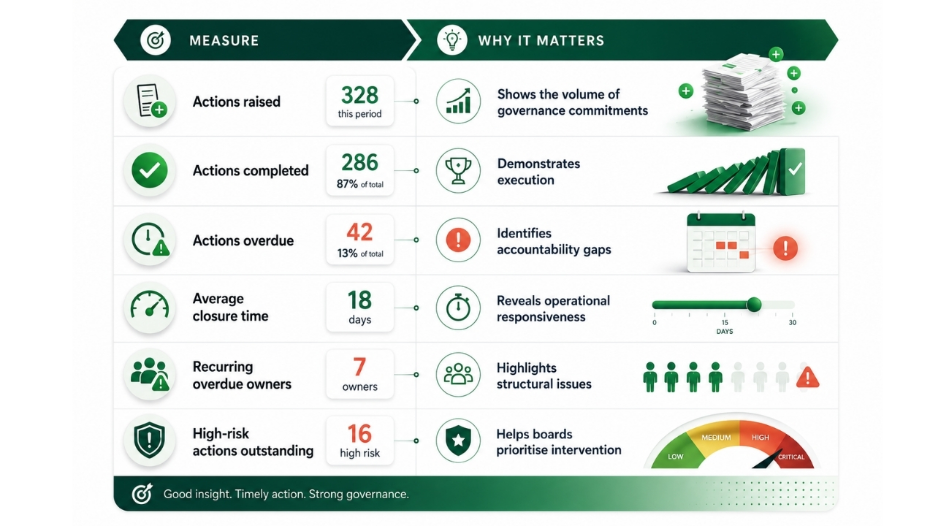
The company secretary does not own every action; that distinction matters, however, the company secretary can create the governance discipline that keeps ownership visible, this is a stronger value proposition than minute taking alone.
Professional Minute Taking Solutions should therefore connect accurate governance records with actions, accountability and follow-through; minutes record the decision, governance helps ensure something happens because of it.
Prove that the function enables growth
Company secretary support often becomes more valuable as an organisation becomes more complex.
- A startup becomes a group
- One entity becomes ten
- The organisation enters new jurisdictions
- Investors join
- New directors are appointed
- Committees are established
- Transactions become more sophisticated
At each stage, governance complexity increases; however, boards can easily interpret additional company secretary resource as overhead unless the relationship between growth and governance capability is clearly explained. The company secretary should therefore connect resource requirements to business change.
A stronger argument would be:
We are not requesting additional governance capacity because the team is busier. We require it because the organisation has added six entities, entered two jurisdictions, increased board activity and introduced additional regulatory obligations.
That is a fundamentally different case, it links governance resources to enterprise complexity.
Likewise, strong Company Formation & Structuring should not be viewed simply as incorporation support. Good structuring establishes decision rights, ownership clarity and governance arrangements that can support future growth.
The value case becomes stronger when governance is presented as infrastructure for expansion rather than an administrative consequence of it.
Stop trying to justify every governance activity financially
There is a temptation to prove value by attaching a financial figure to everything, that can weaken the argument.
Some governance benefits can be quantified reasonably well. Automation may reduce administrative hours. Outsourced support may cost less than building equivalent internal capability. Better workflows may reduce duplicated effort.
Other benefits are inherently harder to monetise.
- What is the precise financial value of an independent director receiving better information before a major decision?
- What is the return on avoiding an invalid governance process that never became a dispute?
- What is the value of better challenge?
Trying to invent precise numbers for these outcomes can create false credibility, instead, company secretaries should combine hard operational metrics with governance evidence.
A more credible value dashboard
Efficiency
- Hours saved through process automation
- Reduction in manual administration
- Faster document retrieval
- Reduced duplication
Compliance
- On-time filing rate
- Number of obligations monitored
- Exceptions identified early
- Record accuracy
Board effectiveness
- Timeliness of board papers
- Action completion
- Director feedback
- Decision cycle time
Resilience
- Number of governance processes documented
- Reduction in dependence on individual knowledge
- Multi-jurisdiction visibility
- Continuity arrangements
Strategic contribution
- Governance input into transactions
- New entity and restructuring support
- Regulatory horizon scanning
- Director induction and board development
This makes the business case more credible because it acknowledges that governance value is multidimensional.
Use technology to create evidence of value
One reason company secretary teams struggle to prove their contribution is that governance information is often scattered.
- Compliance deadlines sit in spreadsheets.
- Board actions appear in meeting notes.
- Entity information sits in different systems.
Governance activity is happening, yet there is no consolidated view of the work or the risk being managed, technology can change that.
A connected governance environment can provide real-time information on:
- Compliance status
- Upcoming obligations
- Board actions
- Entity changes
- Statutory records
- Meeting activity
- Governance workload
- Outstanding risks
According to Cygnetise, centralised governance information and digital tools can help company secretaries reduce fragmented information flows while giving boards clearer insight into risk and governance performance; however, technology should not simply automate administration, it should make governance observable.
Once governance becomes observable, it becomes easier to demonstrate value.
Why CoSec Hub was built differently
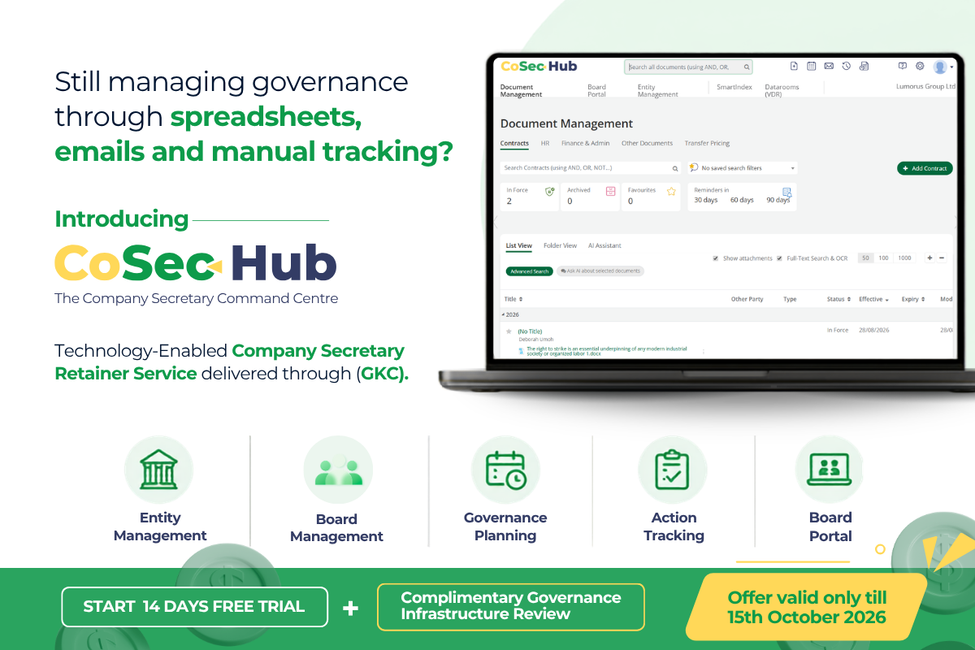
Many governance platforms position themselves primarily as software. CoSec Hub was built around a different philosophy.
Modern company secretary teams need technology. However, they also need governance expertise and operational capacity, that is why CoSec Hub combines two connected layers.
The Technology Layer
Supporting:
- Entity Management
- Compliance Calendars
- Governance Forward Planning
- Board Management
- Contract Management
- Statutory Registers
- Board Action Tracking
- Meeting Lifecycle Management
The Governance Knowledge Centre
Providing:
- Company Secretary Expertise
- Governance Operations Support
- Compliance Monitoring
- Board Administration
- Governance Intelligence
- Multi-Jurisdiction Governance Support
- Governance Advisory
Together they form a Technology-Enabled Company Secretary Retainer Service; not software alone, not outsourcing alone.
Governance infrastructure.
For company secretaries seeking to demonstrate value, that integrated model matters. Technology creates visibility, while experienced governance support helps translate that visibility into action.
The company secretary should report governance intelligence, not a task list
The most effective company secretaries increasingly provide boards with governance intelligence.
A quarterly governance report, for example, might include:
- Compliance status across all entities
- Material upcoming deadlines
- Board and committee action completion
- Director and entity changes
- Shareholder matters
- Governance risks requiring attention
- Regulatory developments
- Decisions expected in the next quarter
- Areas where governance capacity is under pressure
This changes the board’s perception of the function; instead of seeing a team that organises governance, directors see a function that interprets governance conditions and helps leadership act early; that shift is central to demonstrating value. The objective is not to convince the board that the company secretary is busy. The objective is to demonstrate that the organisation is better governed because the company secretary function exists.
Read More: Corporate Governance Support
A practical board conversation
When asking for investment, additional resource or continued external support, company secretaries should avoid framing the discussion around workload alone.
A stronger business case can follow five steps.
1. Start with organisational change
What has changed?
- More entities?
- New jurisdictions?
- Greater regulatory exposure?
- More board activity?
2. Explain the governance consequence
What new obligations, risks or information requirements does that change create?
3. Show current performance
What evidence demonstrates how effectively governance is currently being managed?
4. Identify the capacity gap
Where is the governance infrastructure becoming stretched?
5. Connect investment to outcomes
Will the investment improve compliance confidence, board effectiveness, operational resilience or governance visibility?
This turns the conversation from:
We need another person because there is too much work.
into:
The organisation has become more complex, and governance capability must scale with it if the board wants to maintain the same level of oversight and control.
That is a board-level argument.
The strongest company secretaries make themselves visible without making governance about themselves
There is an important balance.
Company secretaries should demonstrate value, but governance should never become a campaign for personal importance.
The strongest professionals remain focused on the institution.
They make:
- Accountability clearer
- Boards better informed
- Decisions better structured
- Compliance more reliable
- Information easier to access
- Risks more visible
Their value becomes obvious because the organisation functions better.
Azali CPS describes the company secretary as a strategic link between governance, regulation, management and board decision making. That positioning captures the opportunity well.
The future of the profession will not be secured by defending traditional tasks.
It will be secured by demonstrating how company secretary capability improves institutional performance.
Explore Our Services
About CoSec Hub
CoSec Hub is the Company Secretary Command Centre.
Built by Company Secretaries for Company Secretaries, CoSec Hub combines governance technology with governance expertise to support governance operations, compliance oversight, entity management, board administration and governance reporting.
Delivered through CoSec Hub and the Governance Knowledge Centre (GKC), the service provides Technology-Enabled Company Secretary Retainer Services designed for modern company secretary, legal governance, entity management and compliance teams.
For company secretaries under increasing pressure to demonstrate value, the model provides something increasingly important: the ability to turn governance activity into visible governance intelligence.
Lumorus: Better Business, Built on Purpose
Lumorus is a UK-headquartered global governance, company secretary, ESG and advisory firm supporting organisations across Europe, Africa, Asia, the Caribbean, Canada, the Middle East and international markets.
For more than 10 years, we have helped boards, leadership teams and organisations strengthen governance, accountability and organisational resilience.
Is your governance infrastructure strong enough for the complexity, scrutiny and accountability you now face?
Contact Lumorus to request a Governance Infrastructure Assessment and explore how CoSec Hub can help your organisation move from fragmented administration to connected, compliant and board-ready governance.
Email: [email protected]
CoSec Hub + Governance Knowledge Centre (GKC): Where Automation Meets Governance Authority.
Sources
- Cygnetise – How Company Secretaries Can Add Value and Enhance Their Role
- Azali CPS – How a Company Secretary Adds Value to Corporate Strategy
- CoSec Hub – Technology-Enabled Company Secretary Retainer Services and governance infrastructure.