79% governance performance in Kenya is encouraging. It also shows how visible governance quality is becoming
Company Secretaries across Africa are working in a governance environment that is becoming more demanding, more measurable and more connected to wider business risk.
In April 2026, Kenya’s Capital Markets Authority reported that the overall corporate governance score for issuers of securities to the public had increased from 74% to 79% for the 2024/25 financial year. The assessment reviews listed companies and corporate bond issuers against Kenya’s corporate governance framework, which is now a continuing obligation under the country’s public offers, listings and disclosures regime.
That progress matters. However, it also illustrates a wider shift across the continent: governance is becoming easier for regulators, investors and stakeholders to assess.
South Africa’s King V took effect for financial years beginning on or after 1 January 2026, bringing a more streamlined code and standardised disclosure framework. Meanwhile, Nigeria continues to strengthen corporate governance and sustainability reporting, while several African jurisdictions are moving towards the adoption or use of International Sustainability Standards Board requirements.
As a result, the African Company Secretary is no longer dealing only with meetings, registers and annual returns. The role increasingly touches board effectiveness, beneficial ownership, sustainability disclosure, cyber governance, regulatory change, director suitability and complex cross-border structures.
The profession is therefore moving towards a more difficult question:
How do Company Secretaries help boards govern effectively when the organisation, regulation and risk environment are all becoming more complex at the same time?
Read More: Corporate Governance Support
Executive Takeaway
The most important governance challenges facing Company Secretaries across Africa in 2026 are not isolated compliance problems. They are connected issues that require stronger governance infrastructure.
Key pressures include:
- Regulatory fragmentation across jurisdictions
- Rising expectations of boards and directors
- Beneficial ownership and corporate transparency
- Sustainability and ESG reporting
- Cyber and technology governance
- Director skills, independence and suitability
- Multi-jurisdiction entity oversight
- Weak governance information and data
- Heavy reliance on individual knowledge
- Growing demands on Company Secretary teams
The central challenge is therefore not simply doing more work.
It is ensuring that governance remains visible, consistent and accountable as complexity increases.
Challenge 1: Africa remains a collection of different governance systems
There is no single African company law, regulatory framework or governance code.
A group operating in Kenya, Nigeria, Ghana, South Africa, Tanzania and Zambia may face different requirements concerning:
- Board structure
- Director appointments
- Filing obligations
- Beneficial ownership
- Statutory registers
- Governance reporting
- Sustainability disclosure
- Capital markets regulation
- Corporate records
- Shareholder rights
This makes cross-border governance inherently difficult.
The challenge is not simply identifying the rules in each jurisdiction. Company Secretaries must also understand how local obligations connect with group governance.
For example, a parent company may establish minimum board standards across the group, yet local directors still need to fulfil their responsibilities under local law. Similarly, central governance teams may want one compliance calendar while local filings continue to follow different timetables.
Consequently, organisations need both:
- Group-level governance standards
- Local regulatory knowledge
The absence of either creates risk.
A fully decentralised model can leave the board without visibility. On the other hand, excessive centralisation can ignore important local legal requirements.
Explore More: Statutory & Regulatory Compliance
Challenge 2: Governance expectations are moving from process to evidence
It is no longer enough to say that governance processes exist.
Increasingly, organisations need to demonstrate that those processes actually work.
Kenya provides a clear example. The Capital Markets Authority publishes regular State of Corporate Governance reports and maintains formal reporting requirements for issuers. The framework includes governance reporting templates, governance audits and forward-looking event calendars.
This creates a different standard for Company Secretaries.
Boards should be able to demonstrate:
- That directors received appropriate information
- That meetings were properly constituted
- That conflicts were managed
- That decisions were recorded
- That actions were followed through
- That governance obligations were completed
- That evidence remains accessible
As a result, Company Secretary work increasingly creates the governance record against which the organisation may later be judged.
That raises the importance of accurate minutes, reliable statutory records and clear audit trails.
Read More: Minute Taking Solutions
Challenge 3: Board quality is becoming harder to treat as a soft issue
Board composition has always mattered.
However, regulators and governance bodies are paying greater attention to whether directors are genuinely suitable for the responsibilities they hold.
In June 2026, the Institute of Directors in South Africa urged boards to strengthen due diligence when appointing directors. The IoDSA warned against relying only on CVs, interviews or reputation and highlighted new expectations around fit and proper assessments.
The same governance principle applies more broadly across the continent.
Company Secretaries increasingly need to help boards examine:
- Director qualifications
- Relevant experience
- Independence
- Conflicts of interest
- Capacity and time commitment
- Regulatory suitability
- Skills gaps
- Board succession
- Continuing development
This is important because poor board appointments create risks that cannot be corrected through better meeting administration.
A board can have perfect papers and still make weak decisions if it lacks the right people around the table.
Therefore, Company Secretaries should increasingly see board composition as part of governance risk management.
Challenge 4: Independence requires judgement, not box ticking
Director independence is another area where governance can become too mechanical.
In August 2026, the King Committee clarified that nine years of board service should not automatically mean a director ceases to be independent. Instead, length of service is one indicator among several, while the real question is whether the director demonstrates independence of mind.
That distinction is important.
Governance codes can provide useful indicators, but Company Secretaries should help boards avoid turning governance into a formula.
A director may satisfy a formal independence test and still be reluctant to challenge management. Conversely, a long-serving non-executive director may continue to demonstrate strong independence of thought.
The Company Secretary can support the board by ensuring that independence assessments consider:
- Financial relationships
- Business relationships
- Family connections
- Length of service
- Cross-directorships
- Former executive roles
- Significant shareholders
- Actual behaviour in the boardroom
Governance quality depends on substance as much as form.
Challenge 5: Beneficial ownership is becoming a major transparency issue
Corporate ownership transparency is rising rapidly up the governance agenda across Africa.
A July 2026 joint article from the African Union Commission and Open Ownership argued that beneficial ownership transparency is becoming an important tool in strengthening tax governance and reducing illicit financial flows across the continent.
Nigeria has been particularly active. According to Open Ownership, Nigeria became the first African country to establish a comprehensive, publicly accessible and free beneficial ownership register based on the Beneficial Ownership Data Standard. Its Persons with Significant Control register was launched in 2023.
For Company Secretaries, this creates practical governance responsibilities.
They need confidence that:
- Ownership structures are understood
- Significant controllers are identified
- Shareholder records are accurate
- Group and local records agree
- Changes are updated promptly
- Supporting documentation is available
The underlying risk is straightforward.
An organisation may know the name appearing on the share register while still lacking a clear understanding of who ultimately controls the company.
That is increasingly difficult to defend.
Challenge 6: Sustainability reporting is moving into the boardroom
Sustainability reporting is becoming one of the most important new governance pressures for African Company Secretaries.
The IFRS Foundation now lists several African jurisdictions with finalised approaches to the adoption or other use of ISSB Standards, including Ghana, Kenya, Nigeria, Rwanda, Tanzania, Zambia and Zimbabwe.
Nigeria has moved particularly quickly. In February 2026, the Financial Reporting Council of Nigeria issued an amended roadmap and reporting guideline for implementing IFRS S1 and IFRS S2. The regulator said the changes were intended to clarify reporting timelines, assurance requirements and implementation expectations.
By June 2026, the FRC reported that more than 50 Nigerian organisations were moving towards full adoption, while more than 4,500 participants had been reached through capacity-building programmes.
The governance implications are significant.
Company Secretaries increasingly need to understand:
- Which sustainability requirements apply
- Which board committee has oversight
- How ESG risks enter board reporting
- Who owns sustainability data
- How disclosures are approved
- Whether the board can challenge management’s assumptions
- How reporting connects with enterprise risk
This does not mean the Company Secretary should become the sustainability officer.
Instead, they should ensure that sustainability reporting sits within a clear governance framework.
Challenge 7: ESG reporting is becoming a cross-border issue too
The sustainability challenge becomes more complex for multinational African groups.
The IFRS Foundation reported in August 2026 that ISSB Standards were being adopted or otherwise used in more than 40 jurisdictions globally. Its jurisdictional work increasingly focuses on the challenges created when multinational organisations operate across several reporting regimes. (ifrs.org)
For African Company Secretaries supporting regional or international groups, this matters because reporting requirements may differ across subsidiaries.
An organisation could have:
- Mandatory requirements in one country
- Voluntary adoption in another
- Different implementation dates elsewhere
- Group-level reporting requirements from the parent company
Therefore, governance teams need to coordinate sustainability reporting in the same way they coordinate entity compliance.
The key is not simply producing disclosures.
It is making sure the board knows which requirements apply, who owns them and whether the supporting information is reliable.
Challenge 8: Cyber risk is no longer only an IT problem
Digital growth is creating another board-level governance challenge.
Cyberattacks can disrupt operations, expose confidential information, damage reputation and create legal or regulatory consequences.
The Institute of Directors in South Africa describes cyber risk as a material business risk rather than simply an IT concern. Its 2026 director programme emphasises the need for boards to understand cyber threats, governance responsibilities and the decisions required during major incidents.
For Company Secretaries, this creates several practical questions:
- Is cyber risk clearly allocated within the board structure?
- Does the board receive regular reporting?
- Are directors able to understand the information?
- Is there a clear incident escalation process?
- Has the board tested its crisis governance?
- Are third-party risks included?
- Do minutes capture material cyber discussions?
The Company Secretary does not need to become a cyber specialist.
However, they should be able to see whether the board has an effective governance process around cyber risk.
That distinction is becoming increasingly important.
Challenge 9: Technology is improving governance operations, but it can also expose weak infrastructure
Governance technology offers major benefits for African Company Secretaries.
Platforms can support:
- Entity management
- Compliance calendars
- Board meetings
- Statutory records
- Director information
- Board actions
- Governance reporting
However, technology does not fix weak governance automatically.
If entity information is inaccurate, digitising it simply makes inaccurate information easier to access. Likewise, an automated reminder will not solve a compliance obligation that nobody clearly owns.
As a result, organisations need to design the governance operating model before relying too heavily on technology.
A stronger sequence is:
- Clarify governance responsibilities.
- Define the key processes.
- Set minimum standards.
- Establish data ownership.
- Introduce technology.
- Monitor whether the system improves outcomes.
That approach prevents organisations from digitising fragmented governance rather than fixing it.
Explore More: CoSec Hub
Challenge 10: Cross-border growth can reduce board visibility
African expansion often happens faster than governance architecture develops.
- New subsidiaries are incorporated.
- Directors are appointed.
- Local advisers are engaged.
- Regulatory licences are obtained.
The business grows, however, central governance systems may remain largely unchanged, that creates a widening gap between corporate complexity and governance capability.
A strong cross-border model should give leadership visibility over:
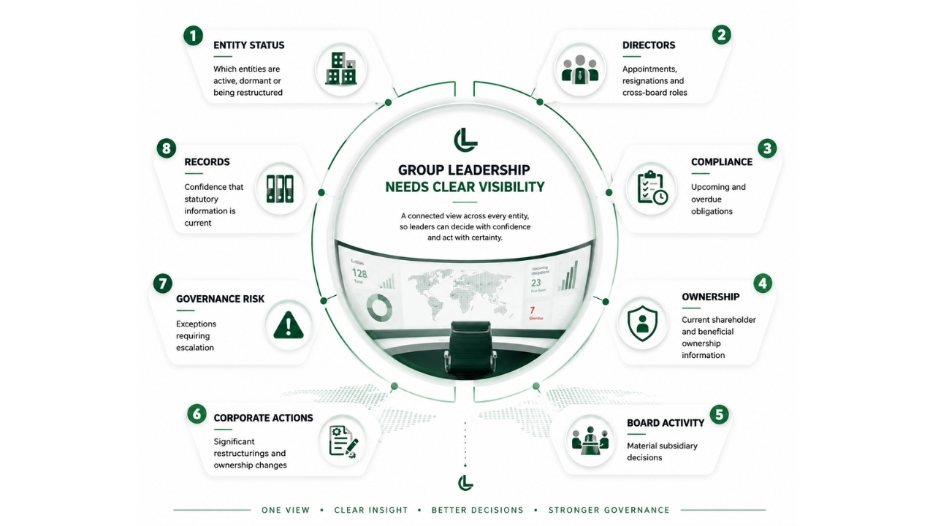
The objective is not to centralise every local decision. Instead, it is to give the group enough information to exercise responsible oversight.
Read More: Company Secretary Outsourcing
Challenge 11: Company Secretaries are being asked to do more without always receiving more capacity
The expanding governance agenda creates an important operating risk.
As board expectations increase, Company Secretaries are expected to support:
- Governance reform
- Regulatory compliance
- Entity oversight
- Sustainability reporting
- Board effectiveness
- Director development
- Risk governance
- Governance reporting
- Transactions
- Stakeholder matters
Yet internal team capacity does not always expand at the same rate, this can create a dangerous pattern in which highly experienced professionals compensate for weak systems through personal effort.
- The Company Secretary remembers the deadline.
- They know which adviser to call.
- They know which board paper needs revising.
- They know which action is still outstanding.
That dedication keeps governance functioning, however, it also creates key-person dependency. Good governance should be supported by systems, processes and shared information rather than relying excessively on institutional memory.
The African Company Secretary challenge map
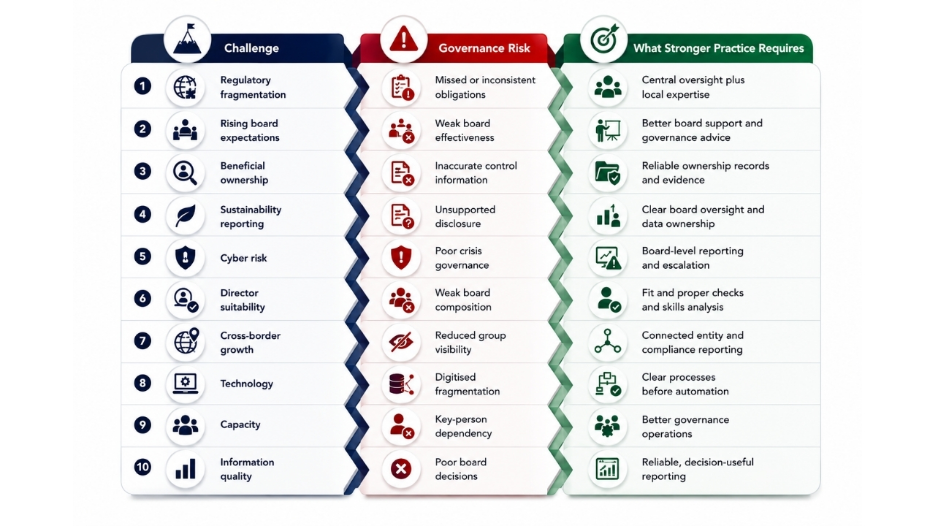
The challenges differ, but the response is consistent. Boards need governance infrastructure that makes accountability and risk visible.
The Lumorus View
The biggest challenge facing African Company Secretaries is not the volume of governance work. It is ensuring that governance remains coherent as regulation, technology and organisational complexity increase at the same time, that distinction matters.
Strong professionals can often compensate for weak systems for longer than the organisation realises. They use judgement, relationships and experience to bridge operational gaps; however, growth eventually exposes the weakness, the answer is not to remove professional judgement, it is to build better infrastructure around it.
That means:
- Reliable governance information
- Clear accountability
- Strong board processes
- Connected compliance
- Technology-enabled visibility
- Local regulatory knowledge
- Professional Company Secretary expertise
This combination allows the profession to spend less time holding fragmented systems together and more time supporting boards with judgement and governance leadership.
What African Company Secretaries should prioritise now
The challenges can appear broad, but Company Secretaries can begin with six practical priorities.
1. Create one governance view
Maintain reliable information about entities, directors, ownership and compliance across the organisation.
2. Strengthen governance forward planning
Regulatory obligations, board decisions and reporting requirements should be visible well before deadlines become urgent.
3. Review board capability
Assess whether board composition, skills, independence and director development remain appropriate.
4. Bring ESG into the governance framework
Sustainability reporting should have clear executive ownership and board oversight.
5. Reduce dependency on individuals
Document critical processes and centralise important governance information.
6. Improve exception reporting
Boards should see the issues that require intervention rather than being overwhelmed by routine governance activity, these priorities can strengthen governance without creating unnecessary bureaucracy.
Why CoSec Hub was built for this environment
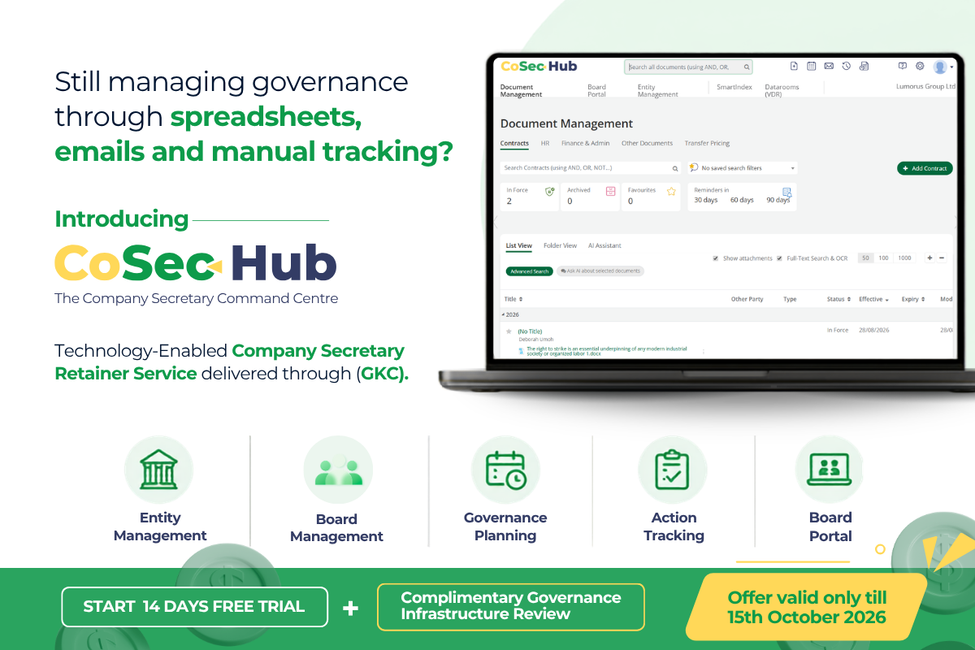
CoSec Hub was designed around the principle that modern Company Secretaries need technology and professional governance expertise working together.
The technology layer supports
- Entity Management
- Compliance Calendars
- Governance Forward Planning
- Board Management
- Contract Management
- Statutory Registers
- Board Action Tracking
- Meeting Lifecycle Management
The Governance Knowledge Centre provides
- Chartered Company Secretary Expertise
- Governance Operations Support
- Compliance Monitoring
- Board Administration
- Governance Intelligence
- Multi-Jurisdiction Governance Support
- Governance Advisory
Together, these capabilities create a Technology-Enabled Company Secretary Retainer Service.
For African organisations, this model addresses two different problems at once; technology provides visibility and structure. Experienced Company Secretaries provide judgement, local understanding and governance advice.
That is particularly important where organisations are expanding across several jurisdictions and need to maintain both local compliance and group-level governance.
Explore: CoSec Hub
Seven questions for the next governance review
Boards and Company Secretaries can use these questions to test whether governance infrastructure is keeping pace:
- Can we see the compliance position of every material entity across the group?
- Are director skills, independence and suitability reviewed properly?
- Can we explain who ultimately owns and controls every significant entity?
- Does the board understand which sustainability reporting requirements apply?
- Is cyber governance clear enough for the board to respond during a major incident?
- Would governance continue effectively if one experienced Company Secretary became unavailable?
- Are we using technology to improve governance, or simply digitising old processes?
If several answers are uncertain, the organisation has identified an operating-model issue rather than simply a compliance problem.
The Bottom Line
The role of the African Company Secretary is becoming more demanding because governance itself is changing.
Kenya is making governance performance increasingly measurable. South Africa has introduced King V. Nigeria is strengthening governance and sustainability reporting expectations, while beneficial ownership transparency is expanding across the continent. At the same time, cyber risk, ESG disclosure and international expansion are creating responsibilities that did not sit as prominently on the Company Secretary agenda a decade ago.
The profession therefore needs to evolve; company Secretaries cannot simply become busier versions of the administrators they were once assumed to be, they need to become stronger governance advisers supported by better information, stronger systems and clearer operating models. Boards also need to recognise this shift, a high-performing Company Secretary does more than keep the organisation compliant.
They help ensure that the board receives the right information, governance obligations are visible, decisions are properly recorded and institutional accountability survives as the organisation grows.
The future of governance in Africa will depend not only on stronger codes and regulation, but on whether organisations build the infrastructure required to turn those expectations into everyday practice.
Continue Exploring Our Services
- Strengthen board and organisational governance: Corporate Governance Support
- Improve statutory and regulatory oversight: Statutory & Regulatory Compliance
- Strengthen board and shareholder governance: Board & Shareholder Meetings
- Build or restructure legal entities: Company Formation & Structuring
- Add scalable Company Secretary capacity: Company Secretary Outsourcing
- Strengthen annual governance reporting: Annual Report Services
- Create stronger board records: Minute Taking Solutions
- Connect governance technology and expertise: CoSec Hub
About CoSec Hub
CoSec Hub is the Company Secretary Command Centre.
Built by Company Secretaries for Company Secretaries, CoSec Hub combines governance technology with Chartered Company Secretary expertise to support entity management, compliance oversight, board administration and governance operations.
Delivered alongside the Governance Knowledge Centre, the model provides Technology-Enabled Company Secretary Retainer Services designed for modern Company Secretary, legal, governance and compliance teams.
For organisations operating across Africa, the objective is to connect local regulatory compliance with group-level visibility, board support and professional governance judgement.
Lumorus: Better Business, Built on Purpose
Lumorus is a UK headquartered global governance, ESG, Company Secretary and advisory firm supporting organisations across Europe, Africa, Asia, the Caribbean, Canada, the Middle East and international markets.
For more than 10 years, we have helped boards, leadership teams and organisations strengthen governance, accountability and organisational resilience.
Our Company Secretary model combines professional governance expertise with technology-enabled operations because African organisations increasingly need both. As regulation, reporting and cross-border complexity grow, governance needs to remain visible, scalable and capable of supporting better board decisions.
Is your Company Secretary function equipped for the governance challenges your organisation will face next, or is professional effort still compensating for weak infrastructure?
Contact Lumorus to explore how our Company Secretary services and CoSec Hub can strengthen governance capability, regulatory visibility and board-ready governance across Africa and international markets.
Email: [email protected]
CoSec Hub + Governance Knowledge Centre: Where Automation Meets Governance Authority.
Sources
- Capital Markets Authority Kenya – 2026 State of Corporate Governance assessment showing an increase in the governance score for issuers from 74% to 79%.
- Capital Markets Authority Kenya – Corporate governance reporting, governance audits and regulatory framework for issuers.
- Institute of Directors in South Africa – King V Report on Corporate Governance, effective for financial years beginning on or after 1 January 2026.
- Institute of Directors in South Africa – 2026 guidance on fit and proper assessments and stronger director due diligence.
- King Committee – 2026 guidance clarifying director independence and the role of tenure in independence assessments.
- Securities and Exchange Commission Nigeria – Nigerian Code of Corporate Governance and SEC governance requirements for public companies.
- Financial Reporting Council of Nigeria – 2026 amended roadmap and sustainability reporting guidance for IFRS S1 and IFRS S2.
- Financial Reporting Council of Nigeria – 2026 update on sustainability reporting adoption and capacity building in Nigeria.
- IFRS Foundation – Jurisdictional profiles showing African progress towards adoption or other use of ISSB Standards.
- IFRS Foundation – 2026 update on ISSB adoption or use across more than 40 jurisdictions and cross-border reporting considerations.
- African Union Commission and Open Ownership – 2026 analysis of beneficial ownership transparency and governance across Africa.
- Open Ownership – 2026 review of Nigeria’s beneficial ownership data and Persons with Significant Control register.
- Institute of Directors in South Africa – 2026 board guidance on cyber risk as a governance and business issue.