Frequently Asked Questions (FAQs)
Regular Questions
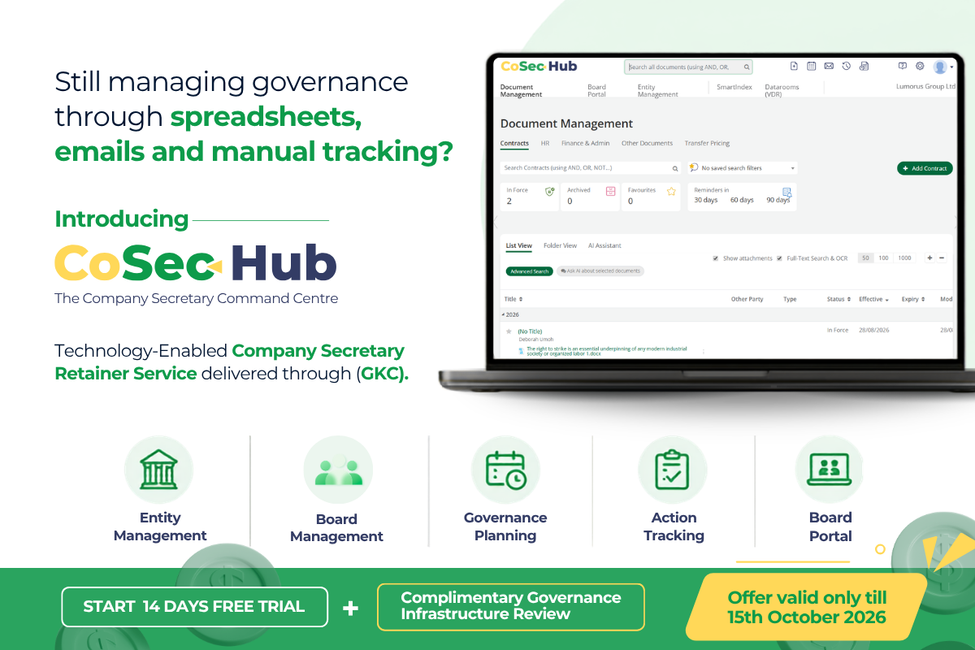
CoSec Hub is Lumorus’ technology-enabled company secretarial support solution. It combines professional company secretarial expertise, structured governance processes, secure digital record-keeping, compliance tracking, and access to a client portal in one operating environment.
No. CoSec Hub is not just a standalone software tool. It combines a professional company secretarial retainer service with governance infrastructure and digital tools, so clients receive both expert support and an organised system for managing governance responsibilities.
CoSec Hub is designed for organisations that need structured company secretarial and governance support, especially growing businesses, SMEs, regulated organisations, groups with subsidiaries, and companies operating across more than one jurisdiction.
CoSec Hub can support meeting documentation, board pack preparation, board and committee minutes, statutory register maintenance, annual filings, compliance deadline tracking, governance consultations, document reviews, and general company secretarial guidance.
Yes. CoSec Hub supports board and committee meetings by helping with agenda preparation, collection of board papers, board pack compilation, circulation of meeting materials, preparation of minutes, and tracking of action items after the meeting
The standard service includes support for up to two meetings per month, with each meeting expected to last around two to three hours. Additional meetings or longer meetings may attract extra fees depending on the scope of work required.
Yes. CoSec Hub helps maintain and review statutory registers so that company records remain accurate, up to date, and ready for regulatory, audit, or board review.
Support may include registers of directors, members, secretaries, transfers, allotments, charges, applications, directors’ residential addresses, and other statutory or governance records relevant to the company’s obligations.
Yes. CoSec Hub can support the preparation and filing of annual returns and other required company filings, helping reduce the risk of missed deadlines, incomplete submissions, or poor record-keeping.
Yes. CoSec Hub is designed to support entity management and compliance coordination across group structures, including parent companies, subsidiaries, branches, and special purpose vehicles where applicable.
Yes. CoSec Hub can assist organisations with multi-jurisdictional governance needs, including compliance planning, filing coordination, and structured record-keeping across different operating regions.
Yes. Clients can access a secure online portal to manage governance information, communicate with the Lumorus team, access key documents, and track relevant governance or compliance matters.
The portal can support access to company records, meeting materials, compliance information, governance documents, support requests, and other resources depending on the client’s service package and onboarding setup.
Not necessarily. CoSec Hub can act as an outsourced company secretarial support function, or it can support an existing internal company secretary, finance team, legal team, or governance team with additional structure, tools, and expertise.
Yes. Many organisations assign company secretarial duties to finance, legal, risk, or operations teams. CoSec Hub helps reduce that pressure by providing specialist governance support, structured workflows, and clearer compliance oversight.
The free first month allows eligible clients to experience the service before making a longer commitment. It may include selected services such as meeting minutes, statutory register review, filing support, governance guidance, and account manager support, subject to the applicable terms and scope.
No. The free first month is designed to give clients an opportunity to assess the service. If the service is not the right fit, clients can choose not to continue, subject to the applicable terms and conditions.
After the first month, clients can continue on the retainer plan, which provides broader and ongoing governance support, including recurring meeting support, statutory register maintenance, compliance reminders, filings, governance advice, and continued access to Lumorus support.
CoSec Hub provides company secretarial, governance, and compliance support. Where legal advice or formal legal opinions are required, this may be provided separately by appropriately qualified professionals, depending on the nature of the request and the client’s jurisdiction.
Yes. CoSec Hub can support the review of governance documents, policies, board materials, shareholder documents, resolutions, and other corporate records to help identify compliance gaps and improve governance quality.
Yes. CoSec Hub helps clients maintain a governance and compliance calendar, including key filing dates, board meetings, regulatory deadlines, and other governance obligations
Yes. CoSec Hub supports deadline tracking and reminders so that important filings, meetings, reviews, and governance actions are not missed.
Support response times depend on the service terms and the nature of the request. The current service model includes email and portal-based support, with response expectations set under the applicable service and fair use policy.
Yes. CoSec Hub is designed to support confidential governance communication, secure document handling, role-based access, and structured digital storage of sensitive company secretarial records.
Yes. CoSec Hub can help collect board papers, compile them into a structured board pack, circulate materials to meeting attendees, and archive final documents for compliance and record-keeping purposes.
Yes. Action item tracking is part of the meeting support process. CoSec Hub can help record decisions, assign follow-up actions, monitor progress, and ensure that outstanding matters are carried forward appropriately.
Yes. CoSec Hub supports secure digital storage of governance and statutory documents, helping clients move away from scattered folders, spreadsheets, email trails, and manual record-keeping.
Yes. Depending on the service package, CoSec Hub can help prepare governance summaries, compliance status updates, health check reports, and executive summaries suitable for board review.
The quarterly health check is an optional review designed to identify governance and compliance risks before they escalate. It may include a compliance review, recommendations, and a board-ready summary of key findings.
You can get started by submitting an application, booking a demo, or contacting the Lumorus team. Once your organisation is assessed as a suitable fit, the team will guide you through onboarding, portal access, and the first month of support.
Applications are reviewed to determine whether an organisation is a suitable fit for CoSec Hub and to ensure the recommended service aligns with its governance requirements.
Review times vary depending on the information provided and application volume. Applicants will be contacted as soon as the review has been completed.
Before onboarding, ensure the appropriate representatives are available, gather any requested governance information or documents, and be prepared to discuss your governance requirements with the Lumorus team. Additional information may be requested depending on your organisation and the agreed service.
You will receive access to the CoSec Hub Client Portal once your application has been approved and you have confirmed that you wish to proceed with either the Trial or a paid subscription. Access instructions will be provided during onboarding.
You can easily get in touch with the team on our platform by visiting our Contact page directly at Contact Us to ask for assistance. Also contact directly via +44 203 840 4850 or [email protected] via email.
Technical Questions
Yes. CoSec Hub is designed to support secure handling of company secretarial, board, compliance, and governance information. Access is controlled based on user roles, and sensitive documents are stored in structured digital repositories with appropriate permission controls.
Only authorised users can access your company information. Access is role-based, meaning users only see the entities, documents, meetings, or records relevant to their role.
No. CoSec Hub is designed around a segregated client structure, where each client’s data, users, documents, settings, and governance records are kept separate.
Yes. CoSec Hub can support parent companies, subsidiaries, branches, SPVs, and other entity structures. This allows organisations to manage governance information across multiple companies from a central environment.
Yes. Users can be assigned different access levels depending on their role. For example, a company secretary, board member, reviewer, administrator, or external adviser may each have different access rights.
Yes. Board members can access relevant meeting materials, board packs, documents, and governance information through the appropriate portal or board access environment, depending on the setup agreed during onboarding.
Yes, MFA or similar secure login controls can be configured where supported by the access environment. This helps protect sensitive governance and board-level information.
Yes. CoSec Hub is being designed to integrate with selected tools and workflows, including document storage, CRM, e-signature, support tickets, calendar systems, and board portal environments where applicable.
The current technical approach uses the Zoho ecosystem for key workflows, including client management, forms, document storage, workflow automation, e-signatures, support tickets, dashboards, and custom application logic.
Yes. CoSec Hub can work with board portal environments to support board pack preparation, secure document circulation, meeting access, approvals, and post-meeting archiving.
Yes. Board packs can be distributed through secure access controls. Depending on the setup, controls may include view-only access, download restrictions, watermarks, expiry settings, and permission-based access.
Yes. CoSec Hub is designed to preserve audit trails for key governance activities, including document uploads, approvals, publishing, access, downloads, edits, filings, and other important actions.
Yes. Where supported by the configured board portal or document environment, access logs can show who viewed, downloaded, annotated, approved, or interacted with documents.
Documents are organised using a structured governance folder model. This may include folders for meetings, agendas, board papers, attendance, minutes, action logs, correspondence, filings, statutory records, and archived materials.
Yes. A standard structure can be created for board and committee meetings, including folders for agenda items, attendance, apologies, draft papers, final papers, logistics, minutes, action logs, and supporting attachments.
Yes. Version control can be applied to governance documents so that changes, re-published packs, updated papers, and final approved versions are properly tracked and archived.
Yes. Workflows can include review and approval controls before documents are published. This helps ensure that uploaded papers are checked before circulation to directors or meeting attendees.
Yes. Maker-checker controls can be configured so that the person uploading a document is not the same person approving or publishing it. This helps reduce errors and improve governance control.
Yes, where supported by the board portal or document access environment, documents can include watermarking to discourage unauthorised sharing and support traceability.
Yes. Expiry controls can be applied where supported, allowing access to certain documents or links to be time-limited.
Calendar integration can be supported depending on the agreed technical setup. The goal is to help align governance calendars, board meetings, filing deadlines, reminders, and personal calendars where practical.
Yes. Automated reminders can be configured for board paper deadlines, meeting dates, filing obligations, action items, policy reviews, director renewals, and other governance tasks.
Yes. Action items can be recorded, assigned to owners, given due dates, tracked by status, and followed up through reminders or escalation workflows.
This can be supported depending on the final workflow configuration. The intended model is to allow users to receive action notifications and either update tasks through the portal or reply through approved communication channels.
Yes. Digital signature workflows can be supported for resolutions, approvals, policy acknowledgements, minutes, filings, and other governance documents where appropriate.
Yes. Signed documents can be stored in the relevant company, meeting, filing, or governance document folder so they remain accessible for audit and compliance purposes.
Yes. Documents and records can be organised with metadata and searchable fields to make it easier to retrieve company records, board papers, filings, registers, and governance documents.
Yes. AI may be used to support selected governance workflows such as document classification, search, meeting summaries, deadline risk alerts, compliance insights, and action item detection. Human review remains important for final decisions and formal governance outputs.
No. AI is used as a support tool to improve efficiency, search, reminders, drafting, and insight generation. Final governance decisions, legal judgments, approvals, and filings remain subject to human review.
Yes. CoSec Hub can support governance dashboards and reports covering items such as upcoming deadlines, overdue actions, filing status, board attendance, document status, policy reviews, and governance health checks.
Yes. Reports and dashboards can be exported or shared in formats suitable for internal review, board packs, audits, or management reporting, depending on the configured tools.
Yes. CoSec Hub can help coordinate regulatory and statutory filing workflows, including deadline tracking, preparation checklists, supporting documents, approvals, and evidence storage.
Not by default. Some filings may require manual review or submission through the relevant regulator’s portal. Where integrations or automation are available, they will be configured carefully and subject to approval.
This depends on the registry, jurisdiction, API availability, and client requirements. The platform is being designed with integration readiness in mind, but some jurisdictions may still require manual or assisted filing processes.
Yes. Existing documents, statutory registers, board papers, and governance records can be migrated into the platform during onboarding. The migration approach will depend on the format and quality of the current records.
Yes. Existing registers in Excel, PDF, or scanned formats can be uploaded. Where possible, data can be converted into structured digital records, subject to review and validation.
Yes. Uploaded records can be reviewed and validated as part of onboarding or ongoing compliance maintenance. Any gaps or inconsistencies can be flagged for correction.
Yes. Workflows can be configured around the client’s governance process, including approvals, escalation rules, document review stages, meeting timelines, filing deadlines, and reporting requirements.
Yes. Certain elements can be customised, including entity structures, user roles, document folders, approval workflows, templates, reminders, and reporting views.
Yes. Where required, portal branding, email templates, and access experiences can be configured to align with the agreed Lumorus or client-facing setup.
Mobile access depends on the specific portal or board environment being used. Where supported, board members may be able to access meeting materials, notifications, and documents through mobile or tablet devices.
Offline access depends on the board portal setup being used. If offline access is enabled, security controls such as device restrictions, remote wipe, or download policies may also apply.
Their access can be removed or deactivated. User lifecycle management ensures that former employees, advisers, or board members no longer retain access to sensitive governance information.
Yes. Access can be revoked or restricted when required, subject to the administrative controls in place.
Yes. External advisers such as lawyers, auditors, consultants, or governance specialists can be granted limited access to specific documents, entities, or workflows where appropriate.
Yes. Access can be scoped so that a user only sees the specific entity, meeting, board pack, folder, or document set that they are authorised to view.
Backup and retention arrangements depend on the underlying systems used for the client environment. As part of onboarding, clients can be informed of the relevant backup, retention, and recovery processes.
Technical support can be provided through the Lumorus support process. Issues may be logged, triaged, and escalated depending on urgency, impact, and the systems involved.
Support requests may be submitted through the portal, email, or an agreed support channel. Requests can be tracked and assigned to the appropriate internal team for resolution.
Yes. CoSec Hub is designed to support growth from a single entity to more complex structures involving multiple subsidiaries, committees, directors, jurisdictions, records, and governance workflows.
You can easily book a live demonstration of our platform by visiting our scheduling page directly at Book a Demo to choose a convenient time to meet with our team.